


“Where can I check my remaining paid leave?”
“Which document explains this approval flow?”
“How do I correct a missed clock-in?”
Questions like these are common in HR, labor affairs, and general affairs departments. Each inquiry may take only a few minutes to answer, but when the same questions are repeated across the organization, the total workload can become significant.
This article introduces a case study of how Kanata, a generative AI business support platform, was used to streamline internal HR and general affairs inquiries.
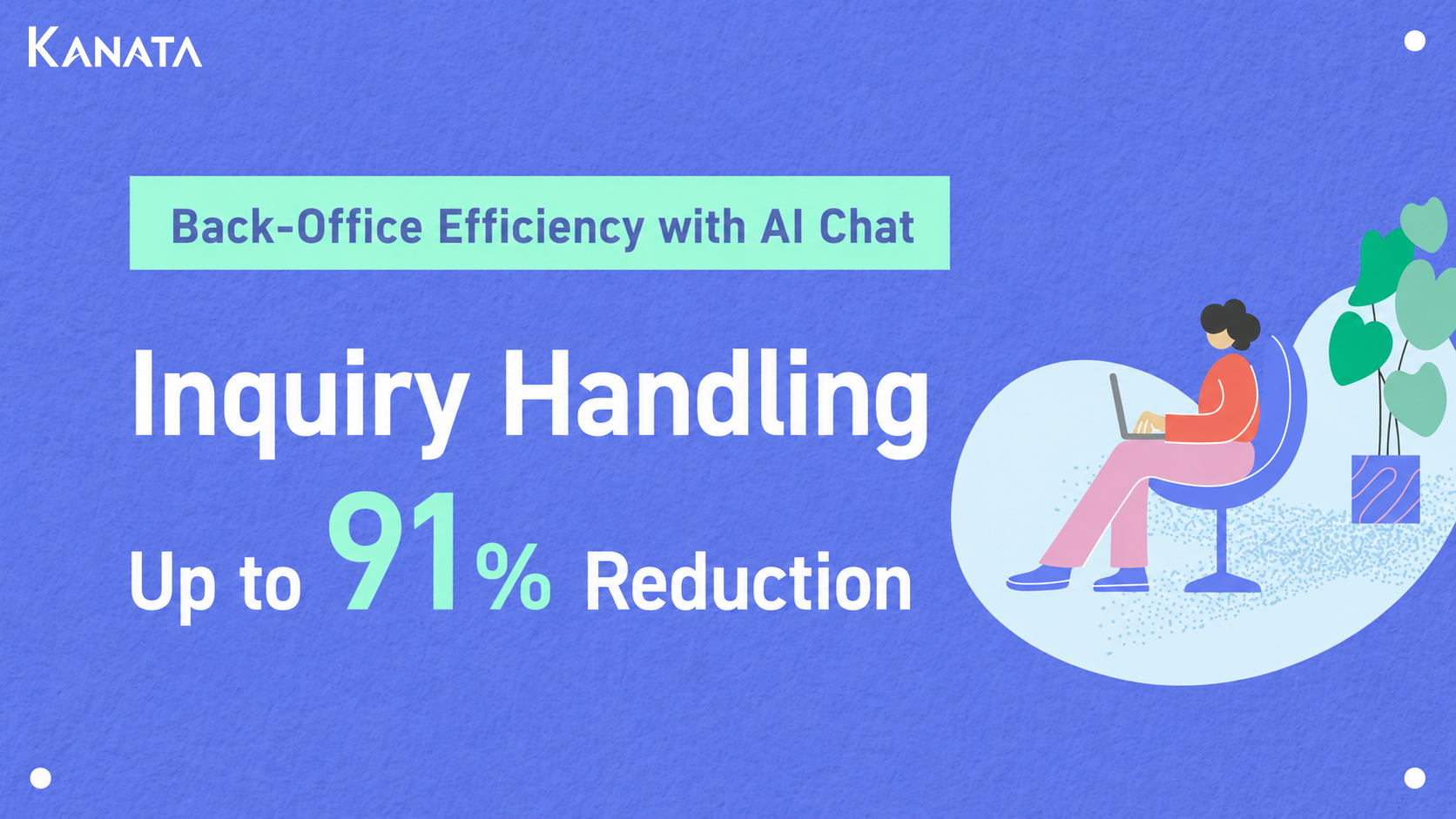
The case focuses on “Moon Inc.”, a pseudonym for a Kanata monitor company with approximately 500 employees. By enabling an AI chatbot to reference internal regulations, FAQs, and application manuals, Moon Inc. reported that 91% of HR and general affairs inquiries were resolved through the AI chatbot’s first response.
In this article, “first-response resolution” means that an employee was able to read the AI chatbot’s answer and proceed to the next action—such as submitting an application or checking a policy—without sending an additional inquiry to the HR team.
The figures in this case study are based on interviews with Moon Inc. and should be understood as approximate. Actual results may vary depending on inquiry volume, the quality of internal documentation, governance rules, and how the chatbot is operated.
Why HR inquiries are well suited to AI chatbot support
HR, labor affairs, and general affairs inquiries often share three characteristics.
First, the questions are repetitive. Employees frequently ask about paid leave, attendance corrections, expense claims, address changes, parental leave, caregiving leave, onboarding procedures, and internal approval flows.
Second, the answers are usually documented somewhere. In many cases, the correct response can be found in employment rules, internal policies, application manuals, or FAQs. The issue is not that the information does not exist; rather, employees often do not know where to find it.
Third, inquiries occur at unpredictable times. Employees ask questions when they need to submit an application, check a rule, or complete a procedure. Those moments do not always align with HR staff availability.
For these reasons, AI chatbots can be especially useful for first-line HR support. When an AI chatbot can reference approved internal documents and provide immediate answers, employees can move forward without waiting for a human response. At the same time, HR and general affairs teams can spend less time on repetitive inquiries and more time on work that requires human judgment, such as policy design, onboarding improvement, employee support, and organizational initiatives.
The challenges Moon Inc. faced
As Moon Inc. grew, its HR and general affairs teams received more internal inquiries.
The most common inquiry categories included the following.
| Inquiry category | Example questions |
|---|---|
| Attendance | “I forgot to clock in. Where should I submit a correction request?” |
| Paid leave | “Where can I check my remaining paid leave? Can I take half-day leave?” |
| Expenses | “Can I claim taxi fares? What should I do if I lost a receipt?” |
| Employee information changes | “Where do I update my address, dependents, marriage, or childbirth information?” |
| Leave systems | “What are the deadlines and required documents for parental or caregiving leave?” |
| Internal rules | “How do I apply for side work, business travel, or equipment purchase approval?” |
Many of these answers already existed in company rules, manuals, and FAQs. However, from the employee’s perspective, it was not always clear which document contained the answer. As a result, employees continued to contact HR staff directly.
The HR team also faced several operational challenges.
Every inquiry required staff to check multiple documents, including work rules, attendance manuals, expense policies, approval flows, and FAQs. In addition, employees often phrased similar questions differently. For example, “How do I take paid leave?” and “I want to take only next Monday morning off—what should I do?” may relate to the same leave procedure, but they may not be easy to resolve through simple keyword search.
This created a gap between the existence of internal knowledge and employees’ ability to access it quickly.
What Moon Inc. implemented with Kanata
Moon Inc. began by using Kanata’s AI chatbot as an HR and labor affairs inquiry bot.
Kanata allows users to organize applications, users, and data by project. Within a project, teams can use applications such as AI chat, AI summarization, and e-learning. They can also manage AI settings, prompts, and learning data in a project library.
Moon Inc. created a dedicated HR and labor affairs project and added an AI chatbot designed specifically for internal inquiry support.
1. Organizing internal policies, FAQs, and manuals as learning data
The first step was to organize the information that the AI chatbot would reference.
Moon Inc. registered documents such as the following.
| Document type | Purpose |
|---|---|
| Employment rules | Working hours, leave, absence, conduct rules |
| Attendance management manual | Clock-in corrections, overtime applications, leave requests |
| Expense policy | Eligible expenses, limits, receipts, approval flows |
| Business travel policy | Transportation, accommodation, daily allowance, travel applications |
| Parental and caregiving leave materials | System overview, deadlines, required documents |
| Application flow documents | Address changes, dependent changes, congratulations/condolences, equipment purchases |
| FAQ documents | Answers to frequently asked employee questions |
The key was not merely uploading documents. Moon Inc. also organized them so that the AI chatbot could reference the correct information more reliably.
For example, if old and new versions of a policy coexist, an AI chatbot may refer to outdated information. To reduce that risk, Moon Inc. included revision dates in document titles and made the latest versions easier to identify.
Examples:
- [Policy] Employment Rules — 2026-04
- [Policy] Expense Reimbursement Rules — 2026-04
- [FAQ] Attendance and Leave Questions — 2026-04
- [Manual] Attendance System User Guide — 2026-04
This type of naming rule also made it easier to replace outdated materials and review the learning data on a monthly basis.
2. Setting a rule that the AI should say “I don’t know” when evidence is missing
For HR inquiry support, one of the most important rules is to prevent the AI from guessing.
Incorrect answers about HR policies can cause real problems for employees. For example, a wrong answer about an application deadline, leave eligibility, or expense claim rule may lead to rework or disadvantage for the employee.
Moon Inc. therefore configured the chatbot with a response policy similar to the following:
You are the company’s HR and labor affairs help desk.
Answer based only on registered internal policies, FAQs, and application manuals.
If the answer is not clearly stated in the registered materials, do not guess. Instead, respond: “The relevant basis could not be confirmed in the company materials. Please contact the HR team.”
Whenever possible, include the source document name, section, or relevant passage.
Explain technical terms in plain language that employees can understand.
This changed the role of the chatbot. It was not designed to answer everything. It was designed to answer questions only when there was a reliable internal basis for doing so.
This approach is consistent with broader AI risk management principles. The U.S. National Institute of Standards and Technology, for example, emphasizes the need to manage AI-related risks to individuals, organizations, and society through structured governance and risk management practices.
3. Consolidating inquiry channels into the AI chatbot
Next, Moon Inc. simplified the employee inquiry flow.
Before the implementation, employees asked questions through several channels:
- Direct messages to HR staff
- General affairs chat channels
- Managers
- Internal portals
- Emails
- Past announcements and shared documents
This made it easier for duplicate questions to occur across multiple channels. It also increased the risk of missed inquiries or inconsistent answers.
Moon Inc. therefore introduced a simple internal rule: for general HR and general affairs questions, employees should first ask the HR inquiry bot.
However, not all inquiries were routed to AI. Questions involving individual circumstances, personal information, sensitive information, policy interpretation, or special approval were still handled directly by HR staff.
4. Reviewing unanswered questions every month
After launch, Moon Inc. placed particular emphasis on questions the AI chatbot could not answer.
An AI chatbot does not become accurate simply by being deployed. Unanswered questions are valuable because they reveal gaps in internal documentation.
Each month, Moon Inc. reviewed inquiry logs from several perspectives.
| Review point | Improvement action |
|---|---|
| Questions the AI could not answer | Add or revise FAQs and policies |
| Answers that were technically correct but difficult to understand | Improve prompts and answer format |
| Repeated questions | Reflect them in onboarding materials or internal portals |
| Questions requiring individual judgment | Classify them as “consult HR directly” cases |
| Questions that could lead to outdated references | Replace or remove old learning data |
Through this cycle, the chatbot became more than a simple inquiry tool. It became a mechanism for continuously improving internal knowledge management.
Results after implementation
After implementation, Moon Inc. reported that 91% of HR and general affairs inquiries were resolved through the AI chatbot’s first response.
The company also estimated the change in monthly response time based on inquiry volume and average handling time.
| Item | Before implementation | After implementation |
|---|---|---|
| Monthly inquiries | Approx. 1,200 | Approx. 1,200 |
| Share handled directly by staff | 100% | 9% |
| Share resolved by AI first response | 0% | 91% |
| Average handling time per inquiry | Approx. 14 minutes | Approx. 14 minutes for staff-handled cases |
| Monthly staff response time | Approx. 280 hours | Approx. 30 hours |
| Estimated time reduction | — | Approx. 250 hours |
These figures are based on interviews with Moon Inc. They are estimates, not independently audited results.
A reduction of approximately 250 hours per month is equivalent to about 31 working days if calculated at eight hours per day. However, this should not be interpreted as meaning that 1.5 HR employees became unnecessary. A more appropriate interpretation is that time previously spent on repetitive inquiries could be reallocated to higher-value work, such as improving internal systems, supporting individual cases, and updating onboarding materials.
Employees also benefited from shorter waiting times. During busy periods such as month-end expense deadlines, attendance closing dates, and onboarding periods, employees could receive immediate answers to routine questions instead of waiting for HR staff to respond.
Key success factors
The key lesson from Moon Inc.’s case is that success did not come from simply introducing an AI chatbot. It came from preparing the conditions under which the AI could answer correctly.
Success factor 1: Start with a clearly defined scope
Trying to make an AI chatbot handle every internal inquiry from the beginning can make operations complicated.
Moon Inc. started with a narrower scope: routine HR and general affairs inquiries.
The chatbot handled questions where:
- The answer existed in internal policies or manuals
- The question involved application procedures
- The question was frequently repeated
- The answer pattern was stable
- Employees could reasonably self-resolve the issue
On the other hand, the following were kept as human-handled areas:
- Harassment-related consultations
- Mental health-related matters
- Individual work accommodations
- Disciplinary or labor dispute matters
- Exceptional leave or return-to-work decisions
- Legal or policy interpretation questions
This clear boundary helped employees understand when to use the chatbot and when to contact HR directly.
Success factor 2: Prepare documents in a form that AI can reference
The quality of AI chatbot answers depends heavily on the quality of the documents it can access.
If multiple documents contain similar content, if the latest version is unclear, or if outdated PDFs remain in the system, the AI may produce unstable answers.
Moon Inc. improved its documentation by:
- Removing outdated policies and manuals
- Adding revision dates to document titles
- Categorizing FAQs
- Rewriting application flows in employee-friendly language
- Clearly identifying cases that require HR consultation
- Prioritizing the most reliable reference documents
This work improved not only the chatbot’s usefulness but also the company’s internal knowledge management.
Success factor 3: Define the chatbot’s answer rules
In HR operations, a plausible answer is not enough. The answer must be grounded in an approved source.
Moon Inc. therefore defined rules such as:
- Answer based on registered policies, FAQs, and manuals
- Show source documents or relevant sections whenever possible
- Do not guess when no source is available
- Escalate questions requiring individual judgment
- Explain technical terms in plain language
- Do not request personal or sensitive information
- Do not handle confidential or unpublished information outside the approved scope
This made the chatbot a first-line support channel based on internal rules, not a general-purpose conversational assistant.
Important considerations when using AI for HR inquiries
AI chatbots can improve efficiency, but HR use cases require careful governance.
Personal and sensitive information should not be entered into the chatbot unless the organization has clearly defined a lawful, secure, and appropriate basis for doing so. The UK Information Commissioner’s Office provides guidance on how data protection law applies to AI systems, including the need to consider fairness, transparency, and risks to individuals.
ref: Guidance on AI and data protection
In Singapore, the Personal Data Protection Commission has published advisory guidelines on the use of personal data in AI recommendation and decision systems. These guidelines discuss data protection obligations during development, testing, monitoring, and deployment of AI systems.
ref: ADVISORY GUIDELINES ON USE OF PERSONAL DATA IN AI RECOMMENDATION AND DECISION SYSTEMS
Organizations should also make sure that AI-supported HR processes include human accountability. Singapore’s Model AI Governance Framework highlights areas such as internal governance, human involvement in AI-augmented decision-making, operations management, and stakeholder communication.
ref: MODEL ARTIFICIAL INTELLIGENCE GOVERNANCE FRAMEWORK SECOND EDITION
In practical terms, this means that an HR chatbot should not be treated as a replacement for HR professionals. It should be positioned as a controlled first-response channel for routine questions, with escalation to human staff when personal circumstances, sensitive information, or policy interpretation are involved.
Implementation steps
Organizations considering an HR inquiry chatbot can begin with the following steps.
- Review inquiries from the past one to three months
- Categorize them by topic, such as attendance, leave, expenses, business travel, onboarding, address changes, and dependent changes
- Prioritize questions that are frequent and have answers in existing documents
- Remove outdated or duplicate materials
- Register the latest policies, FAQs, and application manuals as reference data
- Define answer rules, including “do not guess when there is no source”
- Test the chatbot with a limited group before company-wide rollout
- Review inquiry logs monthly and improve FAQs, prompts, and learning data
This gradual approach reduces operational risk and makes it easier to measure the chatbot’s effectiveness.
Conclusion
HR, labor affairs, and general affairs inquiries tend to increase as organizations grow. At the same time, many of those inquiries can be answered using internal policies, application manuals, and FAQs.
Moon Inc. used Kanata’s AI chatbot to create an HR inquiry bot that could reference internal rules and support employees’ routine questions. As a result, the company reported that 91% of HR and general affairs inquiries were resolved through the chatbot’s first response, and estimated monthly staff response time fell from approximately 280 hours to approximately 30 hours.
However, the goal of an AI chatbot is not to replace HR staff. Its value lies in reducing repetitive inquiry work so that human teams can focus on cases that require judgment, empathy, and organizational improvement.
The main success factors are clear scope definition, well-organized internal documents, strict answer rules, careful handling of personal and sensitive information, and continuous improvement based on unanswered questions.
For companies struggling with repeated internal inquiries, an AI chatbot can be a practical first step toward more efficient and accessible back-office operations—provided that it is implemented with appropriate governance, documentation, and human oversight.