


Excel courses and tool training alone may no longer keep pace with how quickly the front line is changing.
That was the remark made by Morita, the HR director responsible for talent development at an operating company of around 800 employees, during a development meeting attended by the head of sales and a member of the information systems department. Until six months earlier, the firm’s employee education had centred on IT literacy, Office skills and basic prompt training for generative AI. On the ground, however, occasions to hand part of a task over to an AI agent were multiplying, while the questions of “how far we may delegate” and “who takes responsibility for checking the work” remained decidedly unclear.
Today the company has run three months of AI-agent training with Kanata for 120 people across management, planning and operational roles, and has reached the point of building task-design, dialogue-design, critical thinking and collaboration into its development plan. As one voice from the sales department put it, “I came to see that it isn’t just about asking the AI to do the work; you need the perspective to re-engineer the flow of the job itself.”
This article sets out the skills required of people in the age of AI agents, and explains how HR leaders and the executive team ought to revisit their approach to development in what one might call the reskilling-for-the-AI-era agenda. The aim is a state in which employees can design, supervise and responsibly make use of AI agents. That said, a single round of training will not, on its own, turn every employee into someone who can genuinely put AI to work. It needs to be considered alongside policy, day-to-day operation on the front line, and continual review.
In the age of AI agents, what “employee skills” means is shifting
Until now, corporate digital-talent development has prized the ability to use IT tools correctly.
Being able to handle a spreadsheet, share information over a chat tool, run a web meeting, enter data accurately into business systems—these remain foundational skills needed in a great many workplaces today.
Yet in the age of AI agents, those skills alone can hardly be called sufficient. An AI agent is an AI system that, given a user’s instructions, supports the work with a degree of autonomy—referencing information, carrying out procedures, producing deliverables and proposing the next action. Its distinguishing feature is that it reaches further into the business process than an ordinary chat-style AI does.
As a result, the employee’s role is broadening from “operating the tools” to “designing which tasks to entrust to an AI agent and supervising the results.” The World Economic Forum’s Future of Jobs Report 2025 likewise indicates that, between 2025 and 2030, technological change will have a considerable bearing on jobs and skills.
To take an example: under the old model of employee training, teaching people “how to use the minutes-taking tool” was good enough to yield a measurable benefit. In the age of AI agents, however, one needs to be able to answer questions such as these:
- How much of this meeting should the AI be asked to summarise?
- How should decisions reached and matters still outstanding be distinguished from each other?
- Who confirms the nuance of what was said and where responsibility lies?
- To which departments may the minutes the AI produced be circulated?
- Should the AI be allowed to go so far as to propose the action items for the next meeting?
What is called for here is not mere operating ability. It is the ability to design work, the ability to supervise, critical thinking, an understanding of responsibility, and the judgement to divide the roles of people and AI.
Why traditional IT-skills training alone cannot keep pace
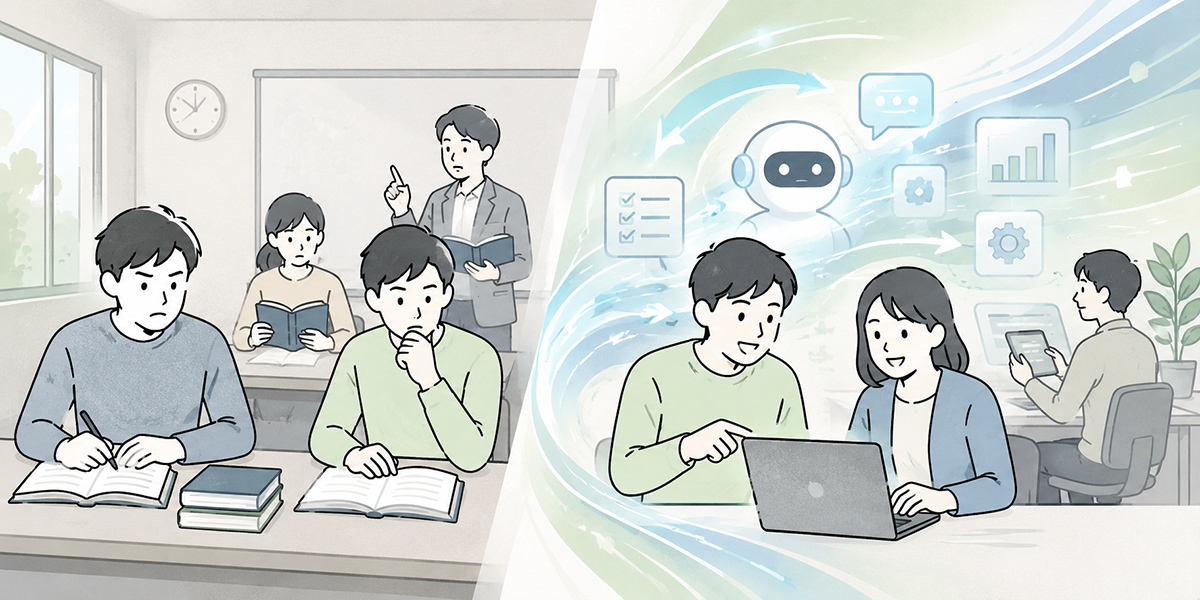
Conventional IT-skills training has been designed on the premise of “using a prescribed tool correctly.”
- Enter data as the manual dictates.
- Approve things on the designated screen.
- Produce documents along the lines of a template.
- Share information by chat or email.
Training of this kind is effective for standardising work. Work in the age of AI agents, on the other hand, does not necessarily proceed by the same steps every time. What to entrust to the AI, which information to pass on, and how to assess the output all vary according to the context of the work.
When a salesperson asks an AI agent to draft a proposal and when an HR professional asks it for a starting point for a training plan, the points to check differ. When a chief information officer defines the scope of AI-agent use, the perspectives of security, access management, logs and data integration are also indispensable. When a chief executive advances AI-agent use as a company-wide policy, a view on return on investment and organisational change is needed as well.
Put another way, AI-agent skills divide into a foundational part common to all employees, and a specialist part to be deepened according to role and department.
In the common part, people need to learn the basic posture for using AI agents safely. In the specialist part, each function—management, information technology, marketing and sales, HR, administration—needs to design ways of applying AI suited to its own standpoint.
Frameworks for the responsible use of AI, such as the OECD AI Principles, set out the roles and capabilities organisations should cultivate as AI adoption and “AI transformation” advance. When a company actually translates this into a development plan, however, it must make it concrete in line with its own operations, customers and information-handling rules.
The basic skills people need in the age of AI agents
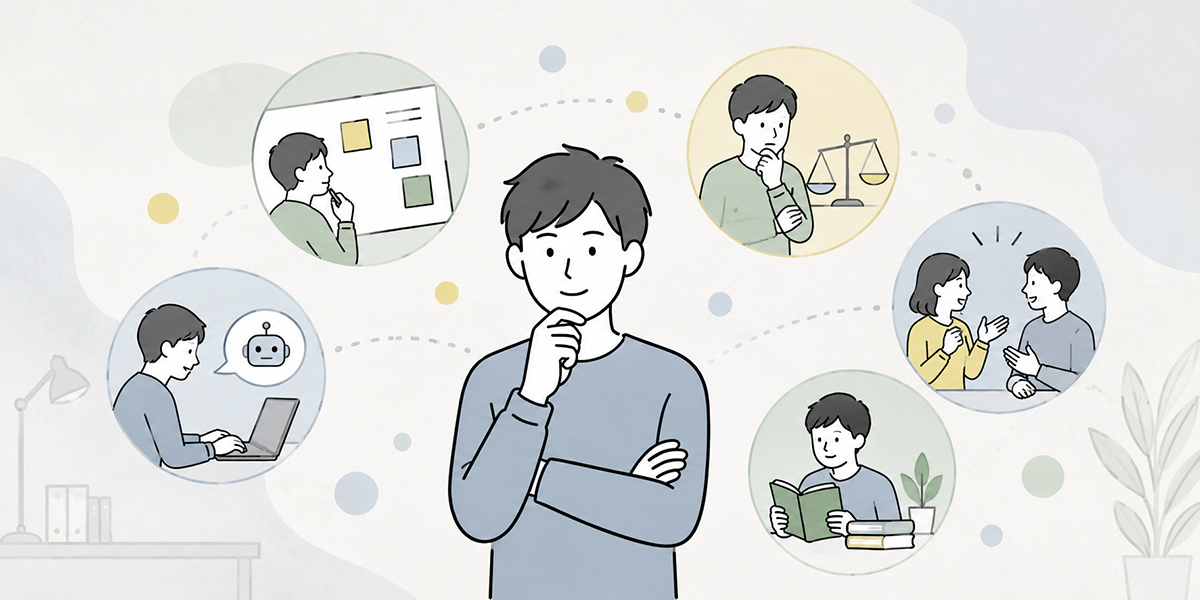
The skills required of employees in the age of AI agents can be sorted, broadly, into five.
| Skill | Summary |
|---|---|
| Task-design ability | The ability to break a job into its flow and separate the parts people should handle from the parts that can be entrusted to an AI agent. |
| Dialogue-design ability | The ability to convey to an AI agent, clearly, the purpose, premises, constraints, output format and criteria for judgement. |
| Supervisory ability | The ability to check what an AI agent has produced, correct it, and send it back where necessary. |
| Critical thinking | A disposition not to swallow the AI’s output whole, but to check the grounds, the premises, the gaps and omissions, and alternative points of view. |
| Human skills | The ability to get work done between people—communication, building consensus, accountability, collaboration, a sense of ethics. |
Task-design ability
The first thing one needs is task-design ability.
Task-design ability is the capacity to break down the flow of work and separate the parts people should handle from the parts that can be entrusted to an AI agent.
Consider, for instance, the work of putting together a sales proposal. Tidying up customer information, summarising notes from past meetings, drafting the structure of the proposal, knocking together a first cut of a competitor-comparison table—these are areas an AI agent can readily support. Building trust with the customer, the final call on the proposal, price negotiation, explanations that carry contractual responsibility—these, on the other hand, are areas people should own.
Introduce an AI agent while that division remains vague, and confusion follows on the front line.
The AI made it, so we sent it out as is.
We haven’t decided who checks it.
It looks handy, so for now we ask the AI to do the lot.
In that state, one can hardly say that people capable of putting AI to work are being developed. What is needed is the ability to think through where, in the business, embedding an AI agent yields a benefit, and to render that into a repeatable workflow.
Dialogue-design ability
Next in importance is dialogue-design ability.
Dialogue-design ability is the capacity to convey to an AI agent, clearly, the purpose, the premises, the constraints, the output format and the criteria for judgement. It is not merely “the ability to type in a question.”
An instruction such as “Please make a proposal,” for example, gives an AI agent little to work with. One needs to convey who the proposal is for, what its purpose is, what the counterpart company’s challenges are, roughly how many pages it should run to, which expressions to avoid, and which information should serve as its basis.
An employee with strong dialogue-design ability does not simply throw the job at the AI. They set up the preconditions so that the AI agent can perform correctly.
This is rather close to the skill of delegating work to a member of staff. Just as a vague request brings back a poor result, an AI agent too needs to be told the purpose and the expected outcome plainly.
Supervisory ability
In the age of AI agents, one needs not only the ability to use AI but the ability to supervise it.
Supervisory ability is the capacity to check the result an AI agent has produced, correct it, and, where necessary, send it back.
AI is good at producing natural prose and well-ordered tables. That does not mean the content is necessarily correct. Figures, proper nouns, dates, legal phrasing, internal rules, promises made to customers—these have to be checked by a person. International guidance on managing the risks of AI, such as the NIST AI Risk Management Framework, makes the case that promoting use and managing risk are two sides of the same coin.
The point to watch, in particular, is that an AI’s output “reading naturally” and its “being correct” are quite separate things. Because the prose is well formed, an error can, if anything, be the harder to spot.
An employee with supervisory ability does not treat the AI’s output as a finished article. They treat it as a draft, a hypothesis, material for comparison, something to be checked.
For a deal summary an AI agent has drafted, say, they check that it does not diverge from what the customer actually said. For a performance-review comment, they check that fact and impression have not become muddled. For an answer on internal regulations, they check the clauses and source material that underpin it.
To use AI agents safely, an organisation needs to make “a person looks at it last” a settled premise.
Critical thinking
In the age of AI agents, critical thinking is indispensable too.
Critical thinking does not mean simply doubting the AI’s proposals. It is a disposition that, rather than swallowing the output whole, checks the grounds, the premises, the gaps and omissions, and alternative ways of seeing.
An AI agent presents the answer that looks optimal within the conditions it has been given. But if the conditions themselves are inadequate, the output too will be skewed. If the information fed in leans towards the viewpoint of one department, the proposal will lean that way as well.
Suppose, for instance, that an AI agent is introduced with the aim of improving efficiency. Look only at the working time and the conclusion tends to be “this should be automated.” Once you take in the customer relationship, the building of internal consensus, quality checks and the handling of exceptions, however, the steps where a person ought to remain come into view.
An employee with critical thinking can put questions back to the AI like these:
- What is the premise of this proposal?
- If there were a dissenting view, what would it be?
- Are there risks being overlooked?
- How would this be judged from another department’s standpoint?
- What further information is needed for this decision?
Being able to frame such questions is an important skill for anyone who would put AI to work.
Human skills
It is precisely because this is the age of AI agents that the importance of human skills rises.
Human skills are the ability to get work done between people—communication, building consensus, accountability, collaboration, a sense of ethics.
As an AI agent comes to carry part of the work, an employee’s job does not simply shrink. If anything, the weight of the judgement and the dialogue that only people can do is likely to grow.
- How do you explain a proposal the AI made to the people involved?
- How do you face employees who are uneasy about automation by AI?
- How far do you explain an AI-assisted process to the customer?
- When departments differ in their rules for using AI agents, how do you reconcile them?
These cannot be solved by AI alone.
Talk of AI-agent skills tends, inevitably, to draw the eye towards technical ability. On the front line, however, AI adoption does not take root without dialogue, agreement and the shouldering of responsibility between people.
People who put AI to work are not those who can “use” AI but those who can “design work with it”
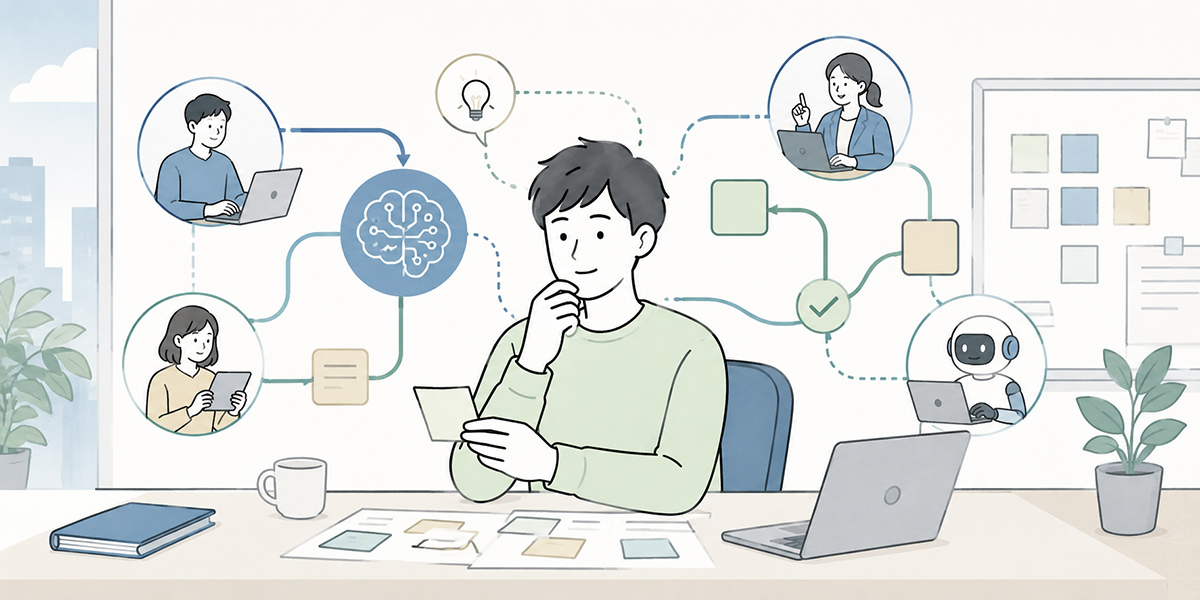
The phrase “people who put AI to work” is likely to be used at ever more companies from here on. Leave its definition vague, though, and the direction of talent development goes vague with it.
Someone who puts AI to work is not merely a person who can use generative-AI tools. Nor is it solely a person who can write a clever prompt.
Someone who puts AI to work is a person who understands the character of AI agents, embeds them in the business, and turns them into results in a form for which people can take responsibility.
Concretely, it is a person who can do the following:
- Break work down and separate the parts to entrust to AI from the parts for people to handle.
- Convey purpose, premises and constraints to the AI clearly.
- Check the AI’s output and spot errors and risks.
- Settle the rules for using AI while reaching agreement with those involved.
- Systematise it into a form the whole team—not just themselves—can reproduce.
Seen this way, developing people who can put AI to work is not a job for the IT department alone. It is a theme that involves several functions—HR, management, the front-line departments, information systems, legal, sales, marketing.
The training design reskilling for the AI era calls for
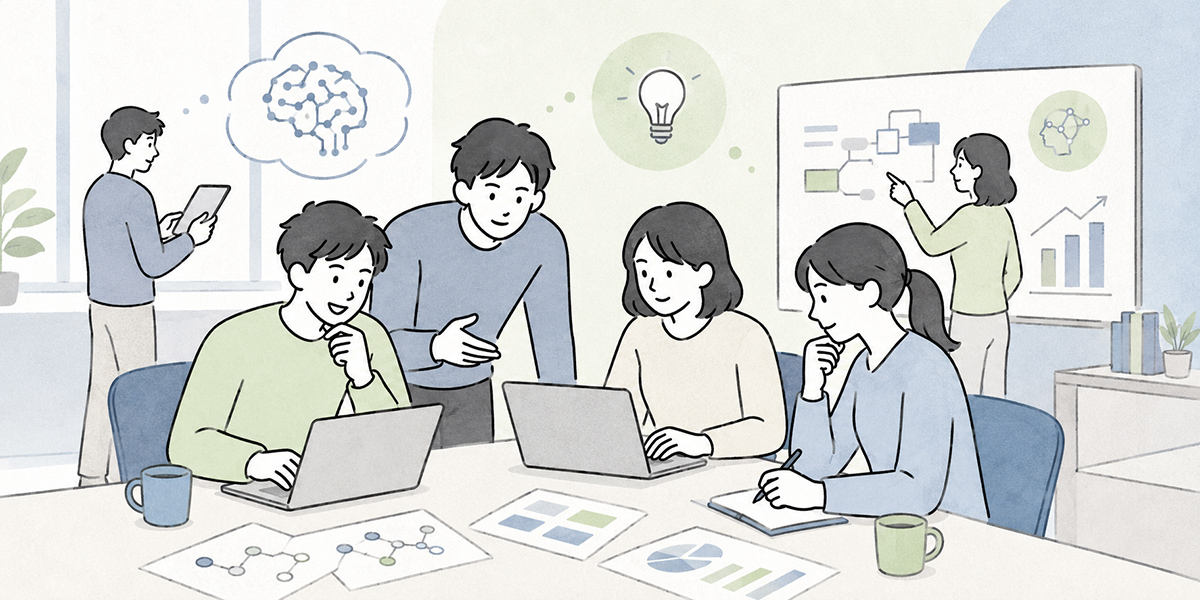
In reskilling for the age of AI agents, it is important to design the training content in stages.
Teach advanced AI-agent operation straight off and it will struggle to take root on the front line. Stop, on the other hand, at basic tool operation, and it will scarcely lead to a transformation of the business. The OECD Skills Outlook 2025 likewise points out that, with shifts in skill demand moving faster than the usual policy cycle, agile skills policy grounded in lifelong learning and labour-market information matters a great deal.
For training design within a company, it is easier to get one’s bearings by thinking in three stages.
Get everyone’s basic understanding aligned
The first stage is to understand what an AI agent is, how it differs from generative AI, and what it is good and bad at.
Here, an explanation brought close to the actual work matters more than a specialist technical account.
- An AI agent is an assistant that takes instructions and carries several tasks forward.
- It is not something that wholly substitutes for judgement and responsibility.
- Its output may contain errors, and a person’s check is needed.
- There is information it may handle and information it may not.
At this stage, both excessive expectation of AI and excessive anxiety about it need to be tempered.
Run application exercises by function
The next stage is to run exercises that take actual work as their subject.
- For sales, summarising meeting notes, structuring proposals, drafting likely questions by customer.
- For HR, training plans, handling internal enquiries, drafting evaluation comments.
- For administration, checking regulations, taking minutes, producing standard documents.
- For planning, organising information, building comparison tables, marshalling material for decisions.
What matters here is not to let it end at “giving the AI a try.”
- Which task did you use it for?
- Which information did you feed in?
- Which output proved usable?
- Where was a person’s check required?
- Which prompts or procedures can be reused next time?
Reflecting in this way turns individual experience into organisational learning.
Move on to team operation and rule-making
In the final stage, AI-agent use is settled into team operation.
Individuals using it handily, on their own, will not steady the productivity and quality of the organisation as a whole. Prompts, workflows, checking rules, learning data and access management need to be set in order as a team.
Set up a project per department, for instance, and use an AI platform on which frequently used prompts and reference material can be registered in a library, and individual know-how becomes easier for the team to reuse. Because Kanata handles AI chat, AI summarisation, e-learning and project-level management of learning data within one environment, it is one option for companies that want to connect training content to real work.
Whichever tool one uses, though, what matters is not “that it was introduced” but “how it is embedded in the work, who checks it, and how it is improved.”
How to assess employees’ AI-agent skills
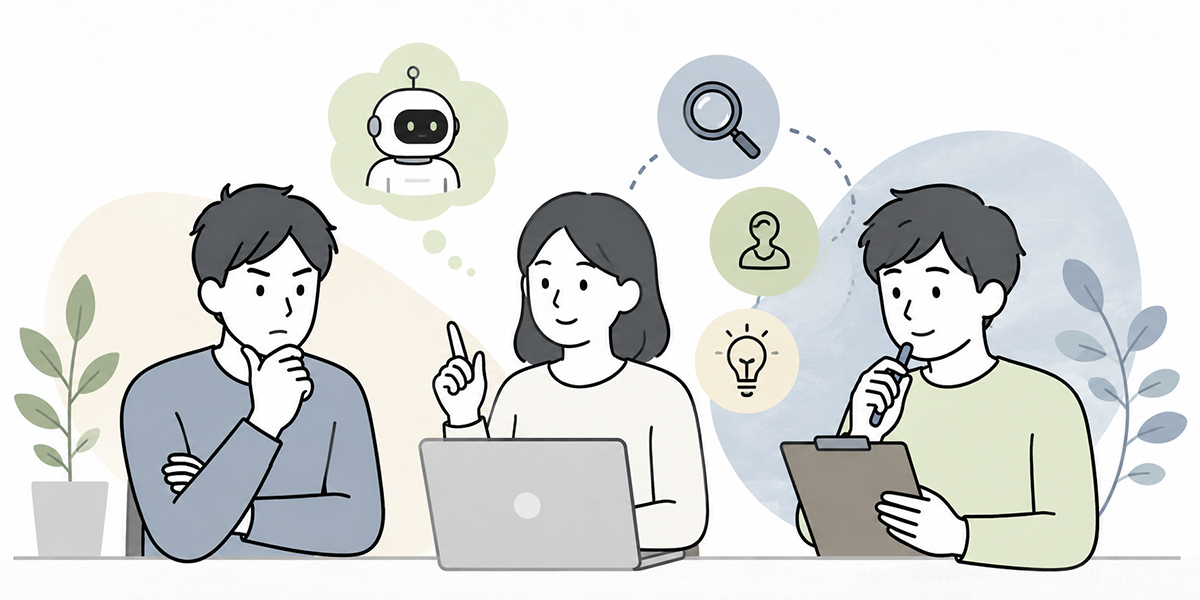
When you run AI-agent training, you also need to revisit your evaluation measures.
“How many times someone used the AI” or “whether they attended the training” alone cannot gauge whether a skill has taken hold. What matters is whether, using an AI agent, the quality of the work or the way it is carried out has changed.
As points of assessment, the following come to mind:
- Quality of task design
- Whether the work entrusted to AI and the work people handle are divided appropriately. Rather than handing everything to the AI, the important thing is whether the person can judge where to use it in light of risk and responsibility.
- Clarity of instruction
- Whether purpose, premises, constraints and output format are conveyed to the AI agent clearly. Whether it has been organised into a form other employees can reuse, rather than a request that depends on one individual, is also a point of assessment.
- Disposition to check output
- Whether, rather than using the AI’s output as is, the person checks the figures, dates, proper nouns, grounds and phrasing. For material going outside the company or output bearing on important decisions in particular, whether it has passed a human review matters.
- Sharing with the team
- Whether prompts and ways of using the AI gained individually are shared with the team. A person who puts AI to work is not someone who benefits from it alone; they are someone who raises the whole organisation’s level of use.
- Responsible use
- Whether they show due care for information handling, access rights, customer data, personal data and legal risk. In putting AI agents to work, convenience and responsibility must be handled as a set.
What to watch for in putting AI agents to work
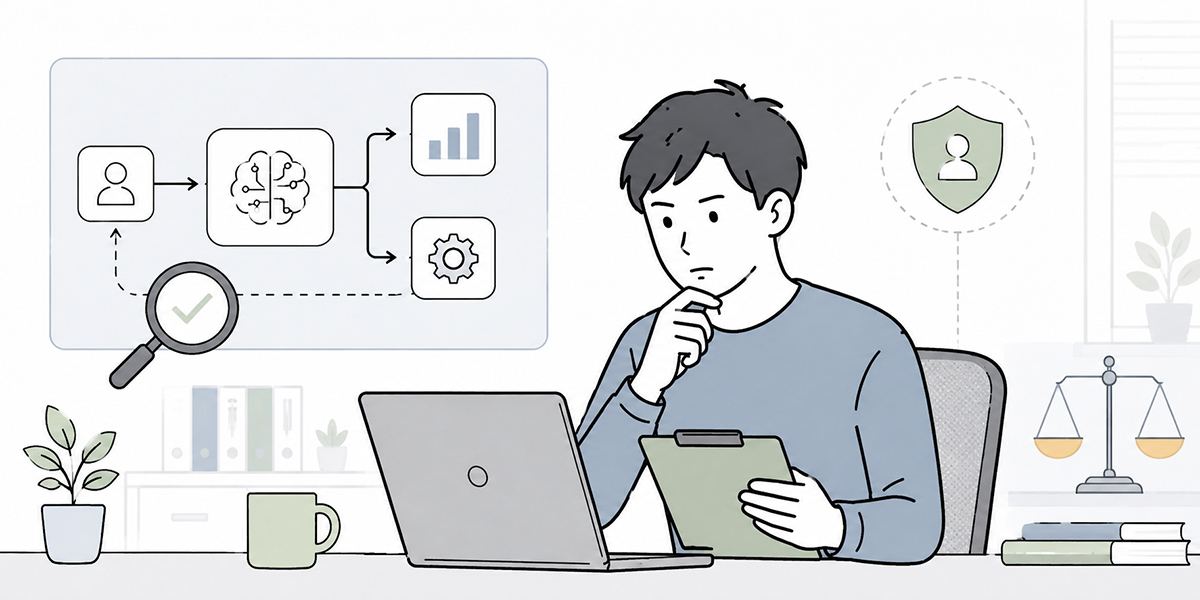
AI agents widen the possibilities of work, yet they are no panacea.
- First, an AI agent cannot bear responsibility. For judgements that draw on its output and for explanations to customers, a person or the organisation must, in the end, take responsibility.
- Second, an AI agent can misread context. Circumstances peculiar to the company, the relationship with a customer, past history, tacit agreements—these may not be reflected unless made explicit.
- Third, putting an AI agent to work does not take root through introduction alone. It needs to be tied to the front-line workflow, the evaluation system, management and the rules for handling information.
- Fourth, a skills gap may widen. Between employees who can make the most of AI and those who do not know how to use it, differences in productivity and in the capacity to handle information can arise. In reskilling for the AI era, then, development needs to aim not just at a handful of advanced people but at a state in which all employees hold a minimum of common skills.
On promoting the use of generative AI alongside risk management, the NIST AI Risk Management Framework is a useful reference.
In summary: reskilling for the age of AI agents begins with redefining employee skills
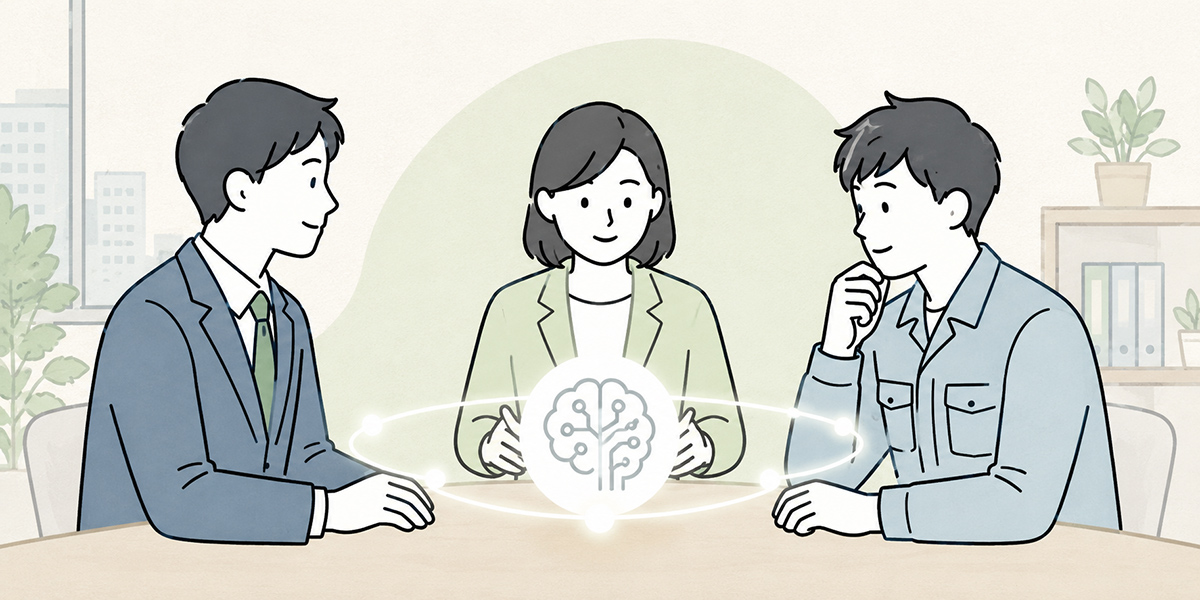
The employee skills called for in the age of AI agents differ from the IT skills of old.
Basic digital literacy is, of course, still needed. But that alone cannot embed an AI agent in the work and carry it through to results.
Employees from here on will be asked not only for the ability to operate AI but for the ability to design work with it. What to entrust to the AI. How to instruct it. How to check the output. Where a person takes responsibility. How to reach agreement with those involved.
People who can think these through are precisely the ones who put AI to work in the age of AI agents.
Development for the reskilling AI era is not something a single round of training brings to a close. Combine basic understanding, function-by-function exercises, team operation, the evaluation system and continual review, and it takes root in the organisation little by little.
An AI agent is not something that wholly replaces an employee’s work. Rather, it is something that creates the conditions for people to face the more important judgement, dialogue, design and responsibility.
That is exactly why companies need, now, to revisit the skills they ask of their employees.
Q&A: Frequently asked questions about employee skills in the age of AI agents
In the age of AI agents, what skills should all employees acquire?What everyone needs in common is task-design ability, dialogue-design ability, supervisory ability, critical thinking and human skills. Beyond the ability to operate AI, what is asked for is the ability to judge the scope to entrust to AI, check its output, and embed it in the work while building consensus with people.
What kind of person is someone who “puts AI to work”?Someone who puts AI to work is not merely a person who can use generative AI or AI agents. It is a person who can break work down, design where to embed the AI, check the output, and carry it through to results responsibly. The ability to turn it into something the team can reproduce—not just to make one’s own work more efficient—matters too.
How does AI-agent training differ from traditional IT-skills training?Traditional IT-skills training centred on learning how to operate a prescribed tool. AI-agent training, by contrast, needs to address which parts of the work to entrust to the AI, which information to hand it, how to verify the output and who takes responsibility. The weight falls more on task design and judgement than on operating a tool.
Which department should AI-agent training start from?It is generally easier to begin with a department with plenty of routine work and where people can readily check the deliverables—minutes, internal enquiries, proposal drafts, training materials, regulation checks, for example. In departments handling customer data or confidential information, however, the information-handling rules need to be set in order beforehand.
Are there tasks that should not be entrusted to an AI agent?There are. Legal judgements, final management decisions, finalising performance evaluations, important promises to customers, and judgements involving confidential or personal information—these need a person to take responsibility. An AI agent can be used for drafts and for organising the points at issue, but entrusting it with the final decision or with accountability should be avoided.