

The training went down a storm, yet only a handful of people are actually using the thing.
It is a lament one hears rather often from the people charged with driving digital transformation after a company has rolled out generative AI tools across the board. Not so long ago, the main job was simply getting an AI chat or summarisation tool into a usable state and walking everyone through the basics in an introductory session. Today the emphasis has shifted away from adoption itself and towards keeping people using these tools in their daily work, and lifting the rate at which they actually do so.
The transformation lead frets over how to broaden uptake; the people on the ground are not sure what they are even meant to ask; and managers want to know whether any of it is feeding through to business results. Usage clusters around a few enthusiasts, momentum stalls, and there is nowhere comfortable to ask a question or share what worked. Leave those problems to fester and AI, for all its usefulness, never quite becomes a habit the organisation actually keeps.
The ideal is a state in which colleagues swap prompts and worked examples, can turn to one another when they are stuck, and where fresh ways of working bubble up from the front line. That said, AI is no panacea, and merely standing up a study group or a community guarantees nothing.
This article is written for the people in transformation, HR and IT functions who want to widen AI adoption across the business. It sets out how to design an internal community and a programme of study sessions that carry early enthusiasm into steady operation and keep improving it over time.
Why AI Adoption Tends to Stall Once the Tools Are In

When a company first introduces generative AI internally, the opening hurdle is simply getting to a usable footing: issuing accounts, settling the rules of use, and running basic training. Clear that stage and, in most organisations, interest spikes for a while.
That initial flush of interest does not, however, automatically translate into sustained use. As McKinsey’s 2025 report notes, almost every company is now investing in AI, yet only a small minority believe their own adoption has reached any kind of mature state.
In short, the question has moved on from “should we adopt it?” to “how do we weave it into the work and keep people using it?”
Why the Post-Training Buzz Fizzles Out
Straight after AI training, plenty of staff feel it looks handy and resolve to give it a go. Whether that energy settles into everyday work is quite another matter.
There are three main reasons.
- The training is pitched too generally. People may grasp the basic operations and a few stock prompts, but if they cannot see how to apply them to their own remit, use does not stick.
- There is nowhere to ask questions. Once people start using the tools in earnest, doubts surface — “Am I allowed to enter this information?”, “Can I trust this output?”, “Is there a better way to ask?” — and with no easy place to raise them, they grind to a halt before they have really begun.
- Internal examples are invisible. Without shared “this worked nicely for me” cases from the same company and the same department, staff struggle to see AI adoption as something that applies to them.
Three Patterns Behind Lopsided Adoption
Where AI use clusters around a few people, it tends to follow one of these patterns.
It Relies on Individual Trial and Error
You may have a colleague who uses AI a great deal, but whose know-how stays locked inside their own head. Their personal productivity may well have risen, yet none of it becomes shared organisational knowledge.
In that case good prompts and worked examples never get shared, and everyone else is left repeating the same trial and error.
The Temperature Varies Widely by Department
In functions that deal in prose and documents — marketing, sales, planning, back-office — AI adoption tends to move along nicely. In departments built around frontline operations or routine processing, the reaction is often “this has nothing to do with us”.
In reality, though, plenty of uses are common to most departments: drafting minutes, handling enquiries, tidying up manuals, sketching out reports. The absence of department-specific illustrations of how to use AI is one reason the gap widens.
Managers Do Not Understand the Point of Adoption
Even when staff want to use AI, it is hard to fold it into the work if their managers do not grasp why it matters.
If someone drafts a first cut of a document with AI but their manager is sceptical of the practice, adoption stays a private, hidden knack. Conversely, when managers understand which tasks AI suits and which still need a human check, uptake tends to spread at the level of the whole team.
Defining the Problems Your Community and Study Sessions Should Solve

An internal community or study session is not merely a gathering place for people who happen to be curious about AI. Begin with a hazy purpose and you may find that, after a few sessions, attendance dwindles and all that remains is the burden on whoever is running it.
What matters is deciding, at the outset, exactly what you want the community or sessions to solve.
Anchor the Purpose in “Repeatable Use at Work”, Not “Networking”
The point of an AI community is not socialising for its own sake, but turning useful, work-ready know-how into something that can be reliably repeated.
Suppose a colleague mentions that they use AI to draft customer-facing emails. Hearing about it is a momentary spark and little more. The trick is to capture the following alongside it.
- Which task it was used for
- What sort of input was provided
- How the output was edited
- Which parts a human checked
- What you would change to make it usable in other departments
Only once that much is shared does an individual’s knack become organisational knowledge.
Segment Your Audience: All Staff, by Department, and the Driving Team
An AI study session is not a matter of serving the same content to everyone. Different audiences need different things.
For all staff, cover the basic ground rules for using AI safely, along with common use cases that slot easily into daily work — drafting emails, minutes, summaries, rewriting documents, and putting together first drafts for research.
By department, cover examples close to each function’s own work — sales, marketing, HR, general affairs, IT, and so on. If a theme is not close to their own job, attendees simply conclude “looks handy, but not for me”.
For the driving team, cover running the community, putting internal rules in order, reading the adoption data, and handling enquiries. Here the theme is less how to use AI itself and more how to spread it across the organisation.
Decide What the First Three Months Should Look Like
As an illustration rather than hard data, the first three months of operation might aim for something like the following.
| Period | Main aim | Example activities |
|---|---|---|
| Month 1 | Lower the psychological barrier to using AI | Run a basic session for all staff and create an atmosphere in which it is fine to experiment and fine to ask. |
| Month 2 | Gather department-specific use cases | Work with themes close to the day job — meeting notes for sales, policy enquiries for back-office, article outlines for marketing. |
| Month 3 | Put shared examples into a reusable form | Collate the most-used prompts and watch-points and feed them into later sessions and manuals. |
The idea, then, is not to chase a grand result from the outset but to establish a rhythm of trying, sharing and reusing.
The Basic Design of an AI Adoption Community

An internal community will not sustain itself if you simply leave it to spring up of its own accord. In the early stages especially, you need to design the operating structure, the cadence, the rules for taking part, and the way things are shared.
Decide the Roles of the Organising Team
It is important not to pile the running of an AI community onto a single person. If the transformation lead carries it alone — choosing themes, inviting attendees, facilitating on the day, preparing materials, fielding questions and measuring impact — it all lands on one set of shoulders and becomes hard to keep going.
At a minimum, splitting out the following roles makes things far easier to run.
- Transformation lead
- Designs the overall direction and the schedule of sessions. Their role is to set out the aims of AI adoption, the rules of use, and the metrics for measuring impact.
- Frontline representative
- Brings along themes that are genuinely usable in the work. They share the real snags cropping up on the ground so that sessions do not drift into armchair theory.
- Managers
- Take on the job of connecting adoption to better ways of working. Rather than simply saying “do use AI”, they point to which tasks, used well, feed through to the team’s results.
- IT and security
- Confirm what information may and may not be entered, along with account management and permissions. The wider AI adoption spreads, the more the rules around information handling matter.
Set the Cadence at “What You Can Sustain”
Sessions do not embed themselves simply because you hold them often. Quite the opposite: if the load on organisers and participants is too great, the whole thing falls away.
As an illustration, the following is a realistic design for the early stages.
- Monthly: a session for the whole company or by department
- Weekly: sharing worked examples via chat or a message board
- Monthly: a review by the organising team
- Quarterly: a stocktake of adoption and outstanding issues
That cadence is only an illustration. It will need adjusting for headcount, the nature of the work, the tools already in place, and the number of people driving the effort. The point is to avoid over-engineering it at the start and to begin with the smallest unit you can keep up.
Start with Themes That Are Easy to Join
For the first sessions, themes that most staff can use straight away tend to draw people in more readily than advanced AI techniques or sophisticated automation.
For example, themes such as these.
- Drafting emails
- Turning meeting notes into minutes
- Summarising long passages of text
- Sketching out the structure of a document
- Making internal explanations clearer
- Tidying up weekly reports and one-to-one notes
Showing off advanced use from the very start may inspire a few, but it can also make beginners feel it is beyond them. In the early stages, it is safer to start with tasks that everyone has experienced at least once.
How to Build Study-Session Themes

An internal study programme will not embed itself if you merely change the theme each time. What matters is designing a flow in which attendees feel they can do a little more than they could last time.
Session 1: What to Hand to AI, and What a Human Should Check
In the first session, make the division of labour clear rather than dwelling on the mechanics of using AI.
AI is well suited to first drafts, summaries, comparison tables, idea generation, rephrasing and organising the points at issue. Final judgement, fact-checking, accountability for customer interactions, and specialist calls in legal, accounting or HR matters all still need a human to check them.
Sharing that line at the outset makes it far easier for staff to use AI with confidence.
Session 2: Learn the Shape of a Good Prompt
The next theme to tackle is the shape of a prompt. A prompt is simply the instruction you give to the AI.
A common failing is the vague instruction — “tidy this up nicely” or “make it clearer”. Ask vaguely and the output will be vague too.
In the session, share a shape along these lines.
- Role
- Specify the standpoint from which you want the AI to answer.
- Aim
- Make clear what you are trying to achieve.
- Audience
- Specify who the output is for.
- Background
- Provide the material needed to make a judgement.
- Output format
- Specify the form you want — bullet points, a table, an email, and so on.
- Constraints
- Set out word count, tone, anything to avoid, and points to watch.
Use this shape and the output tends to come out more consistently. Even so, a well-formed prompt does not guarantee the output is accurate. Proper nouns, figures, dates, and anything touching legal, employment or accounting matters should be handled on the assumption that a human will check them.
Session 3: Bring Department-Specific Use Cases
Once people have learned the basics and the shape of a prompt, the next step is to work through use cases by department.
For sales, themes might be tidying up meeting notes, outlining a proposal, or drafting customer emails. For HR, training announcements, internal FAQs, or organising interview notes. For IT, handling enquiries, writing manuals, or pulling together incident reports all sit comfortably.
Putting concrete department examples on the table makes it much easier for attendees to think “I could use that in my work too”.
Session 4: Share What Did Not Work
In an AI study session, the failures matter as much as the successes.
For instance, failures such as these.
- The output was far too generic
- The answer conflicted with internal rules
- Fact and conjecture were muddled together
- It took longer to fix than expected
- It was unclear how far it could be trusted
Sharing these failures puts people at ease, because they realise they are not the only ones who struggle. Picking apart the causes also points the way to better use.
A Sample Timetable for a 60-Minute Session
As an illustration rather than hard data, a 60-minute session might be designed as follows.
| Time | Content |
|---|---|
| 0–5 min | Share the theme and goal for the session. |
| 5–15 min | Explain the basic thinking. |
| 15–30 min | Run a demonstration with a real work example. |
| 30–45 min | Attendees try it against their own work. |
| 45–55 min | Share takeaways, questions and failures. |
| 55–60 min | Decide what to try before next time. |
The crux is not to let it end at explanation. Build in even a single stretch where people try it against their own work, and they are far more likely to act on it once the session is over.
Sharing Rules That Let the Front Line Run on Its Own

For a community to run under its own steam, it is not enough for staff to post freely; you also need a shared form for that sharing.
Without a form, posts end up all over the place and become hard to revisit later. A posting template, by contrast, helps worked examples accumulate as genuine knowledge.
What to Record When Sharing a Prompt
When sharing a prompt, the prompt text alone is not enough. Recording the following alongside it makes it far easier for others to reuse.
- The task it was used for
- The kind of information entered
- The format you wanted out
- The result actually obtained
- The points a human edited
- Anything to watch out for
- What to change to use it in another department
For instance, rather than sharing just a “prompt for writing up minutes”, note that you used it to “split the notes from a 30-minute regular meeting into decisions, action items and discussion points” — doing so makes the use case clear.
Share the Failures, Not Just the Successes
If only the successes are shared, beginners can feel discouraged, thinking they are the only ones who are not doing well. It is worth setting a rule from the outset that welcomes sharing failures too, and deliberately collecting them as well.
- Prompts that did not work
- Cases where the output missed expectations
- Cases that improved once you asked again
- Cases where the input information was lacking
- Points where you felt a human ought to check
With AI, the process of trying, stumbling and improving matters more than getting it right first time. Sharing failures lifts the whole organisation’s rate of learning.
Managers Should Connect It to “Better Work”, Not “Mandatory Use”
How managers involve themselves matters too.
Mandate use — “you must use AI” — and staff will use it for form’s sake. What counts is not the using of AI in itself, but being clear about which part of the work you want to improve.
For instance, a team might share questions such as these.
- Is writing up minutes after meetings taking too long?
- Is the quality of customer emails inconsistent?
- Have answers to internal enquiries become locked in one person’s head?
- Are we spending too long on first drafts of documents?
- Have weekly and other reports become mere box-ticking?
Start from the work problem in this way and AI becomes a means rather than the end.
Designing How You Measure Impact

To keep a community or study programme going, you need to measure its impact. Demand a strict return on investment too early, though, and the front line’s healthy trial and error can grind to a halt.
The starting point is to look at quantitative and qualitative measures in combination.
Before Measuring the Adoption Rate, Decide What Counts as Adoption
It is all very well to say “we want to lift the AI adoption rate”, but what counts as adoption differs from company to company.
Does merely logging in count? Using it at least once a month? Or putting AI output into an actual work product? Leave the definition vague and the numbers tell you little. It helps to set out stages such as the following.
- Aware
- They know the AI tool exists.
- Tried
- They have used it once.
- Regular use
- They use it several times a month or more.
- Built into the work
- There is a flow in which it is used for specific tasks.
- Sharing
- They share their own way of using it with colleagues.
Splitting things into these stages makes it easier to spot states such as “the number of users has risen, but it is not built into the work” or “some departments have got as far as sharing”.
Do Not Judge on Quantitative Measures Alone
Quantitative measures might include the following.
- Number of session attendees
- Attendance rate among the target staff
- Number of posts to the community
- Number of questions
- Number of prompts shared
- Number of prompts reused
- Number of times the AI tool is used
- Number of users by department
These figures cannot be judged in isolation, however. High attendance means little if the tools are not used in the work; conversely, even modest attendance may point to the next stage of growth if a particular department is using them deeply.
Use Qualitative Measures to See Psychological Barriers and Changes in the Work
In the early stages, qualitative measures matter too.
For instance, look for changes such as these.
- Have people come to understand what to ask the AI?
- Is there a habit of checking the output rather than trusting it outright?
- Are they drawing on how other colleagues use it?
- Has the burden of preparing documents and minutes fallen compared with before?
- Can managers explain where AI is useful in the work?
- Are people able to raise security concerns?
You can pick up such changes from surveys, post-session comments, and the observations of the organising team.
As the OECD’s Skills Outlook 2025 sets out, responding to shifting demand for skills calls for continuous learning and a flexible approach informed by labour-market intelligence. AI adoption, likewise, is better designed as an ongoing learning opportunity than treated as something a single training session can wrap up.
Example KPIs for the First Three Months
As an illustration rather than hard data, the first three months might involve KPIs such as these.
- The proportion of target staff who attended at least one session
- The number of people who tried AI at least once after a session
- The number of questions posted to the community
- The number of prompts shared
- The number of use cases submitted by department
- The proportion who said they could now picture using it in their work
The important thing here is not to use the numbers solely to grade people. KPIs are there to show where to improve next.
For example, a high attendance rate paired with few posts may point to a high psychological barrier to sharing, while frequent AI use with no use cases emerging may mean it is staying locked in individual use.
The Improvement Cycle That Keeps It Running

An AI community is not a build-it-once-and-leave-it affair. If anything, improving as you run it is the whole premise.
Review Themes, Attendees and Questions Each Month
Roughly once a month, set aside time for the organising team to review. Here is what to check.
- Which themes drew the highest attendance
- Which departments asked the most questions
- Which questions keep coming up
- Where beginners are getting stuck
- How managers have responded
- Whether any unease has surfaced around security or the rules
Use this review to adjust the theme and shared materials for the next session.
Signs a Session Has Stopped Earning Its Keep
If you keep running sessions but the impact is thin, there are tell-tale signs.
- The same people turn up every time
- No questions come from beginners
- Example-sharing is dominated by a handful of people
- Themes close to the actual work are not being covered
- Nothing follows through into action afterwards
- Managers are not across the content
In that case, reworking the theme or format is more effective than simply holding more sessions.
Rather than repeating company-wide briefings, for example, switch to small department-level workshops; instead of a lecture format, move to one where attendees bring
their own work along. Adjustments of that sort are what is needed.
Do Not Let the Running of It Hinge on One Person
Driving AI adoption does not last if it rests on the enthusiasm of a single person.
To avoid that dependence, a few things help.
- Keep a facilitation script for sessions
- Turn frequently asked questions into an FAQ
- Classify and store shared prompts
- Designate an informal champion in each department
- Fix a standard format for the monthly review
- Rotate the organising team periodically
Aiming for a state that keeps going even when a particular person is away is a key point in running a community.
Use Tools to Ease the Operating Burden

Keeping a community or study programme going also calls for ways to lighten the operating load. Combining an AI chat, AI summarisation, e-learning and a knowledge-management tool makes it easier to streamline the preparation and review of sessions.
Whatever the particular tool, the important thing is to choose one that fits your own security posture, your existing business systems, and your staff’s level of IT literacy.
Use an AI Chat for Prompt Advice and Thinking Aloud
An AI chat is an entry point for staff to try AI in their daily work.
After a session, for instance, it can serve as a place to ask “if I were to use AI for this task, what instructions should I give?” You can start with relatively approachable jobs — email text, minutes, document structure, first drafts of reports.
Use AI Summarisation to Organise Session Notes and Feedback
Once a session has been held, you are left with attendees’ questions, chat logs, survey responses and meeting notes. Leave them as they are and they are hard to put to use next time.
With AI summarisation you can classify the questions raised in a session, or draw out points for improvement from what attendees said. Where the material contains personal or confidential information, however, it must be handled in line with your internal rules.
Use E-Learning to Reuse Training Content
Explaining the same content in a live session every time is a heavy drain on whoever is driving the effort.
Basic operations, the rules of use, prompt shapes and security watch-points are all easier to reuse once turned into e-learning. It also makes it easier to deliver the same content to new joiners and latecomers.
Where Kanata Fits In
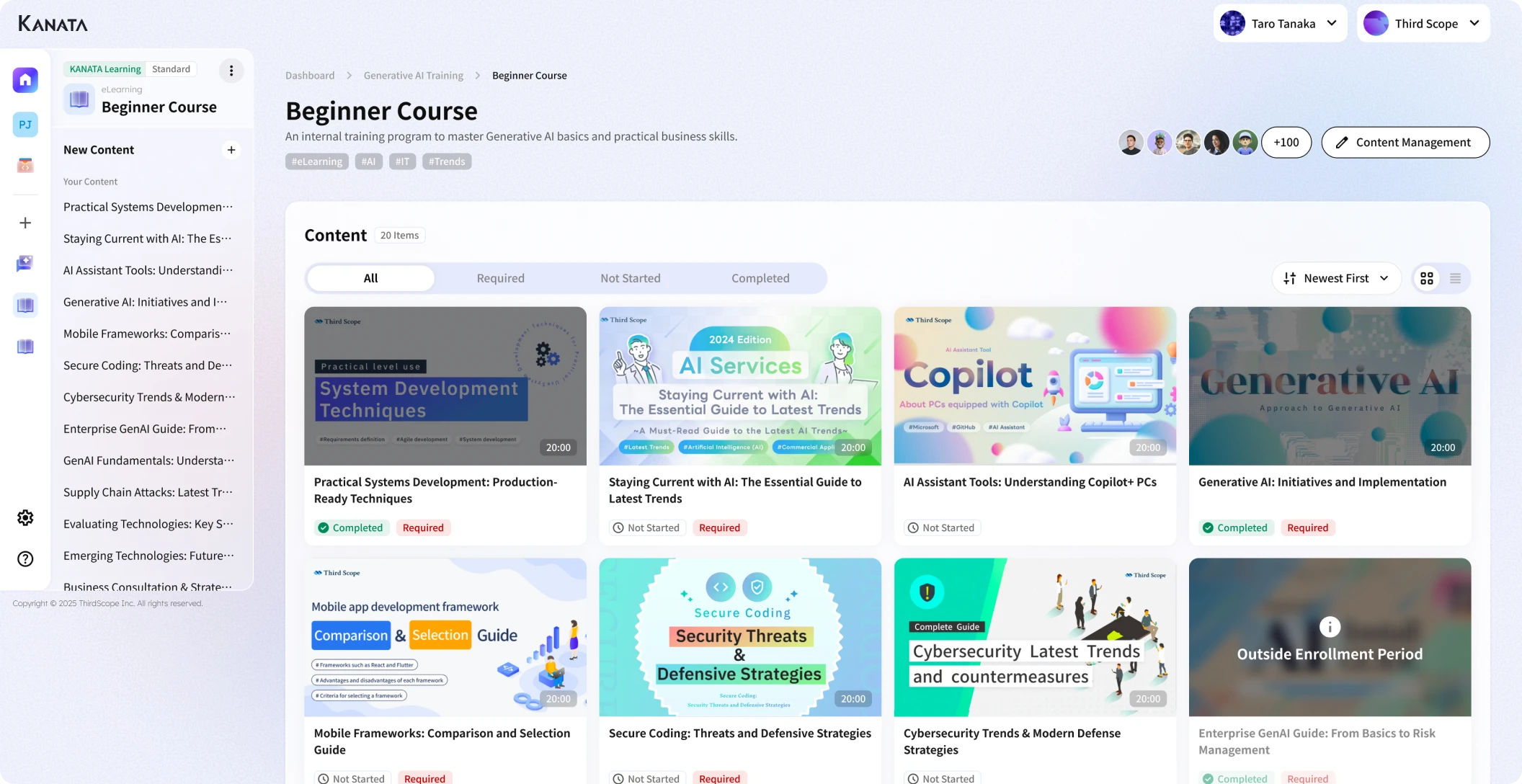
If your company uses Kanata, combining AI chat, AI summarisation, e-learning and project-level library management makes it easier to organise the prompts and learning material that emerge once a session is over.
You might, for example, save the prompts used in a session to a prompt library, organise attendees’ questions with AI summarisation, and reuse the basic training as e-learning.
That said, with Kanata or any other tool, what matters is being clear about the rules of operation, permissions and information handling. The tool itself does not guarantee that adoption will stick.
In Summary

Lifting the AI adoption rate takes more than introducing the tools and running some training.
You need a place where staff can try AI against their own work, ask about what they do not understand, and share both what worked and what did not. And to keep that place going, you must look beyond attendance and usage counts to how far it is built into the work and how staff’s psychological barriers are shifting.
An internal community or study programme is the mechanism that stops AI adoption belonging only to a knowledgeable few. Rather than the transformation lead labouring alone, the front line brings examples, managers connect it to better work, and IT and security underpin safe use. Only when those several perspectives come together does AI adoption begin to run under its own steam within the organisation.
Even so, building a community does not in itself guarantee a higher adoption rate. You cannot do without a clear purpose, themes kept close to the actual work, and measurement that feeds improvement.
It is quite enough to start with a small monthly session and a weekly swap of worked examples. The point is not to build a perfect system, but to nurture, little by little, the habit of colleagues learning from one another.
Q&A
Should the AI adoption community be open to all staff from the start?
There is no need to make participation by all staff compulsory from the outset. In the early stages it is more realistic to begin with interested staff and departmental representatives, and to share what you learn there across the company. For all staff, it helps to set up a separate occasion to convey the basic rules and safe use.
How often should sessions be held?
As an illustration rather than hard data, one approach in the early stages is to begin with a monthly session and a weekly swap of examples. Rather than raising the frequency, give priority to keeping it going and to people being able to try things in their work afterwards.
Which metrics should we use to gauge the AI adoption rate?
Judging by login counts or usage frequency alone is not enough. Alongside session attendance, the number of posts, the number of shared prompts and the number of department use cases, it helps to check qualitative aspects too — whether people can now picture using it in their work, and whether there is a habit of checking the output — so as to grasp the real state of things.
If we share failures, won’t staff stop using AI?
Quite the reverse — sharing failures can make people more comfortable using it. Because AI does not always give the right answer, sharing what did not work and the points to check guards against over-reliance and leads to safer use.
If we just introduce the tools, will AI adoption embed itself naturally?
Introducing the tools does not necessarily mean adoption embeds itself. Only when the rules of use, study sessions, example-sharing, managers’ understanding and impact measurement all come together does it become woven into the work. The tools are only a means of supporting the mechanism; they need to be considered together with the design of how it all runs.