

Just checking whether this invoice matches last month’s purchase order takes up my entire morning.
These are Iida’s words (not their real name), an accounting manager at a manufacturer of roughly 800 staff. In the meeting room before the monthly close, accounting staff were poring over invoices against purchase orders, the general-affairs team was checking approval documents for missing entries, and the department head was waiting on a judgement: “Under our rules, how far is this expenditure actually permitted?” In the past, matching supporting documents, checking approval paperwork and searching the expense regulations all depended on each person’s individual experience, and the exception cases that genuinely needed a decision were the very ones most likely to be put off.
These days they are trialling department-specific training in generative AI, run jointly across accounting, general affairs and management, in which AI is asked to lay out the points to check before the invoice and approval reviews proper begin. Over the past three months, for instance, they applied this to 120 approval and invoice-checking tasks, having people review the checklist the AI had organised; this made it considerably easier to align the review criteria across staff.
This article sets out how to fold AI for accounting, AI for approvals, AI for invoice checking and AI for regulation search into on-the-job training, and how to embed back-office AI safely. The aim is a state in which the review criteria barely shift no matter who is handling the work, and judgements within the workflow are less likely to stall. That said, AI is not the final approver. Interpreting regulations, complying with electronic record-keeping requirements and making audit judgements only become workable in practice when underpinned by human review and internal rules.
Why generative-AI training is becoming necessary in accounting and administrative departments

The work of accounting, finance, general-affairs and administrative departments is not made up of simple, routine tasks alone.
Behind checking the amount on an invoice, spotting an omission in an approval document, or examining whether something complies with the expense regulations, there is always a judgement to be made: is this fine to process as normal, should it be treated as an exception, and what information should be passed to the approver?
In practice, however, the checking work that sits just ahead of that judgement eats up a great deal of time.
Before the monthly close, for example, work of the following kind tends to pile up:
- Checking the contents of invoices against purchase orders, delivery notes and contracts
- Checking the purpose, amount, approval route and attachments of approval documents
- Checking the expense, purchasing and authority-delegation regulations
- Checking the retention requirements relating to electronic record-keeping law
- Organising evidence and explanatory materials in readiness for audits
- Fielding queries from staff about expense, purchasing and application rules
For anyone in accounting or general affairs, this is everyday work. Yet when every bit of it is checked by human eyes alone, the time left for exception judgements and improvement work steadily dwindles.
Training in generative AI is needed not merely to cut the hours spent. It is needed to align the review criteria, reduce reliance on particular individuals, and make it easier for people to concentrate on the work that genuinely calls for human judgement.
In accounting and administrative departments especially, it is not simply a matter of letting people use AI freely. The information handled may include transaction data, internal regulations, approval histories, personal data and undisclosed financial information. So training must make clear not only how to operate the tools, but “what to entrust to AI and what people must decide.”
Separating the work you hand to AI from the work people must own

The first thing to sort out when bringing generative AI into accounting is to divide the work into “tasks easily entrusted to AI” and “tasks for which people must take responsibility.”
| Category | Typical examples of work |
|---|---|
| Work easily entrusted to AI | Drawing up the points to check, summarising documents, flagging omissions, searching regulations, building comparison tables, drafting explanatory text |
| Work for which people must take responsibility | Final approval, exception judgements, interpreting regulations, audit judgements, negotiating with suppliers, decisions that carry accountability |
Consider, for instance, how one might use AI for invoice checking.
AI can be asked to organise the “points worth checking” from the contents of an invoice. It can produce a list of the items a member of staff ought to look at: the purchase-order number, supplier name, billing period, amount, consumption tax, payment due date, whether supporting documents are attached, and so on.
It is not appropriate, however, for AI to make the final call on “may this invoice be paid.” That decision wraps in contractual terms, acceptance status, exceptional discounts, the history of past dealings and other matters the organisation must own.
The same holds for AI used on approval documents. AI can read an approval document and organise its purpose, background, amount, risks and the points the approver should look at. But whether it should be approved is something the approver must judge in light of the organisation’s policy, budget, internal controls and risk appetite.
AI for regulation search is much the same. AI is genuinely useful as an aide that searches out the relevant regulations and clauses. Yet exceptional handling not written into the rules, and judgements that touch several regulations at once, will need checking by HR, general affairs, accounting, legal or audit.
In training, sharing this dividing line at the very outset matters. Adopting AI does not mean handing responsibility to AI. It means reducing the burden of organising information so that people can make decisions responsibly.
What AI for invoice checking can do

AI for invoice checking is a comparatively approachable area for accounting and finance departments, the reason being that what needs checking is fairly standardised.
An invoice carries a settled set of items: supplier name, billing date, invoice number, amount, consumption tax, payment due date, remittance details, line items, notes and so on. When matching against purchase orders, delivery notes and contracts, the points to look at are likewise fairly fixed.
In training, the realistic approach is to treat invoice checking not as “work to be automated by AI” but as “work whose review criteria are to be standardised.”
Drawing up the points to check on an invoice
From the contents of an invoice, have the AI organise the items that ought to be checked.
You might ask, for instance:
For this invoice, list the items an accounting clerk should check. Separate out the points that ought to be matched against the purchase order, delivery note and contract. Do not judge whether it may be paid; show only the items to check and any missing information.
Asked this way, the AI can organise the amount, supplier, billing period, payment terms, tax treatment, attachments, approval status and the like. For new staff or those just moved into the role, it doubles as material for learning the shape of a proper review.
Building a checklist for matching supporting documents
Matching supporting documents means cross-checking the evidence — invoices, purchase orders, delivery notes, contracts, acceptance records and so on — to confirm there is no inconsistency in the substance of a transaction.
There are cases where you cannot judge from the invoice alone whether the billing is correct, because several documents — the purchase order, delivery note, acceptance record, contract, approval document — need to be matched together.
You can ask the AI as follows:
Create a checklist for matching an invoice against the purchase order and delivery note. Also indicate the additional documents to check should any discrepancy arise.
Used this way, it becomes easier to align the checking steps that had differed from one person to the next.
Drafting an explanation of discrepancies
For example, a request of this sort:
There is a discrepancy between the ordered amount and the billed amount. Draft a Slack message, courteous and concise, to check with the relevant department.
Rather than sending the AI’s wording as it stands, the member of staff revises it once they have confirmed the facts. This eases the psychological burden of composing the query.
What to watch out for with AI for invoice checking
AI for invoice checking has its limits.
AI can surface the points to check from the information it is given, but it does not guarantee that the billing is genuinely correct. The amount, tax category, payment terms, remittance details and supplier name in particular need to be reconciled against the originals by a person.
Likewise, the retention and search requirements relating to electronic record-keeping must be checked against your internal rules and the systems you use. As a general matter, organisations should confirm how electronic transaction records must be kept and over what period.
When considering how data-protection obligations bear on these workflows, it is worth consulting the UK ICO’s Guidance on AI and data protection.
You can ask AI for a general explanation, but whether it fits your own operations is something to confirm with the head of accounting, the information-systems team, your tax adviser and those responsible for audits.
What AI for approvals can do

AI for approvals offers value to both approvers and applicants.
For the applicant, it surfaces missing information or thin explanations in an approval document beforehand. For the approver, it lays out the points needed for a decision before they wade through a long document.
At many companies, approval documents get sent back. The reasons run to the familiar: the basis for the amount is weak, the purpose is vague, the cost-effectiveness is not set out, the risks are not organised, attachments are missing, the approval route is not appropriate, and so on.
Such send-backs are a burden on applicant and approver alike. In AI training, it matters to frame AI for approvals not as “something that automates approval” but as “something that gets matters into a state where the approver can decide more easily.”
Checking an approval document for missing information
Feed the approval document to the AI and ask it as follows:
For the approval document below, point out the information missing for an approver to decide. Check it against purpose, background, basis for the amount, alternatives, risks, cost-effectiveness and approval route. Do not judge whether it should be approved.
Used this way, a self-check before submission becomes far easier. For junior staff and newly appointed managers in particular, it serves as training in how to write an approval document.
Producing a summary for the approver
When an approval document runs long, the approver takes time to grasp the whole picture. AI can serve as an aide that organises the key points for the approver.
You might have it organise matters in the following format:
- Purpose of the request
- Amount requested
- Background
- Expected effect
- Principal risks
- Points the approver should check
- Missing information
- Relevant regulations and approval criteria
Organised in this form, the approver finds it easier to grasp the points worth looking at before deciding.
Analysing the reasons for sent-back approvals
You can also organise the reasons past approvals were sent back and have the AI classify them.
Classify the reasons past approval documents were sent back, and organise the common missing items in order of frequency. Also create a pre-submission checklist to prevent recurrence.
Do not judge whether to approve. Organise only the points the approver should examine.
Approval documents may also contain undisclosed business plans, investment plans, HR information and supplier information. For that reason, you need to decide in advance what may be entered into AI, what should be masked, and what must never be entered at all.
What AI for regulation search can do

AI for regulation search is an area readily put to use right across the administrative side — accounting, general affairs, HR, legal, information systems.
Day to day, staff put questions of this kind:
- Can I claim this equipment as an expense?
- What is the daily allowance on a business trip?
- Whose approval does an order of this amount need?
- Can I claim communication costs while working from home?
- Does this contract need a legal check?
When a member of staff has to hunt through the regulations to answer each of these, simply handling the queries chips away at the day. And if the wording or judgement shifts from one respondent to another, it can become a risk to internal control.
AI for regulation search can be used as an aide that, while referring to internal regulations, FAQs and operating manuals, looks out the relevant passages in answer to a member of staff’s question.
Making answers cite the regulation name and clause
What matters with AI for regulation search is showing not just an answer but the grounds for it.
Rather than simply replying “yes, you can claim it,” the design needs to set out the regulation name and clause that serve as the basis — something like “this falls under Article X of the expense regulations, so it may be claimed provided the conditions are met.”
In training, working with a prompt of the following kind brings you closer to practice:
Answer the member of staff’s question on the basis of the registered internal regulations. In your answer, always indicate the regulation name, clause and relevant passage that form the basis. Where it is not stated explicitly in the regulations, do not answer by conjecture; write “this needs to be checked with the responsible department.”
This “do not answer by conjecture” design is especially important with AI for regulation search.
Laying out the scope of impact when regulations are revised
AI for regulation search is useful not only for queries but for checks when regulations are revised.
When revising the expense regulations, for instance, the change may ripple into related application forms, FAQs, workflows, internal notices and training materials. Having the AI surface the scope of impact from the substance of the revision helps reduce missed updates.
From the draft revision of the expense regulations, organise the internal procedures, FAQs, application forms and approval flows that may be affected.
This kind of use feeds into knowledge search for general affairs and the administrative side too.
Watch out for old and new regulations sitting side by side
A problem that readily arises in running AI for regulation search is old and new regulations becoming mixed together.
When you have the AI refer to several documents, you need to make clear the revision date, the effective date, the version number and whether a document has been withdrawn. Answering while still referring to an old regulation leads to mistaken guidance.
In training, you should also cover organising the following information before registering regulations with the AI:
- Regulation name
- Version number
- Revision date
- Effective date
- Owning department
- Whether it has been withdrawn
- Related FAQs and application forms
AI for regulation search makes knowledge search more convenient, but it can also amplify shortcomings in information management as they stand. That is precisely why a stocktake of regulations, FAQs and manuals needs to run alongside the AI training.
Department-specific AI training is not “tool training” but “redesigning the work”

Where AI training for accounting and administrative departments tends to come unstuck is in finishing at an explanation of how to operate the tool and nothing more.
Granted, you do need to cover how to use the AI chat, how to feed in files and how to write prompts. But that on its own does not change the work on the ground.
What is genuinely needed is to break the work down and redesign which parts AI can assist with and which parts people must own.
Taking stock of the work
First, draw up the work that arises day to day in accounting, general affairs and the administrative side.
You might classify it as follows:
- Invoice checking
- Payment processing
- Expense settlement
- Approval checking
- Purchasing requests
- Contract checking
- Regulation queries
- Preparing audit materials
- Updating internal FAQs
- Preparing monthly reporting materials
At this stage, do not agonise over whether AI can be used; set out the work on the ground in concrete terms.
Dividing routine checks from exception judgements
Next, split each piece of work into “routine checks” and “exception judgements.”
For invoice checking, the presence of a purchase-order number, the amount, the payment due date and whether attachments are present are routine checks. How to treat a difference between the purchase-order amount and the invoice amount, whether to pay billing that falls outside the contract, and whether to permit exceptional handling are exception judgements.
For an approval, missing entries or whether attachments are present are routine checks. An investment decision, or whether to grant approval, is an exception judgement.
In AI training, it is effective to have the participants carry out this classification themselves. By breaking down their own work, the feeling shifts from “handing it to AI” to “using AI as an aide.”
Practising with masked materials
In training for accounting and administrative departments, you should avoid using live data as it is.
Invoices, approval documents, contracts and regulations may contain supplier information, amounts, individuals’ names and undisclosed information. So the training should use masked materials.
For example, replace a supplier name with “Company A,” a contact’s name with “Person B,” and an amount with “a masked amount (for example, Amount C).” Rather than using actual internal regulations as they stand, one approach is to use samples edited for training.
At this stage, participants learn through experience what may and may not be entered into AI.
When handling information that includes personal data, it is worth consulting the UK ICO’s Guidance on AI and data protection.
Building prompts by task
Next, create prompts for invoice checking, approval checking and regulation search respectively.
For invoice checking, a prompt of this kind comes to mind:
You are an aide assisting an accounting clerk’s checks. For the invoice information below, list the points that ought to be matched against the purchase order, delivery note and contract. Do not judge whether it may be paid; show only the items to check and any missing information.
For approval checking, do it as follows:
You are an aide reviewing approval documents. For the approval contents below, organise the information missing for an approver to decide, the risks, and the regulations to check. Do not judge whether it should be approved.
For regulation search, build in constraints like these:
You are an aide for internal regulation search. In your answer, indicate the regulation name and clause that form the basis. Where it is not stated explicitly in the regulations, do not conjecture; reply that it needs checking with the responsible department.
Giving the AI a clear role and clear constraints in this way helps keep the quality of its output steady.
Practising reviewing the output
In AI training, you need not only practice in writing prompts but practice in reviewing the AI’s output.
Look at the output and check it against the following points:
- Are fact and conjecture kept separate?
- Are there errors in amounts or dates?
- Is the basis in the regulations shown?
- Is the AI standing in for the approval judgement?
- Is the missing information made clear?
- Is the wording suitable for internal use?
- Would it cause misunderstanding if put straight into the workflow?
AI can produce text that reads plausibly. So the goal of training is not “getting AI to produce a tidy answer.” It is to build the ability to have people verify the AI’s output and shape it into a form usable in the work.
Design points when using an AI platform

When using generative AI in accounting and administrative departments, there are several options: a general-purpose chat AI, an internal AI platform, AI features that integrate with workflow systems, and so on. Whichever you choose, what matters is whether you can refer safely to internal regulations, FAQs and operating manuals, whether the output is easy to review, and whether the team can manage prompts and knowledge.
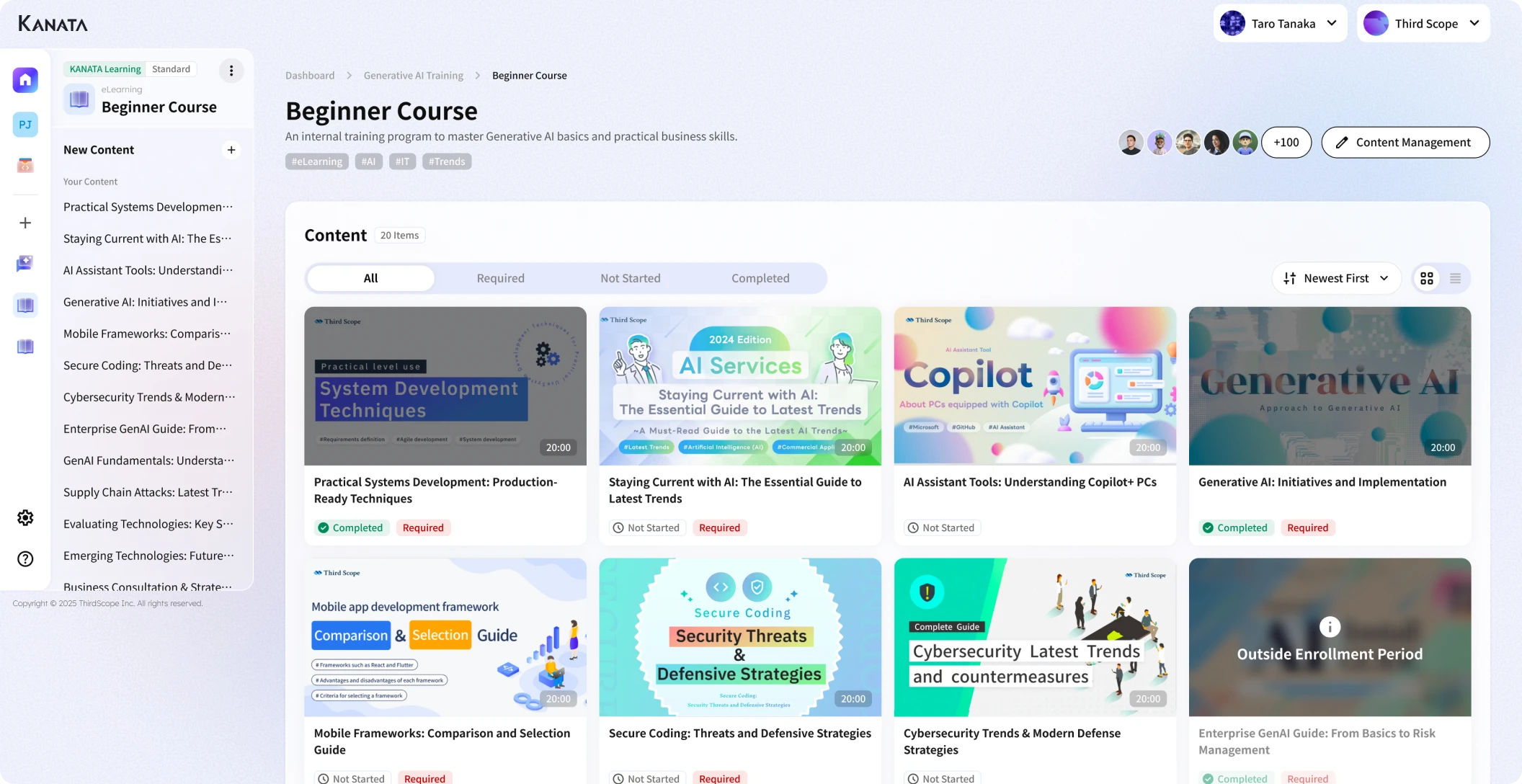
Where you use a service such as Kanata, which lets you combine AI chat, AI summarisation, learning data, a prompt library and e-learning, it becomes easier to connect what was learned in training straight through to operations on the ground. That said, in deciding on adoption you need to confirm how well it sits with existing systems, along with access management, log management, the data-handling terms and consistency with your internal security policy.
Running regulation-search and review-criteria exercises with AI chat
AI chat suits exercises in invoice checking, approval checking and regulation search.
In training, participants look at a sample invoice or approval document and have the AI produce the points to check. They then review the output as a team and discuss: “this point is usable,” “this wording is risky,” “this judgement is one a person should make.”
Through this process, not only does the way of using AI take shape, but the department’s own review criteria fall into line.
Organising approval documents and audit materials with AI summarisation
For the gist of long documents — approval documents, meeting notes, audit materials, draft regulation revisions — AI summarisation is effective.
For example, run an approval document through AI summarisation and organise it for the approver in the following format:
- Purpose
- Background
- Amount
- Expected effect
- Risks
- Points the approver should check
- Missing information
For audits too, when organising past minutes or application histories, AI summarisation can be used to extract the points at issue. Before anything is submitted as audit material, however, it must be reconciled against the originals.
Registering regulations, FAQs and manuals as learning data
To use AI for regulation search in practice, you need to put the information it refers to in order.
Register the expense regulations, purchasing regulations, authority-delegation regulations, application manuals, FAQs and query histories as learning data for an internal AI platform, and the AI finds it easier to answer with reference to them.
Before registering, though, a stocktake of the information is needed. If old regulations, duplicate FAQs and withdrawn application flows are mixed in, the AI’s answers will be muddled too.
Having the administrative side tidy its knowledge before and after AI training is an important undertaking in its own right.
Standardising review criteria with a prompt library
A prompt you have built once should not be left in someone’s personal notes but put into a form the team can reuse.
For example, turn prompts of the following kind into a library:
- Invoice-checking prompt
- Supporting-document-matching prompt
- Approval-document review prompt
- Approver summary prompt
- Regulation-search answer prompt
- Audit-material organising prompt
- Internal-query answer prompt
Sharing prompts reduces the variation from one person to the next. And if prompts improved on the ground after training are re-registered, the organisation builds up a settled pattern for using AI.
Making it continuous training through e-learning
AI use in accounting and administrative departments is hard to embed through a single classroom session. The situations in which you use it change with the season — the monthly work cycle, the closing period, audits, regulation revisions.
So make the training content into e-learning that can be revisited at the moment it is needed.
For example, prepare materials of the following kind:
- The basics of AI for invoice checking
- How to use AI for approvals
- Points to watch with AI for regulation search
- Information that must never be entered
- Checkpoints for reviewing AI output
- Points to watch when using AI for audits
It can also be put to use in the onboarding of new joiners and transferees. The key to embedding it is not to make AI training a one-off event but to fold it into the standard education of the back office.
The risks training must always cover

With AI use in accounting and administrative departments, you need to address the risks before the efficiency gains.
The matters to watch in particular are information management, mistaken answers, where responsibility sits, and audits.
Invoices and approval documents may contain individuals’ names, supplier names, account details, contract amounts, undisclosed investment plans and more.
In training, make clear what information may and may not be entered into AI.
As a general rule, the following information should be handled with care:
- Personal data
- Bank-account details
- Sensitive identifiers such as national ID numbers
- Undisclosed financial information
- Information relating to M&A or personnel changes
- Confidential customer information
- Information whose external sharing is restricted under contract
When using AI in practice, you need to check your internal security policy, your contractual terms and the data-handling terms of the AI service you use. Frameworks for AI governance likewise stress confirming the handling of information and the division of responsibility.
Do not turn AI output straight into the approval document
The summaries and checklists AI produces are convenient, but using them as the approval document just as they stand is dangerous.
The amount, date, supplier name, tax category, regulation clause and approval route in particular need reconciling against the originals by a person.
In training, it may be worth getting into the habit of appending a note of the following kind to the end of AI output:
This output is a checking aid; the final judgement is made by the responsible member of staff and the approver, having confirmed the originals.
Even just inserting this single sentence makes the AI’s role harder to misread.
Do not let AI conjecture on what is not in the regulations
With AI for regulation search, “not answering when there is no answer” matters.
AI will sometimes try to produce some answer to a question. But answering in generalities about something not stated explicitly in the regulations leads to mistaken guidance.
For that reason, always build the following constraint into the prompt:
Where it is not stated explicitly in the regulations, do not conjecture; reply that it needs checking with the responsible department.
This design matters for upholding internal control.
Keep an audit trail when using AI for audits
When using AI for audits, you should avoid a state in which it is unclear what the AI referred to and what output it produced.
Even where you use AI output to organise materials or extract the points at issue, the materials finally submitted must be prepared on the basis of the originals, retaining the reviewer, the review date and the source materials referred to.
AI can be an aide that eases audit work, but it does not stand in for the audit trail itself.
Indicators for gauging how well it has embedded after adoption

AI training does not end once it has been delivered. You need to confirm whether it is being used on the ground and whether the work is improving.
In accounting and administrative departments, you might set indicators of the following kind.
Average time taken on invoice checking
Compare the checking time per item before and after introducing AI for invoice checking.
If you chase simple time savings alone, however, checking quality may slip. Alongside the checking time, you should also watch the number of send-backs, the number of missed checks and the number of re-checks.
Number of sent-back approvals
When looking at the effect of AI for approvals, the number of sent-back approvals is a useful reference.
In particular, confirm whether send-backs for reasons that AI makes it easy to pre-check — missing entries, missing attachments, a weak basis for the amount, thin risk explanation — are falling.
Number of regulation queries and the self-resolution rate
With AI for regulation search, it matters to look not just at the number of queries from staff but at the self-resolution rate.
Did checking the regulations via AI chat reduce queries to the responsible person? And conversely, in which areas are the questions AI cannot resolve concentrated? Looking at this also feeds into putting your regulations and FAQs in order.
Time spent searching for materials during audits
In audits, the time spent searching for the materials you need is a heavy burden.
Once you can use AI to organise where materials are and the points at issue, the opening response to an audit may become quicker. The accuracy of submitted materials, however, must be confirmed by a person.
AI usage logs and review quality
The wider AI use spreads, the more it matters to grasp where and how it is being used.
By checking usage logs, review histories, prompt-revision histories and the state of knowledge-data updates, you can move from idiosyncratic, person-by-person use towards organised operation.
Points for making AI training succeed in accounting and administrative departments

Making AI training a success in accounting and administrative departments rests on a few prerequisites.
- Do not make the purpose of AI “replacing people.” The value of accounting and administrative departments is not simply in processing things faster. It is in upholding controls, keeping the quality of judgements, and creating a state in which the whole organisation can get on with its work in confidence.
- Use materials close to the actual work. A generic AI course can be hard to connect to work on the ground. By practising on themes close to practice — invoices, approval documents, regulations, FAQs, audit materials — it becomes easier to picture where to use it after the training.
- Make clear the scope you hand to AI and the scope people judge. Introduce it while this dividing line stays vague and the people on the ground grow uneasy. Conversely, when the AI’s role is clear, staff find it easier to use with confidence.
- Share prompts and knowledge as a team. People simply using it conveniently as individuals will not change the organisation’s work. By sharing and continually improving the patterns for review criteria, regulation answers and approval review, the quality of the whole back office rises.
- Carry out regular reviews. Regulations get revised and workflows change. The information and prompts you register with the AI need updating on a regular basis too.
In summary: hand routine checks to AI, and let people concentrate on exception judgements and control

Generative-AI use in accounting and administrative departments is not merely an efficiency measure.
AI for invoice checking supports the matching of supporting documents and the standardising of review criteria. AI for approvals organises what is missing from a request and the points the approver should look at. AI for regulation search serves as an aide that, in answer to queries from staff, seeks out well-grounded answers.
AI does not, however, take on the final judgement. Whether to pay, whether to approve, interpreting regulations, handling audits and exceptional processing are areas people must own.
That is precisely why AI training in accounting and administrative departments needs to be designed to take in not only tool operation but the breaking-down of the work, information management, prompt design, output review and internal control.
An environment such as Kanata, which lets you combine AI chat, AI summarisation, learning data, a prompt library and e-learning, is one option for connecting training content through to operations on the ground. Whatever tool you use, though, the premise is to confirm access management, log management, data handling and consistency with internal regulations.
What you should aim for is not an organisation that dumps its work wholesale onto AI. It is an organisation in which the review criteria align no matter who is handling the work, the information needed for exception judgements gathers quickly, and accounting and administrative departments can concentrate on control and judgement.
If you are run off your feet with the monthly close, approvals, regulation checks and audits, the realistic place to begin is to pick a single piece of work and start by separating the routine checks you hand to AI from the exception judgements people own.
Q&A: common questions about AI training in accounting and administrative departments
When using generative AI in accounting and administrative departments, which work is easiest to start with?
The easiest to start with is drawing up the points to check on invoices and approval documents. Rather than handing payment or approval decisions to AI from the outset, using it as an aide that organises the items a member of staff should check makes it easier to fold into the work.
Can AI for invoice checking judge whether an invoice is right or wrong?
AI can organise the points to check on an invoice, but it does not guarantee that the billing is correct. The amount, tax category, payment terms, remittance details, supplier name and the like need to be reconciled against the originals and related documents by a person.
Can using AI for approvals automate the approval work?
It should not be used as something that automates the approval work itself. AI for approvals is best used as an aide that organises what is missing from a request, the risks and the points the approver should check. Whether to approve is judged by the approver in light of the organisation’s policy, budget and internal controls.
How can mistaken answers be prevented with AI for regulation search?
Specify in the prompt that the regulation name, clause and relevant passage must always be shown. It is also important to design it so that, where something is not stated explicitly in the regulations, the AI does not conjecture but replies “this needs checking with the responsible department.” A stocktake of the learning data is needed too, so that old and new regulations do not become mixed together.
What are the benefits of using an AI platform such as Kanata?
The benefit is being able to combine AI chat, AI summarisation, learning data, a prompt library and e-learning. It becomes easier to share prompts for invoice and approval checking, to organise regulations and FAQs as learning data, and to feed training content into continuous learning. At the point of adoption, however, you need to confirm access management, log management, the data-handling terms and how well it sits with existing systems.