

We’ve made minute-taking quicker with AI. Yet the way we actually run deals hasn’t changed one bit.
Those were the words of Kudo (not their real name), a sales-planning manager at a B2B company, at the Monday-morning sales meeting. Six months earlier, the firm’s inside sales team had been tidying up call notes with AI, field sales had been drafting first-pass proposals, and customer success had been preparing pre-renewal summaries. But targeting, lead nurturing, deal management and CRM (SFA) entry were all siloed by department, and it took an age for information from customer touchpoints to feed back into decision-making.
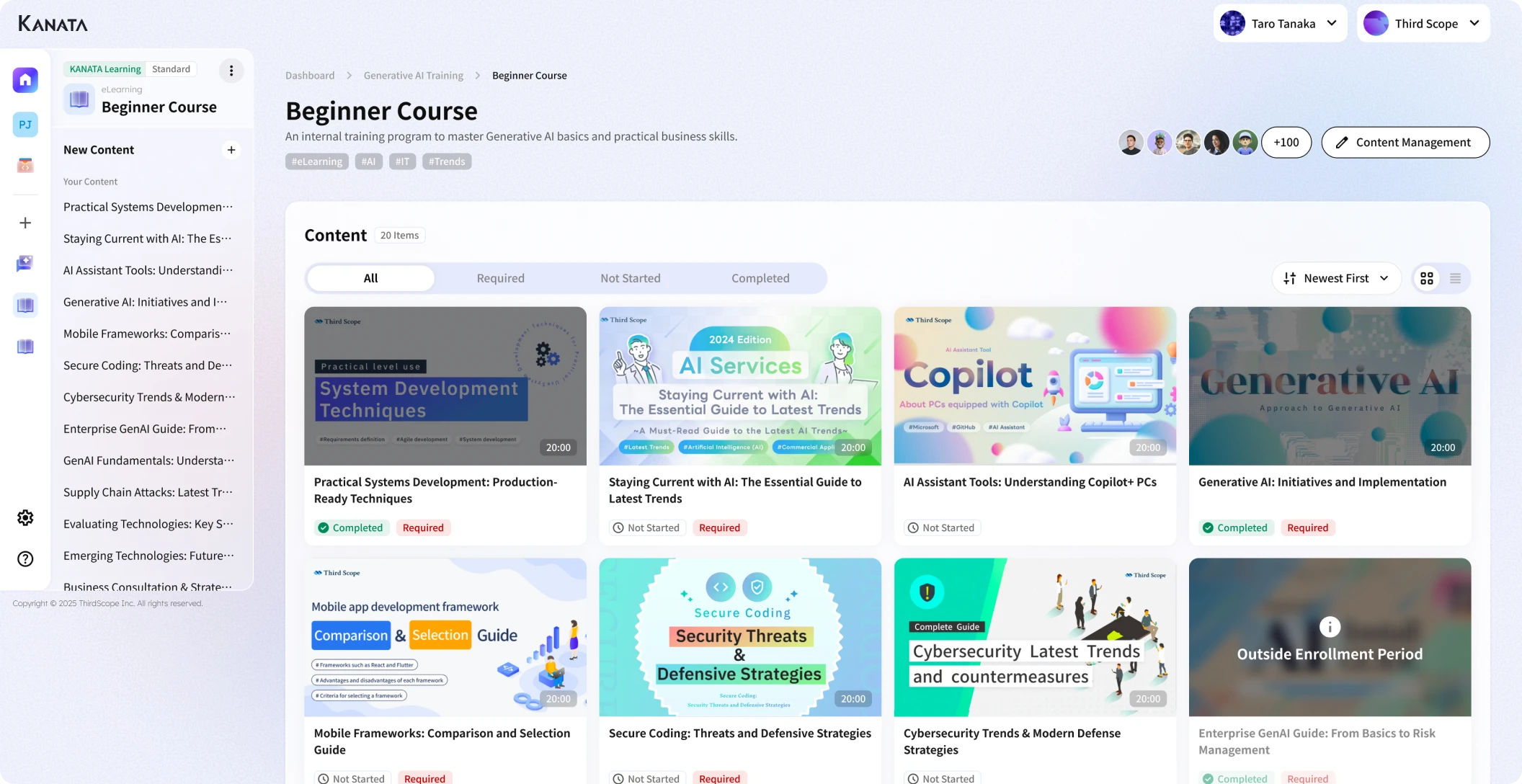
Today the company has shifted to a way of working in which, for new deals opened in the past three months, the CRM entry rules and the output format of AI summaries are aligned, and the next action after each meeting is confirmed by the following business day. When you use a tool such as Kanata — the platform we provide, which lets you handle AI chat, AI summarisation and training-data management within the same working environment — you can organise meeting notes and sales materials in a form that is easy to reuse. Kanata is designed as a business-support platform offering AI chat, AI summarisation, e-learning and more.
This article sets out how to move from using AI piecemeal, as a tool, to rethinking the entire sales process on the assumption that AI is part of it. The aim is a state in which understanding of the customer and the next move stay consistent whoever is handling the account, and inside sales, field sales and customer success can all act on the same information. That said, redesigning AI-led sales is no panacea. Only when input rules, CRM operation and on-the-ground review come together do you get repeatable improvement.
Why your sales process doesn’t change, even though you’re using AI

The use of generative AI is spreading across sales teams. Summarising meeting notes, drafting emails, sketching out proposals, organising competitive comparisons — in plenty of individual tasks, people increasingly feel things have “got easier”.
Seen through the eyes of a sales leader or sales-planning manager, however, the sales process as a whole has not necessarily changed. Consider, for instance, the following state of affairs.
- Inside sales is tidying up call notes with AI
- Field sales is drafting proposals with AI
- Managers are summarising weekly reports with AI
- Customer success is organising customer status with AI
- And yet the information in the CRM varies from one rep to the next
- Post-meeting next actions differ in their level of detail and in how deadlines are set
- The customer’s mood and the hypotheses about their issues are not handed over adequately between departments
In this state, AI is being used, but the sales process itself remains stuck in the old way of working.
AI does shorten the time spent on some tasks. But unless what you record in the CRM, the items you check after a meeting and the way the next action is decided all change, decision-making across sales as a whole will not speed up. If anything, AI-generated notes and drafts pile up in individuals’ own hands, and it can become unclear which information counts as the official record.
What matters when thinking about an AI-led sales process is not bolting AI on as a mere support tool, but rethinking the flow of sales activity itself.
The scope you should be looking at when redesigning the sales process

Mention redesigning the sales process and you might picture changing CRM fields or drawing up a sales-flow diagram. Those things matter too, of course. When you take AI as a given, however, you need to take a rather broader view.
Sales activity generally proceeds along the following lines.
- Organising the market and customer segments
- Targeting
- Lead generation
- Lead nurturing
- Initial contact by inside sales
- Conversion to a deal and proposal by field sales
- Deal and pipeline management
- Won/lost decision
- Handover to customer success
- Retention, upsell and referral generation
Traditionally, a person recorded each of these stages, a person organised them, and a person handed them to the next owner. When you take AI as a given, you add stages where AI drafts, AI summarises, AI classifies and AI proposes candidate next actions.
That said, you don’t hand everything to AI.
| Who | Well-suited role |
|---|---|
| AI | Organising, summarising, classifying and comparing information, and producing first drafts |
| People | Building the customer relationship, final judgement, price negotiation and important decisions |
To get results from AI-led sales transformation, making this division of labour clear is the starting point. It is worth noting that, against the backdrop of this widespread AI adoption, some surveys point to data quality, training and risk management as challenges on the company side. Salesforce’s “State of Sales” report, for instance, finds that even as AI use spreads across sales teams, concerns about budget, training and a lack of data persist.
What you should make visible first is the “flow of customer information”

The first thing to do when redesigning AI-led sales is not to choose a tool. What you should make visible first is where customer information is created, where it stalls, and where it fails to be passed on.
Try posing the following questions, for instance.
- Where are the customer issues uncovered at first contact recorded?
- Are call notes transcribed into the CRM, or do they stay in someone’s personal notes?
- Are the concerns the customer raised in a meeting reflected in the proposal?
- Are the reasons for lost deals fed into the next round of targeting?
- Are the expectations set at the point of winning the deal handed over to customer success?
- Does the customer’s pre-renewal status become learning material for new-business sales and marketing initiatives?
The points where you cannot answer these questions are the bottlenecks in your sales process.
Introduce AI but leave these bottlenecks in place and all you get is more “summarised information” and “tidy prose”. What matters is how you connect the information AI has organised to the next sales action or decision.
Simply summarising inside sales’ call notes with AI, for example, is not enough. You need to extract the “issue”, “timing of consideration”, “stakeholders” and “items to confirm next time” from the summary and make them feed into the CRM fields.
Likewise, merely producing meeting minutes with AI is not enough. It is important to pull out the “next action”, “the customer’s homework”, “your own homework” and “loss risk” from the minutes and put them in a state the manager can review.
The sales areas where AI should be built in

When redesigning the sales process around AI, it is more realistic not to try to change every stage at once. Start with the areas where the effect is easy to see and which are easy to embed in day-to-day operation.
The representative areas are targeting, lead nurturing, deal management, proposal work and the handover to customer success.
Targeting
In targeting, you redefine the kind of customer you should be going after, drawing on existing customers, deal history, lost-deal reasons and how different industries respond.
AI is well-suited to organising past meeting notes and customer attributes and extracting what they have in common. You can, for instance, compare the companies you won with those you lost and organise points such as the following.
- Industry
- Headcount
- Departmental structure
- The decision-maker’s job title
- Overt issues
- Latent issues
- What prompted them to consider adoption
- Concerns that tend to surface when a deal is lost
This kind of organisation makes it easier for the sales team to discuss “which companies to prioritise” on the basis of past data, not just individual experience.
You should avoid adopting AI’s targeting suggestions wholesale, however. Where the existing data is skewed, AI’s proposals may inherit that same bias. In the end, the sales leader or marketing manager needs to make the call in light of market potential, strategy and business direction.
Lead nurturing
In lead nurturing, you design which information to deliver, and when, according to the customer’s stage of consideration.
AI can be used as an aid to classifying the state of a lead, drawing on the customer’s response history and enquiry content — sorting leads, for example, into categories such as the following.
- Before issue awareness
- Gathering information
- Comparing options
- Before internal sign-off
- Adoption timing undecided
- Considering switching from an existing tool
Once you can make these distinctions, it becomes easier to vary the content of emails, webinars, white papers and meeting requests.
Even firms that used to send much the same outreach to every lead find that, with AI, designing touchpoints to suit the customer’s state becomes easier. This is an important area of application for sales-enablement AI.
Nurturing is not simply a matter of automating, however. Send a forceful sales message while the customer has yet to put their issue into words and it can backfire. The point is to classify with AI and have a person adjust the warmth of the communication.
Deal management
Deal management is one of the areas where the benefit of AI is easiest to see.
After a meeting, a great deal of information arises: minutes, customer issues, stakeholder details, concerns, next actions and so on. Yet the busier the rep, the more CRM entry tends to be put off.
Put AI to work here and you can organise the following from meeting notes or a recording.
- Meeting summary
- The customer’s main issues
- The criteria the customer cares about
- Decision-makers and stakeholders
- Remarks about budget
- Timing of adoption
- The state of any competitive comparison
- Next action
- Loss risk
- A summary for transcription into the CRM
Even when using CRM-focused AI, the important thing is to define in advance what to keep in the CRM.
However neatly AI summarises a long meeting note, if it isn’t tied to the CRM fields, the manager cannot compare the state of deals. When redesigning deal management, it is important to align AI’s output format with the CRM fields.
Proposal work
AI is also useful for producing proposals and pitch materials.
Rather than having AI knock out a finished proposal straight away, though, it is better suited in practice to first organising the structure and the key points.
Have AI organise the following items, for instance.
- Hypotheses about the customer’s issues
- The background to the issues
- The proposal concept
- Adoption steps
- Expected benefits
- Competitive comparison
- Anticipated objections
- Questions to confirm at the next meeting
If the rep reviews at this stage, they can correct the direction of the proposal early on.
AI’s role is not to finish the proposal. It is to lay out, quickly, the points the rep ought to think about, and to make gaps easier to spot.
Bringing AI into proposal work also helps junior reps get up to speed, because the customer understanding and objection-handling that veterans do in their heads can be turned into a template through dialogue with AI.
Handover to customer success
In redesigning the sales process, it is important not to stop at the won deal.
In B2B services, if the customer’s expectations at the point of signing diverge from the support delivered after adoption, it can lead to early churn or stalled usage. The handover from sales to customer success should therefore be designed as part of the sales process.
Use AI and you can organise the following from the pre-win deal history.
- What the customer wants to achieve with adoption
- What the customer was anxious about
- The metrics the decision-maker cared about
- Which department to prioritise for initial rollout
- The support promised at the time of contract
- The scope for upsell or expansion
With this information organised, customer success can hold a conversation grounded in the customer’s context from the very first meeting.
Conversely, if this information isn’t handed over, the customer may feel “I told sales all this, and now I’m explaining it again”. Reducing this break in the customer experience is another important aim of redesigning the sales process.
Tool design when building AI into the sales process

When building AI into the sales process, there is more than one option. AI features built into your CRM, minute-taking AI, sales-support tools, an internal AI chat, knowledge-management tools — there are several to choose from.
The first thing to think about, therefore, is not “which tool is best” but “which information in the sales process is used, by whom, and at what point”.
On that basis, choose a tool from perspectives such as the following.
- How easily does it integrate with your CRM?
- Can it handle meeting notes and sales materials securely?
- Can prompts and output formats be standardised across the team?
- Can access rights be separated by department?
- Is it easy for reps to use within their day-to-day work?
- Is it easy to fit into a way of working where people review AI’s output?
If you use Kanata, you can make the most of being able to handle AI chat, AI summarisation and training-data management within the same working environment. For example, you might organise sales materials as training data, consult the AI chat when preparing for a meeting, and use AI summarisation afterwards to produce a note for transcription into the CRM.
That said — and this holds for any tool, not just Kanata — you still need to design the CRM fields, the input rules and the review setup separately. A tool is part of redesigning the sales process; it is no substitute for the process itself.
Organising sales materials as training data

Organise your sales materials, service explainer decks, FAQs, case studies and competitive comparison tables as training data and reps find it easier to put questions to AI when preparing for a meeting.
They can ask the following sorts of questions, for instance.
- When proposing to the head of IT at a manufacturer, organise the concerns that commonly come up and some example responses.
- Drawing on past case studies, give me three pitches that land well with a company of around 1,000 employees.
- For this customer’s issue, organise the features the proposal should emphasise.
You can create a situation in which reps get the information they need by consulting AI, rather than hunting through materials every time.
Standardising meeting notes with AI summarisation

Meeting notes vary enormously in how they are written from one rep to the next. Some write in detail; others leave only a few lines. This variation makes it hard for managers to assess deals.
When using AI summarisation, it is important to decide the post-meeting output format in advance — something like the following, for instance.
- Meeting overview
- Customer issues
- Summary of the customer’s remarks
- State of consideration
- Decision-making stakeholders
- Competitive situation
- Next action
- Summary for CRM transcription
- Items to confirm
Standardise on this format and managers find it easier to compare the state of each deal. Reps, too, are less likely to be in doubt about what to record.
Sharing sales know-how through a prompt library

One thing easily overlooked in applying AI to the sales process is the reuse of prompts.
Lock a prompt that produced results inside one person’s chat history and it never becomes organisational knowledge. Turn prompts for meeting prep, minute-summarising, proposal structuring, objection-handling and loss analysis into a library, by contrast, and they become a sales asset the whole team can use.
You might prepare prompts such as the following, for instance.
- A prompt for understanding the customer before a new meeting
- A prompt for organising BANT from meeting notes
- A prompt for building the structure of a proposal
- A prompt for anticipating the customer’s objections
- A prompt for classifying reasons for lost deals
- A prompt for producing a CS handover note
The essence of sales-enablement AI is not merely to make individuals’ work a little easier. It is to turn sales behaviour that produces results into a template, and make it easy for the whole team to reproduce.
How to go about redesigning the sales process

From here, let me set out the steps for redesigning the sales process on the assumption that AI is part of it.
Write out your current sales process
First, write your current sales process out on a single page.
At this point, write the flow as it actually plays out on the ground, not the ideal flow.
- Where do leads come in from?
- Who handles the first response?
- What is the threshold for treating it as a deal?
- Where do the meeting notes end up?
- When is CRM entry done?
- What do managers look at to make a call?
- What gets handed over to CS after a win?
Write out the real flow and the places where “this is left to the individual” or “information stalls here” start to become visible.
Decide the purpose of bringing in AI
Next, decide the purpose of bringing in AI.
Common purposes are the following.
- Reduce the burden of CRM entry
- Make the post-meeting next action clear
- Speed up proposal writing
- Support junior reps in preparing for meetings
- Make it easier to analyse reasons for lost deals
- Raise the quality of the handover to CS
Bring AI in while the purpose stays vague, and you end up with something that feels handy but whose benefit you can’t actually pin down.
To begin with, I’d recommend narrowing it to one or two purposes. Purposes that can be translated into behaviour work well — for example, “make the next action clear within 24 hours of a meeting” or “build the CRM’s mandatory fields from the AI summary”.
Decide AI’s output format
What matters in applying AI is making the output consistent.
For the same meeting summary, if the prompt differs from person to person, the format that comes out differs too. That makes it hard to compare and analyse as an organisation.
So decide an output format for each of the main tasks — deal management, proposals, lead classification, CS handover and so on.
For a post-meeting summary, for instance, useful items to include might be the following.
- Meeting date and time
- Customer name
- Attendees
- Customer issues
- Background to the consideration
- The customer’s remarks
- Decision-makers and stakeholders
- Competitive situation
- Next action
- Deadline
- Owner
- Items to confirm
Once the format is settled, transcription into the CRM and manager review become easier.
Try it on a small scale
Try to change the entire sales process in one go and the burden on the front line becomes considerable. To begin with, it is more realistic to narrow things to one team, one product and one process.
There are starting points such as the following, for instance.
- Use AI only for the summary after a new meeting
- Use AI only for the proposal structure of a particular product
- Standardise only the organising of inside sales’ call notes
- Use AI only to produce the CS handover note
Starting small makes it easier to get concrete feedback from the front line.
This field isn’t needed in the CRM.
This summary doesn’t let a manager make a call.
It’s no use unless the next action has a deadline on it.
You revise the prompts and operating rules on the basis of such comments.
Review operation while watching the KPIs
In redesigning AI-led sales, you don’t introduce it and then you’re done. Reviewing it as you operate is the premise.
The KPIs to watch are not sales alone. In the early stages, it is easier to improve by watching metrics relating to sales behaviour and information quality — metrics such as the following, for instance.
- Time taken to complete CRM entry after a meeting
- Rate at which a next action is set
- Rate at which meeting notes are filled in
- Rate at which manager reviews are carried out
- Time taken to write a proposal
- Rate at which lost-deal reasons are classified
- Rate at which CS handover notes are produced
- Number of follow-up queries after a handover
Review these metrics monthly and adjust how AI is used, the input rules, the CRM fields and the review setup.
Merely introducing AI will not embed sales transformation. To make it stick, you need to arrange things so the front line finds it easy to use, managers find it easy to judge by, and the next owner finds it easy to take over.
Where AI-led sales redesign tends to go wrong

There are several pitfalls when redesigning the sales process on the assumption that AI is part of it.
Introducing the tool becomes the goal
The most common failure is for introducing the AI tool itself to become the goal.
We’ve made AI available
We’ve handed reps an account
We’ve started summarising minutes
None of this, on its own, changes the sales process.
What matters is deciding which business judgement you will speed up with AI, which information-sharing you will improve, and which sales behaviour you will standardise.
Bringing in AI while CRM operation stays vague
Use AI while your CRM input rules stay vague, and its output will be vague too.
If it isn’t settled at what level of detail to write the “customer issue”, whether a deadline must always go on the “next action”, or whether to separate the “decision-maker” from the “influencer”, then what each rep enters will vary.
When putting CRM-focused AI to work, you need to be clear not only about what to have AI output, but also about what to manage in the CRM.
Skipping front-line review
The summaries and proposals AI produces must always be checked by the front line.
AI is good at organising things plausibly, but it cannot necessarily capture the customer’s subtle mood, or the sense of unease the rep felt, with any accuracy.
When a customer says “we’ll think about it”, for instance, whether that is genuine consideration or a roundabout no can be hard to judge from the words alone.
AI’s output should be treated not as a replacement for the rep’s judgement, but as material to support it.
Putting off the information-management rules
Sales data contains information that must be handled with care: customer names, contact names, contract terms, deal history, pricing and the like.
As you press ahead with AI, you need to be clear about which information may be entered, which should be masked, and within which project it should be handled.
When handling a customer’s personal data or contractually confidential information in particular, you must operate in line with internal rules, contractual terms and your information-security policy. NIST’s AI Risk Management Framework sets out a framework for organisations to identify and manage risk in the use of AI, including generative AI.
The thinking everyone should hold in common

The vantage point from which one brings AI into sales differs by organisation — executives, the head of IT, the sales leader, the marketing leader, the sales-planning manager and so on. The points each emphasises vary with their role, but what everyone should hold in common is the same.
It is this: don’t let AI end up as nothing more than “a tool for speeding up individuals’ work”.
Across the sales process as a whole, AI’s value can be organised into the following three.
- Organising information quickly
- It organises meeting notes, proposals, the customer’s remarks, reasons for lost deals and the like, and makes them easy to use for the next action.
- Standardising sales behaviour
- The meeting prep and objection-handling that only veterans could do can be rolled out to the team as prompts and training data.
- Speeding up decision-making
- Once the CRM and meeting notes hold the information they need, managers can make calls on deals and on support more quickly.
Redesigning the AI-led sales process means building these into the flow of sales activity.
It is worth noting that McKinsey’s 2025 survey also highlights redesigning workflows and designing AI-governance roles as important considerations when deploying generative AI.
In summary

Bringing AI into the sales front line and redesigning the sales process on the assumption that AI is part of it are two different things.
The former is about making individual tasks more efficient — minute-taking, email wording, proposal drafts. The latter rethinks everything from targeting, lead nurturing, deal management and CRM entry through to the handover to customer success, and changes the flow of customer touchpoints and decision-making.
When redesigning the sales process, first make the flow of customer information visible and decide where AI should go in. On that basis, put in place the output formats, CRM fields, prompts and review setup, and start trying it from a small scope — that is what matters.
A tool such as Kanata, which lets you handle AI chat, AI summarisation and training-data management in one environment, is well-suited to building the means to reuse sales materials, meeting notes and proposal know-how. That said, AI does not make sales succeed automatically. Only with front-line input, managers’ judgement and information-management rules does AI-led sales transformation take root in practice.
From piecemeal AI use to redesigning the whole sales process. The realistic place to start is to write out your current sales process and find a single point where customer information is stalling.
Q&A
What is AI-led sales redesign?
AI-led sales redesign means not merely using AI for part of sales activity, but rethinking the entire sales process on the assumption that AI is part of it — including targeting, lead nurturing, deal management, CRM entry and the handover to customer success. The aim is not only to speed up individuals’ work, but to put the flow of customer information in order and connect it to the next sales action or decision.
Will introducing AI improve the sales process automatically?
It will not improve automatically. AI is effective for summarising, classifying, drafting and comparing, but what to keep in the CRM, who checks the output and at what point the next action is decided all need to be designed by people. It is important to put input rules, output formats and a review setup in place at the same time as bringing in AI.
If I’m bringing AI in first, which sales task should it be?
It is realistic to start with organising notes after a meeting and producing the summary for CRM transcription. The reason is that the burden on the rep is heavy and it ties directly into the manager’s assessment of the deal. Extend it next to building proposal structures, preparing objection-handling and producing CS handover notes, and rolling it out across the whole sales process becomes easier.
What should I watch out for when putting CRM-focused AI to work?
When putting CRM-focused AI to work, it is important to align the CRM fields with AI’s output format. If what you manage stays vague — “customer issue”, “decision-maker”, “competitive situation”, “next action”, “deadline” and so on — AI’s output will vary from rep to rep too. Where CRM operation isn’t in order, you need to review the input rules first.
How can Kanata be used in redesigning the sales process?
Because Kanata lets you handle AI chat, AI summarisation and training-data management within the same working environment, it is well-suited to organising sales materials and meeting notes in a form that is easy to reuse. You might, for instance, register sales materials as training data, organise the points for each customer in the AI chat when preparing for a meeting, and use AI summarisation afterwards to produce a note for CRM transcription. That said, even when using Kanata, the CRM fields, input rules and review setup still need to be designed separately.