

So once again, someone is copying an AI-generated summary back into the SFA and the task manager by hand.
This is a story about workflow-automation AI, drawn from a B2B company that runs several SaaS tools. The people facing the problem were Morita (a pseudonym) from the IT department, who leads the firm’s digital transformation, alongside the operational owners in sales planning, customer success and finance.
Until six months ago, the firm was running a chat AI, a CRM, expense management, Slack and a task manager, each on its own. Meanwhile, transcribing meeting notes, raising approval requests and logging interaction histories were all stitched together by hand. Sales planning felt the post-meeting records were slow to appear; customer success was frustrated that interaction histories were scattered; and finance said that checking each request took time, every single time. The screens they were looking at differed, but the underlying problem was the same. The AI and the SaaS tools were running separately, with people in the middle, ferrying the data across.
Over the past three months, the firm ran a trial of AI SaaS integration across 40 cases following sales meetings. The time spent writing up the record and raising tasks afterwards fell from an average of 18 minutes per case to 7. The reason is straightforward: the AI organised what was said in the meeting, and then, through iPaaS, API integration and webhooks, fed that into the relevant SaaS tools as records, notifications and tasks.
This article sets out the fundamentals of designing workflow automation. It is written for the IT teams, digital-transformation leads and departmental operations owners who already have several SaaS tools in place, yet are still feeling their way when it comes to designing workflow automation that ties in generative AI.
The aim is not a state in which the AI simply produces an answer and stops there. It is one in which input, decision support, execution and record-keeping are joined up, and the whole thing can be run safely, access controls and audit logs included.
That said, merely connecting your SaaS tools does not automate everything. Only once you have exception handling, human review, operating rules and a fresh look at data quality does any of this translate into repeatable improvement.
What AI SaaS integration actually means

AI SaaS integration is the idea of not using generative AI as a standalone chat tool, but connecting it to the SaaS your organisation already runs, the CRM, SFA, Slack, Teams, expense management, attendance, ticketing and marketing-automation tools, and weaving it into the flow of work.
Take a worked example. The AI summarises the audio from a meeting and pulls out the decisions and the to-dos. It then logs those to-dos in the task manager, notifies the relevant people via Slack, and records the meeting notes in the CRM. Once things are joined up to this degree, using AI moves beyond merely getting an answer and into actually carrying the next piece of work forward.
Used on its own, AI tends to centre on drafting, summarising, classifying and brainstorming. With AI SaaS integration, the point becomes handing the AI’s output onward to the next business action.
In other words, the heart of the design is not only what you ask the AI to answer. It is deciding which business process the AI’s output feeds, under what conditions, and into which SaaS.
Why more SaaS tools mean more copy-and-paste

In most companies, each department has adopted whichever SaaS suits it best. Sales uses an SFA, marketing a marketing-automation tool, customer success an enquiry-management system, finance expense management, and HR attendance and labour management.
Each of these tools is useful in its own right. Real work, however, rarely starts and finishes inside a single one of them.
What is agreed in a sales meeting gets recorded in the CRM, shared with colleagues over Slack, and assigned to an owner in the task manager. Where needed, it flows on into quoting, contracting and billing. A customer enquiry, likewise, spans chat, email, the FAQ, ticketing and internal checks.
And whenever those SaaS tools are not connected to one another, a person ends up bridging the gap.
- Copying meeting notes and pasting them into the CRM
- Transcribing a Slack request into the task manager
- Summarising an enquiry and sending it on to another team
- Checking an expense claim and sending the approval request through a separate channel
Each of these looks trivial on its own. Repeated daily, though, they eat into the team’s time and become a source of input errors and missed responses.
The value of workflow-automation AI lies in spotting this information that people are carrying across by hand, and using AI-and-SaaS integration to reduce it.
Start your automation design with the data flow

When you set out to integrate AI and SaaS, the first thing to think about is not which tool to use. It is the business data flow.
A data flow describes where information originates, who checks it, which SaaS it is recorded in, and which action it moves on to next.
For the work that follows a sales meeting, for instance, you can lay it out as follows.
| Stage | What happens |
|---|---|
| Input | Meeting notes, the meeting recording, and supplementary comments from the salesperson |
| AI processing | Summarising, extracting the customer’s issues, classifying to-dos, and proposing the next action |
| Human review | The salesperson or their manager checks the content |
| SaaS integration | Logging the meeting notes in the CRM and raising the to-dos in the task manager |
| Notification | Sharing with the relevant people via Slack or Teams |
| Record | Saving what was carried out and the outcome as a log entry |
Skip drawing out this flow and jump straight to which iPaaS to use or which API to connect, and you may well end up with only partial automation.
Start by dividing the work into the following four parts.
- Input
- Where the information comes in from
- Decision support
- What the AI organises, classifies and proposes
- Execution
- What is done, and in which SaaS
- Record
- Where the results are kept
Once these four are clear, the design of your AI SaaS integration becomes far easier to make concrete.
The main ways to connect AI and SaaS

Broadly speaking, there are three ways to integrate AI and SaaS: API integration, webhooks and iPaaS.
API integration
API integration is the mechanism by which one piece of software exchanges data with another according to a defined procedure. By passing the AI’s output to a SaaS API, you can create, update, search and send notifications.
For example, the AI pulls a to-do such as “send the proposal materials next time” out of the meeting notes, then passes that to the task manager’s API to create the task.
API integration is flexible and copes well with complex processes. In return, it calls for an understanding of the API specification, authentication, error handling and an ongoing maintenance arrangement, which is why the IT department or a development team tends to be involved.
Webhooks
A webhook is a mechanism that automatically notifies another system when a particular event occurs.
You can use events such as “a form was submitted”, “a particular emoji was added in Slack” or “a deal’s status changed in the CRM” as the trigger that sets AI processing or SaaS integration in motion.
Webhooks matter because they create the starting point for workflow automation. Rather than someone pressing a button each time, an event in the business itself becomes the trigger.
iPaaS
iPaaS stands for Integration Platform as a Service: a cloud-based foundation for connecting multiple SaaS tools and systems. With no-code or low-code, you can design data synchronisation, notifications, automatic registration and conditional branching between SaaS tools.
Gartner’s “Market Share Analysis: Integration Platform as a Service, Worldwide, 2024” reports that the iPaaS market grew 23.4% year on year in 2024, reaching some 8.5 billion US dollars. The drivers behind this are the spread of SaaS usage, no-code and low-code development, and the wider take-up of AI.
With iPaaS, even a company with limited development resources can try out workflow automation reasonably quickly. But the fact that you can build something without code does not mean design and governance go out of the window. Unless you keep track of who built a given integration, where it failed and whether its permissions are appropriate, you run the risk of the whole thing turning into a black box.
Which work to automate, and which to leave alone

AI SaaS integration suits work that recurs, whose input format is reasonably stable, and whose criteria for judgement can be put into words.
Tasks of the following kind, for example, are good candidates.
- Summarising meetings and raising the to-dos
- Classifying enquiries and routing them to the right department
- Drafting CRM records from meeting notes
- Checking expense claims for omissions
- Pulling the key points out of interview notes
- Turning Slack posts into tasks
- Classifying and tallying customer survey responses
Some work, on the other hand, is not suited to full automation.
- The final call on contract terms or pricing
- Performance reviews and disciplinary decisions
- Sending a significant letter of apology to a customer
- Specialist judgements in legal, accounting or employment matters
- Work riddled with exceptions, where the criteria shift frequently
You can hand the AI the drafting and the marshalling of the issues here. The final judgement, and the check before anything is acted on, should rest with a person.
The important thing is to draw a line between the work you delegate to AI and the work for which a person remains accountable. NIST’s AI Risk Management Framework, for its part, places weight on the organisational discipline of identifying, measuring and managing the risks of AI systems.
Do not leave access control until later

The one thing to watch most closely in AI SaaS integration is access control.
Whenever the AI accesses a SaaS tool, the question of whose privileges it acts under is unavoidable. How you manage it depends on whether you connect through an individual’s account, a shared departmental service account, or a dedicated system account issued for the purpose.
Suppose you set up the CRM integration under a salesperson’s personal account. If that person moves on or leaves, the integration may simply stop. Run everything through a single high-privilege shared account instead, and it becomes hard to trace who did what.
Where you use OAuth, you should keep the scope of what you grant to a minimum. OAuth is the mechanism for giving a particular application limited access without handing over the user’s password directly.
The points worth weighing up are these.
- Is read-only access enough?
- Do you need the ability to create new records?
- Should updating existing data be permitted?
- Is a delete permission genuinely necessary?
- Is there an agreed procedure for switching the integration off?
IETF RFC 9700, “Best Current Practice for OAuth 2.0 Security” sets out an updated threat model for OAuth 2.0 along with countermeasures for the risks observed in real-world use.
With AI SaaS integration, it pays to design to the principle of least privilege from the outset.
Build audit logging and error handling into the design

In workflow automation, it is not enough that things work when all goes well; you also need to notice when something fails.
Consider a process in which the AI summarises meeting notes and registers them in the CRM. Can you, at that point, trace the following?
- Which input data was used
- What the AI produced as output
- Who checked the content
- What was registered, and in which SaaS
- Whether the registration succeeded or failed
- And if it failed, who was notified
Without a record of these, you cannot get to the root of a problem when one arises.
Audit logs are indispensable in particular where data on the SaaS side is updated on the strength of the AI’s output. An audit log is not merely a matter of system administration; it is the mechanism that makes business accountability clear.
Error handling matters just as much.
When an API call fails, how many times do you retry? After a set number of failures, who gets told? And if the AI’s output is incomplete, do you halt the process, or send it to a person to check?
Deciding these rules in advance makes it far easier to avoid the situation where something you thought was automated had in fact stalled somewhere. In systems that involve web applications and APIs, authentication and authorisation, logging and misconfiguration are persistent risks. When designing, security guides such as the OWASP Top 10:2025 are also worth consulting.
Using Kanata as a starting point for automation

When you think about AI SaaS integration, there is no need to automate everything at once. The realistic place to start is with AI tidying up the inputs and with reusing the firm’s own working knowledge.
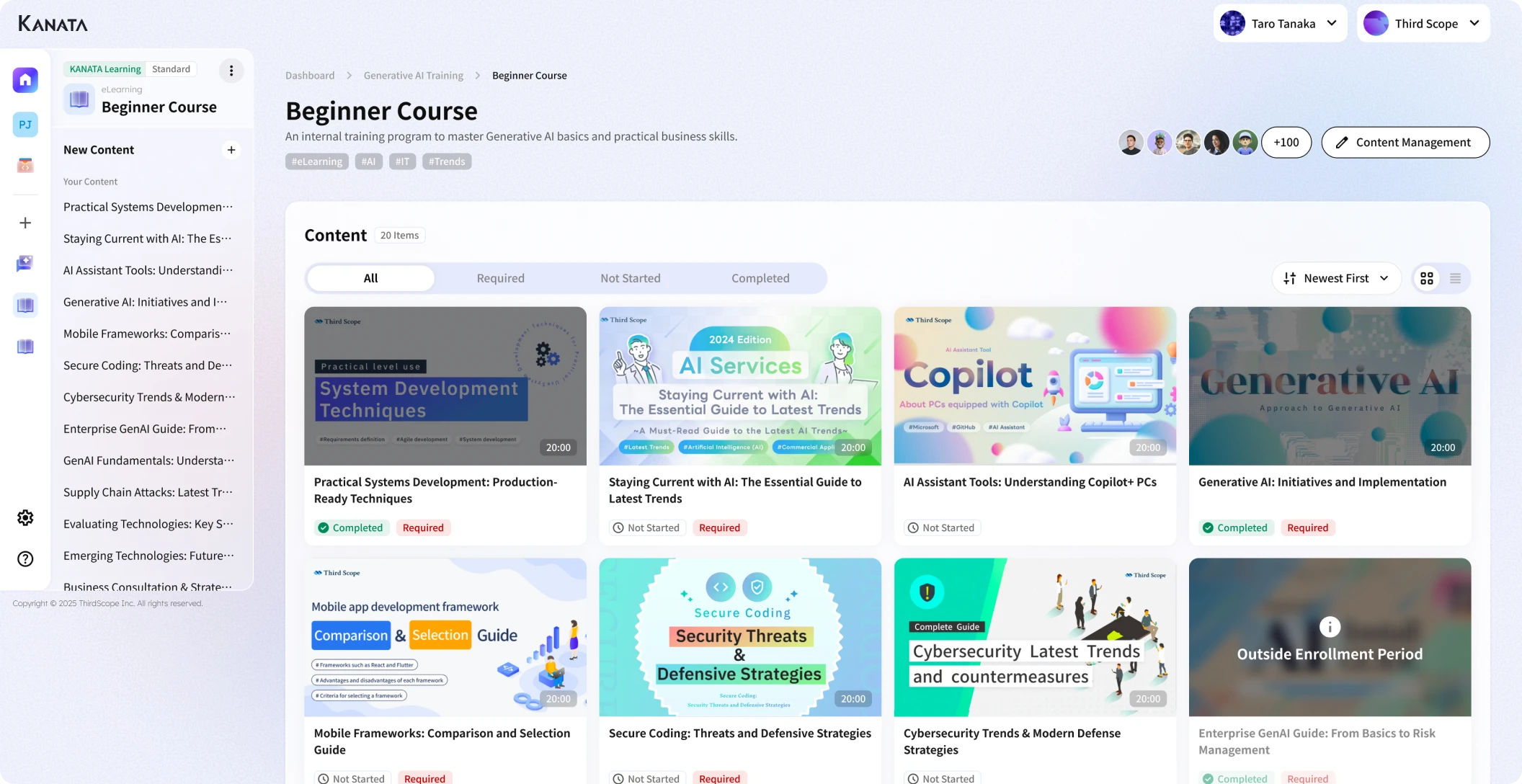
A work-support platform such as Kanata, for instance, lets you organise the information a task needs using AI chat, AI summaries and per-project libraries.
You might use AI summaries to organise meeting recordings and documents and to extract the decisions and to-dos; save your frequently used summary formats and CRM input rules in a prompt library; and register sales materials, internal policies, FAQs and past minutes in a knowledge library so the AI can refer to them.
Laying this groundwork to keep the quality of the AI’s output steady, and only then moving on to SaaS integration, makes the workflow automation considerably easier to design.
Kanata is, of course, not the only option. Your existing groupware, an iPaaS, the AI features bundled with your CRM, RPA, an in-house workflow platform — the right approach differs from company to company. Kanata suits the case where you want AI chat and summaries as the way into your work, while managing prompts and knowledge on a per-project basis.
What matters is not installing a particular tool, but bringing the information the AI draws on, the prompts it uses, the SaaS it acts through and the people who check the work together into a single, coherent design.
If you start small, where should you begin?

The best work to tackle first is something whose reach is not too broad and whose results are easy to see.
Writing up minutes after a meeting and raising the to-dos
Because the input is confined to meeting notes and recordings, and the output, the minutes, the decisions, the to-dos, is easy to read off, this makes a comfortable first target.
Classifying enquiries and routing them to an owner
Here the AI reads the text of an enquiry, assigns a category and priority, and notifies the relevant department. Even without automating the full reply, the first-pass classification alone shows a visible benefit.
Helping log sales meeting notes in the CRM
The AI tidies up the notes the salesperson wrote and shapes them into a form that is easy to enter into the CRM. To begin with, the safe approach is not automatic registration but drafting, with a human check in between.
Turning Slack posts into tasks
Triggered by a particular channel, emoji or keyword, the AI organises the request and registers it in the task manager. It pairs well with webhooks.
Rather than aiming from the start at sweeping, company-wide automation, beginning with one task, one department and one data flow makes the problems, and the benefits, much easier to verify.
A checklist to run through before you start

Before you begin with AI SaaS integration, check the following.
- Does the target work recur on a weekly or daily basis?
- Is the format of the input data reasonably consistent?
- Is there a clear split between what the AI handles and what a person checks?
- Are the APIs or webhooks of the SaaS you want to connect available to you?
- Can the OAuth scope be kept to a minimum?
- Can the outcome of each action be kept as an audit log?
- Is it settled who gets notified when an error occurs?
- Can the process owner review it regularly once it is automated?
- Are the rules for handling personal and confidential information clear?
- Can each department’s operating rules be documented?
If this checklist throws up more questions than answers, the sensible course is not to rush into automation but to start by making the workflow itself visible.
In summary: with AI SaaS integration, redesigning the work matters more than merely connecting it

The point of AI SaaS integration is not simply to connect one tool to another. It is to take a fresh look at the transcribing, checking, notifying and recording that people were doing in between, and to redesign the business process itself.
Generative AI is strong at summarising, classifying, extracting, drafting and supporting decisions. SaaS is the foundation that accumulates data, moves the work along and shares it with the people involved. Connect the two well and you can improve the whole flow, from input through to execution and record-keeping.
Acting on the AI’s output as it stands, however, calls for care. Unless you design in access control, audit logging, error handling, human review and the handling of exceptions, a convenient piece of automation can quietly become a fresh source of risk.
Start by picking a single task and setting out its flow, input, AI processing, human review, SaaS integration and record-keeping.
AI SaaS integration is not a purely technical matter. It is an exercise in which management, IT and the front line look at the same workflow together and decide what to automate and where to keep human judgement.
Q&A: the basics of AI SaaS integration
What is AI SaaS integration?
AI SaaS integration is the idea of connecting generative AI to SaaS such as a CRM, SFA, Slack, expense management or ticketing, so that the input, decision support, execution and record-keeping of a task become one continuous flow. What sets it apart is that it does not merely have the AI answer; it carries that output on into the next business action.
If you are automating something first, what kind of work is best suited?
To begin with, writing up minutes and raising to-dos after a meeting, classifying enquiries, and helping log meeting notes in the CRM are all good fits. Starting with work that recurs, has a reasonably consistent input format and lends itself to a human check lets you verify the benefit while keeping the risk down.
How should I choose between iPaaS and API integration?
iPaaS suits the case where you want to connect several SaaS tools with no-code or low-code. API integration suits the case where you need more complex branching, bespoke processing or deep integration with an existing system. Whichever you choose, you still have to design the data flow, the access control and the error handling.
What risks should I be especially mindful of in AI SaaS integration?
The main risks are an incorrect AI output being registered in a SaaS tool as it stands, an integration being built with excessive privileges, and the absence of an audit log leaving you unable to trace the cause of a problem. From the outset, you need to build in human checkpoints, least privilege, log retention and error notifications.
When does Kanata become a sensible option?
Kanata becomes a sensible option where you want AI chat and AI summaries as the way into your work, while managing prompts and knowledge on a per-project basis. It suits companies that want to begin with meeting summaries, referring to internal documents and reusing standard prompts in particular. That said, it is important to check it against your own workflow, alongside other options such as your existing SaaS, an iPaaS or the AI features built into your CRM.