

This AI had been drafting replies to our clients automatically, right up to the point of sending. Who, exactly, was meant to be stopping it?
At that, the meeting room went quiet for a moment. This is a story about autonomous AI risk, recounted by Tamura, who runs the information systems function at a manufacturer we will call Company A, as he sat down with three departments: legal, sales planning, and people development. Six months earlier, the company had begun handing AI agents the drafting of quotations, the writing of customer emails, and internal knowledge searches. On the ground, however, people skipped the checks on access management and data protection because it was simply more convenient, and a view was doing the rounds on Slack: “If the AI wrote it, it must be fine.”
I have seen much the same scene play out time and again at the coalface of AI adoption. The less AI expertise a company has, the more the danger lies not in AI being useless but in its being rather more useful than expected. AI writes natural-sounding prose, returns plausible-looking judgements, and carries part of the workflow forward. Behind all that convenience, work can quietly proceed while it remains unclear who checks it, where it gets stopped, and what is recorded.
At present, Company A is running an advanced reskilling programme over the past three months for 42 people, and is starting to make scenario exercises based on real incidents, compliance checks, and post-incident review into a shared vocabulary. This article sets out how companies that have begun entrusting work to autonomous AI can sharpen their teams’ risk sensitivity through AI security training and AI ethics training. The aim is a state in which staff can judge when AI ought to be stopped, what information to verify, and where the line sits for consulting a manager or legal. That said, training alone will not eliminate every risk. It needs to be thought through alongside rules, logs, permission design, and continual review.
Autonomous AI risk starts with “it’s convenient, so it’s fine” on the ground

While generative AI is used for drafting and summarising, in most cases a human enters the input, a human checks the output, and a human decides the next move.
Once autonomous AI and AI agents come into play, however, the picture changes. The AI takes an instruction, calls several tools, searches for information, drafts documents, and in some cases proceeds right up to the brink of sending an email or executing a workflow.
The risk that arises here is not merely the familiar problem of “the AI’s answer was wrong.” Consider, for instance, the following situations.
- Feeding the AI material containing customer information without checking it properly first
- A person sending a reply drafted by the AI outside the company without checking it sufficiently
- Judging matters that bear on contractual terms or internal regulations on the strength of the AI’s answer alone
- A member of staff who has no business doing so accessing internal information by way of the AI
- After something goes wrong, being unable to review who issued which instruction
When I support a company’s AI adoption, the first thing I ask is not “which AI tool shall we bring in.” It is who is doing what work, with what information, and how far they intend to let the AI go.
In practice, most risks arise less from the AI itself than from shortcomings in the judgement of the people using it, the workflow, the permission design, and the verification procedures.The OECD likewise points to bias, discrimination, privacy infringement, and security and safety problems among AI risks, and underlines the need to keep a continual eye on the risks that accompany AI use.
Preparing for autonomous AI risk takes more than prohibitions and strict limits. You need to create a state in which the people on the ground can think for themselves: “this looks handy, but where does the risk lie?” And that is precisely where risk-sensitivity training comes in.
What is risk-sensitivity training?

Risk-sensitivity training is not simply a course for memorising AI rules.
It is training for judging, in situations where autonomous AI is in use, what is dangerous, how far the AI can be trusted, and at which point a human should step in.
Conventional AI security training has tended to centre on basic rules such as “don’t enter personal data,” “don’t put confidential information into external tools,” and “check the output.” Those remain important, of course.
But once an AI agent is autonomously carrying part of the work forward, you need to go a step further. The question is whether people can answer the likes of the following.
- Is this a task it is acceptable to hand to AI?
- How far does the data the AI may reference extend?
- Where is the boundary between operations the AI may carry out and those it must not?
- If the AI’s output is used as is, who is affected, and how?
- When something goes wrong, can the logs and the instructions be traced?
- When in doubt, who should one consult?
The aim of risk-sensitivity training is not to frighten the workforce. Rather, it is to give them a basis for judgement so they can use AI with confidence.
I am sometimes asked in AI training, “Won’t the team stop using it if you explain the risks too thoroughly?” Lay out nothing but prohibitions and, true enough, that is what happens. But proper risk-sensitivity training is not meant to put the brakes on AI use.
The point is not to revert to a state of not using AI, but to widen the range of things that can safely be entrusted to it. The foundation for that is risk sensitivity.
Running autonomous AI calls for AI governance education

As autonomous AI adoption advances, the areas that cannot be managed by the individual user’s judgement alone keep growing.
In sales, AI is used to draft meeting notes and proposals. In HR, it is used to draft training materials and appraisal comments. In legal, it might be used for a first pass over contracts. In information systems, it may be built into enquiry handling and internal knowledge searches.
The wider these departmental use cases spread, the more the types of risk change too.
In sales, the handling of customer information and contractual terms becomes the issue. In HR, it is the handling of personal data and appraisal information. In legal, it is leaving legal judgements too much to the AI. In information systems, it is the scope of permission management, log management, and external integrations.
In short, simply handing the same set of rules to every employee is not enough.
AI governance education needs to set out the company-wide common rules and then enable each department to translate them into their own work.The EU AI Act, too, requires providers and deployers of AI systems to take measures so that the people operating and using AI have a sufficient level of AI literacy..
As common rules, the following kinds of content come to mind, for instance.
- Separating information that may be entered from information that is prohibited
- Separating work that may be entrusted to AI from work that must not be
- Having a human give a final check to anything that leaves the company
- Consulting a manager, legal, or information systems when a judgement is in doubt
- Keeping logs and history for important AI use
- Reporting incidents openly rather than concealing them
That said, merely documenting rules will not embed them on the ground.
In my experience, the moment the workforce truly changes is not “when they read the rules” but when they feel “something just like this could happen in my own job.” That is exactly why you need to work through “how would I judge this?” repeatedly in scenario exercises, until it is understood in the team’s own words.
Themes worth covering in risk-sensitivity training

Training to run autonomous AI safely needs to cover at least the following five themes.
Permission management
When you entrust work to autonomous AI, the first thing to check is permission management.
Which data can the AI access? Which tools can it operate? Under whose authority does it run? Is there a record of what it did? Run it with these points left vague, and a member of staff may end up touching, by way of the AI, information they have no right to see. It can also become impossible to tell who approved what the AI produced.
In training, it is effective to work through questions such as the following.
- When letting the AI search internal material, how far into the folders may it reference?
- Is material that only senior staff may see being referenced by a general employee’s AI?
- When the AI drafts emails or chat messages, who should hold the authority to send them?
- Who should be able to review the AI’s execution logs?
Permission management is not a theme for information systems alone. It matters that the people on the ground are conscious of “what this AI can access.”
I sometimes explain this as being rather like managing keys. Entrusting work to AI means, in some cases, handing the AI a set of keys. Which rooms’ keys are you handing over? Is there a record of the keys being used? Is it prevented from wandering outside on its own? Simply holding that mental picture changes how the team sees things.
Data protection
Next in importance is data protection.
The information entered into AI comes in many kinds: public information, general internal information, customer information, personal data, confidential information, and so on. Treat them all with the same instinct and you risk a data breach.
In training, simply teaching “don’t enter personal data” is not enough. You need to give examples that are genuinely easy to get wrong in real work.
Consider, for instance, the following cases.
- Meeting notes contain the customer’s name, the contact’s name, and a sense of the budget
- Recruitment interview notes contain the candidate’s appraisal and personal data
- A draft contract contains transaction terms and undisclosed information
- Internal personnel-transfer information that has not yet been announced
- An enquiry contains a customer’s personal data
When handling such information with AI, you need to judge whether it may be entered, whether it should be masked, or whether it should not be used at all.
Data-protection training deepens understanding more when, rather than just presenting a classification table, you include an exercise in spotting “where in this text the danger lies.”
At the coalface of AI adoption, I am sometimes asked, “Is it fine if I delete the names?” But even with names removed, when the company name, job title, project name, date, and amount are combined, it can be possible to infer who is meant. Data protection is not merely the act of deleting strings of text; it is also the act of imagining how identifiable the result might be.
Compliance
Autonomous AI also slips readily into judgements that touch on legal matters and internal regulations.
A first review of contracts, regulation-based enquiry handling, checking advertising claims, interpreting internal rules — there is much work one is tempted to put to the AI.
But the AI’s answer is not the final judgement. On matters touching on law, contracts, regulation, labour, and personal-data protection in particular, sign-off from the relevant specialist function is needed.
In training, you need to make the following boundaries clear.
- What it is acceptable to consult the AI about
- What it is acceptable to use the AI’s output for as reference information
- What must not be judged on the AI’s answer alone
- What must always be checked with legal, audit, HR, or information security
Asking the AI “are there risks in this contract?”, for instance, is useful for surfacing the points at issue. But you cannot leave the final judgement of “is it fine to sign this contract?” to the AI.
From a compliance standpoint, what matters is less the use of AI in itself than the standing you give the AI’s output.
I often put this as: the AI can be a sounding board, but it cannot be the person accountable. A human checks the points the AI raised, the specialist function judges, and the organisation takes responsibility. Not breaking that order is what matters.
AI ethics
AI ethics training covers not only data breaches and legal violations but also fairness, accountability, transparency, discriminatory expression, and excessive automation.
Autonomous AI may not merely assist human judgement but slip into the very flow of that judgement — for instance, in screening candidates, prioritising customers, automating enquiry handling, and drafting advertising plans.
If, at such moments, the AI’s output contains bias, or it cannot explain the reasoning for a judgement, the organisation’s trustworthiness may suffer.
In training, it is worth working through questions such as the following.
- Is there bias in the appraisals or classifications the AI has produced?
- Is it making judgements that disadvantage customers or employees?
- Is this not a situation where the use of AI ought to be disclosed?
- Are judgements that humans ought to check being left too much to the AI?
- Has the expression produced become discriminatory, offensive, or unfair?
AI ethics is hard to convey on the ground if discussed only as an abstract ideal. It matters to bring it down to the judgement situations that can arise in real work.
For instance, “directing a marketing campaign only at customers likely to respond” and “unfairly excluding particular attributes” may look similar, yet they mean different things. Whether people can notice that difference is the practical value of AI ethics training.
Post-incident review
In running autonomous AI, post-incident review — once something has gone wrong — also matters.
Which information did the AI reference, which instructions did it receive, what output did it produce, and who approved it? Without being able to confirm these, you cannot prevent a recurrence.
Training needs to cover how to act when an incident occurs, too. For instance, along the following lines.
- On noticing a mis-entry or mis-send, stop work first
- Save the relevant chat history, the input, and the output
- Report to your manager, information systems, legal, and the information-security lead
- Confirm the scope of the impact
- Feed measures to prevent recurrence back into the training content and operating rules
The aim of post-incident review is not to hunt for a culprit. It is to build, as an organisation, a mechanism so the same thing does not happen again once a risk has become reality.
On the projects I support, too, the more openly an organisation can share near-misses, the more soundly its AI use grows. Conversely, where there is an atmosphere that tempts people to hide mistakes, problems accumulate without ever surfacing.
For that, you also need a culture in which it is easy to report. The aim is a state in which the team understands not “I’ll hide it because I’ll be told off” but “reporting early is what protects the organisation.”
Scenario exercises: making the risk personal

The most important part of risk-sensitivity training is the scenario exercises.
Merely reading the briefing material, the team ends up at “we’ll be careful” and no further. Show them a case close to their actual work, however, and they start to think about what they themselves would do.
When I design training, I try as far as possible to put into the scenarios “the sort of words that would turn up in that company’s Slack” and “the sort of judgement that would come up in that department’s meetings.” The team reacts more to a slightly raw case than to a neatly polished teaching example.
Scenario 1: the AI drafted a customer reply automatically
A salesperson asked an AI agent to draft a customer reply on the basis of meeting notes. The AI referenced past proposals and the customer’s enquiry history and produced a reply.
The prose was natural and the content looked, at a glance, unproblematic. But the reply contained pricing terms that had not yet been formally approved within the company.
At this point, we put the following questions to participants.
- At which point should a human have checked it?
- Was the range of information the AI was allowed to reference appropriate?
- Who should be the approver for a reply containing pricing terms?
- What should go onto the pre-send checklist?
Through this exercise, people come to notice that the issue is not the AI’s writing quality but the workflow and the approval design.
The better the AI’s wording, the more people let their guard down. I have myself looked at AI-generated prose, thought “this could be used as is,” and only then noticed that a figure or an assumption was subtly off. That is exactly why, the more readable the prose, the more a human needs to pause at the end and check.
Scenario 2: the internal-regulations bot gave a wrong answer
An HR department built an internal enquiry bot based on the work rules and expense regulations. When an employee asked, “can this travel expense be reimbursed?”, the AI answered, “it can.”
In reality, however, there was an exception condition, and it was a case requiring managerial approval.
In this case, the questions to think through in training are as follows.
- On which regulation did the AI base its answer?
- Did the answer show a source or a clause number?
- Was it designed to answer “I don’t know” where the regulations do not state something explicitly?
- Was it displayed so that employees would not mistake the AI’s answer for the final judgement?
This scenario conveys that, rather than getting the AI to “give an answer,” the importance lies in designing it to “say it doesn’t know.”
At the coalface of AI use, one is tempted to push up the “answer rate.” But in areas touching on regulations or legal matters, a design that declines to answer is also needed. An AI that can say it does not know what it does not know is, in the end, the more trusted.
Scenario 3: the marketing automated recommendation was skewed
A marketing department asked an AI agent to extract campaign targets based on customer data. The AI produced a list of high-priority customers based on purchase history and attribute information.
Looking at the result, however, there was a tendency for customers of a particular attribute to be readily excluded.
In this case, we work through questions such as the following.
- Was the data the AI used for its judgement appropriate?
- Is there any unfair treatment of the excluded customers?
- Can the reasoning for the judgement be explained?
- What evaluation criteria should a human be checking?
- Where are the points to revisit from an AI-ethics standpoint?
Through this exercise, AI ethics training can be handled not as abstract theory but as a practical matter of judgement.
On the marketing and sales front, the boundary between efficiency and fairness can become hard to see. Pursuing results matters. But whether the AI’s recommendation is unfairly excluding someone matters every bit as much.
Steps for designing risk-sensitivity training

When running risk-sensitivity training, rather than starting straight in on the materials, it is effective to design it along the following sequence.
Map out your company’s AI use cases
First, take stock of which work AI is being used for in your company.
Check not only what has gone through a usage request but also what is being used ad hoc on the ground. Generative AI use is often more widespread than the information systems function is aware of.
The items to map out are as follows.
- The department using it
- The purpose of use
- The information being entered
- How the output is used
- The internal data being referenced
- Whether there is integration with external tools
- The points at which a human checks
- The current rules and approval flow
What matters here is to grasp the reality rather than to blame people for using it. Without an atmosphere in which the team can speak honestly, the risks remain unseen.
When I conduct these interviews, too, I try not to leap straight to “well, that’s dangerous.” I first ask why they used it that way and where the bottleneck in their work was. Behind the risk, there is usually a pressing, genuine need for efficiency on the ground.
Build risk scenarios
Next, based on the use cases you have mapped, build the risk scenarios to use in training.
Scenarios are more effective the closer they are to your own company’s work, rather than being generic.
For instance, customer replies and proposal drafting suit the sales department; training materials and appraisal comments suit HR; contract review suits legal; and permission management and log checking suit information systems.
When creating scenarios, include the following elements.
- Who is using the AI
- For what work they are using it
- Which information they are entering or referencing
- What output or operation the AI performed
- Where the risk lies
- How it ought properly to have been handled
Risk scenarios are not there to frighten. They are built as a practice ground for judgement.
A scenario that resonates on the ground need not be a tale of some great disaster. If anything, a small near-miss that makes people think “I could easily do that myself” often has the greater training effect.
Turn the judgement criteria into a checklist
After the scenario exercises, you need to distil them into a checklist usable on the ground.
For instance, a checklist for before using an AI agent might look like this.
- Is this work within the range it is acceptable to hand to AI?
- Does the information being entered contain personal data or confidential information?
- If needed, has the information been masked?
- Is the range of data the AI references appropriate?
- Has it been decided who will check the output?
- Will a human give a final check to anything that leaves the company?
- Is the point of contact clear for when a judgement is in doubt?
- Are execution logs and history kept?
A checklist that is too long goes unused. It matters, first of all, to narrow it to items the team can check as a matter of routine.
What I often recommend is making it “a checklist you can run through in ten seconds before sending.” A short set of checks that actually gets used holds more value on the ground than a perfect, exhaustive table.
Build it into post-training operations
Training is not done once it has been delivered.
It only takes on meaning once it is reflected, after the training, in the workflow, the approval rules, the AI usage guidelines, the prompt templates, the permission settings, and the log checks.
For instance, the following kinds of operating practice come to mind.
- Posting the pre-use AI checklist on the internal portal
- Stating explicitly in frequently used prompts that “where uncertain, mark it as needing checking”
- Setting an approval flow for AI output relating to customer contact or contracts
- Reviewing the AI usage logs monthly
- Reflecting incidents and near-misses in the training materials
- Building it into onboarding for new joiners and transferees
Risk sensitivity is not something completed by a single training session. It is something to be confirmed and updated repeatedly in the course of the work.
AI adoption is, to my mind, less a matter of installing a system than of designing habits. Understand it at the first training, return to a busy day-to-day, and you forget it. That is exactly why the judgement criteria need to be embedded where the team will see them — in the work screens, the prompts, the approval flows, and the pinned messages in chat.
Putting the environment in place to run training on an ongoing basis

To run risk-sensitivity training on an ongoing basis, it is not enough to create training materials and hand them out.
You need an environment in which participants can learn, ask questions, do exercises, reflect, and reach the information they need. An LMS, an internal portal, a knowledge-management tool, an AI chat platform — there are several options. What matters is to design the training not as a one-off event but as a continual education process.
Use e-learning to level the basic knowledge
First, the basic parts of AI security training and AI ethics training are easier to run if turned into e-learning.
You distribute the following kinds of content to all employees as common teaching material.
- The difference between autonomous AI and ordinary generative AI
- Information that may be entered and prohibited information
- The basics of permission management
- The points to check in AI output
- The reporting procedure when an incident occurs
- The basic perspectives of AI ethics
It is important not to leave such material to classroom sessions alone but to keep it in a form people can revisit afterwards. Because the same grounding can be shared with transferees and new joiners too, it becomes easier to curb variation in understanding across the organisation.
Run scenario exercises via AI chat
Next, use AI chat to run scenario exercises.
For instance, prepare a chat that puts a question such as the following to participants.
You are a salesperson. An AI agent has drafted a customer reply. The body contains pricing terms and a delivery date. List the things you should check before sending.
Participants enter their own thoughts, and the AI returns additional considerations and oversights. In this way, participants do not merely view the material passively but learn while making judgements for themselves.
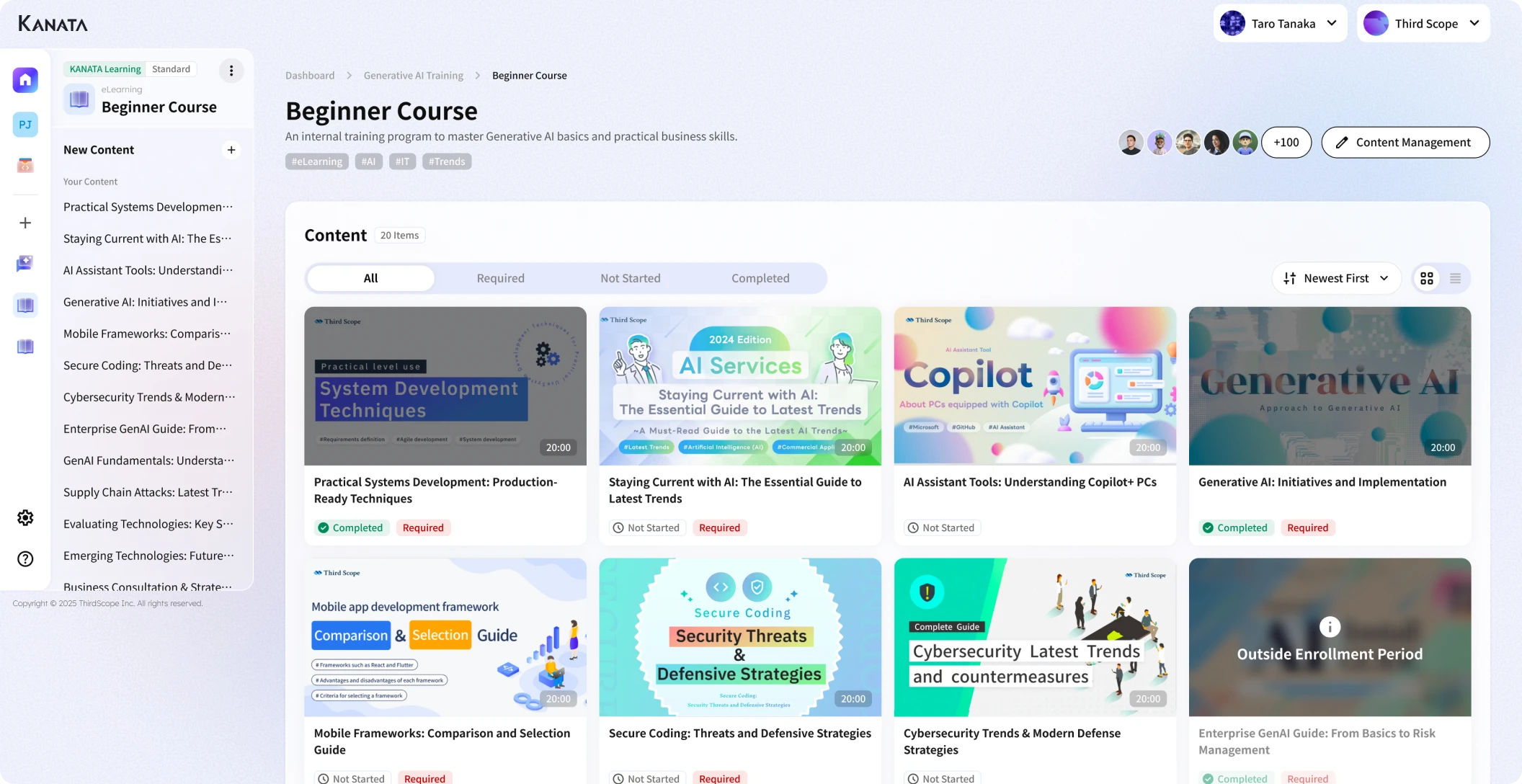
Kanata, with its ability to combine AI chat, e-learning, and project-level knowledge management, has the advantage of making it easy to vary the exercise content for departments such as sales, HR, legal, and information systems. It also suits an approach of running a company-wide foundational course and then drilling deeper into risk scenarios department by department.
That said, whichever tool you use, simply introducing the tool will not embed the training. You need to design the lot as a set: the teaching design, the post-session reflection, the point of contact for queries, permission management, and the operation of log checking.
Accumulate internal rules and case examples
In risk-sensitivity training, it also matters that internal rules and case examples can be referenced repeatedly.
In the knowledge base for training, it is worth organising information such as the following.
- AI usage guidelines
- Information-management regulations
- Personal-data protection rules
- The incident reporting flow
- Department-specific AI usage rules
- Materials for scenario exercises
- Frequently asked questions and answers
- A list of work requiring approval
Organise these and participants can check them when they are in doubt about “what to do in this case.”
That said, where internal regulations or confidential information are involved, you must always check the access-permission and data-management settings. Making every document accessible to everyone, simply because it is convenient, sits at odds with the very aim of risk-sensitivity training.
Put training logs to work for improvement
Once the training has been run, rather than looking only at attendance rates, check which questions caused the most hesitation and which risk scenarios drew the most wrong answers.
For instance, along the following lines.
- Many people hesitate over judgements about personal data
- Many people think AI output can be used as is
- Judgement is weak on cases requiring legal sign-off
- Many people do not know whom to report to when an incident occurs
- People do not take permission management as their own concern
Based on these results, you update the materials and the checklist.
Risk-sensitivity training embeds better by improving it while watching the team’s reactions than by trying to create the perfect material on the first go. I take the view that AI training should be seen not as a “deliverable” but as something “operated.” The material you create first is, at best, a first edition. By taking in the actual questions, hesitations, failures, and near-misses, you grow it into training that fits your own company.
A checklist for running autonomous AI safely

To sharpen risk sensitivity for autonomous AI, you need not only training but a checklist usable in day-to-day work.
The following is a basic checklist that is easy for the team to use.
Before asking the AI
- Is this work within the range it is acceptable to hand to AI?
- Does the information being entered contain personal data, confidential information, or undisclosed information?
- Have you masked things such as customer names, personal names, amounts, and contractual terms?
- Is the internal material the AI references limited to an appropriate range?
- Is this not content requiring specialist sign-off from legal, HR, information systems, and the like?
After the AI has produced output
- Have you checked the proper nouns, figures, dates, and sources?
- Has a human given a final check to anything that leaves the company?
- Are there any over-categorical statements or exaggerated claims?
- Is there any expression that disadvantages customers or employees?
- Are you treating the AI’s output as the final judgement?
Before the AI executes an operation
- Has a human checked what is to be executed?
- Is the approver clear?
- Will an execution log be kept?
- Is there a way to undo a mistaken execution?
- Do you grasp the scope of the impact?
When a judgement is in doubt
- Have you consulted your manager?
- Have you checked with legal, HR, information systems, or the information-security lead?
- Are you able to make the judgement “don’t proceed while still unclear”?
- Have you recorded what you consulted on and the resulting judgement?
This checklist will not apply to every company as it stands. Adjust it to your own work, regulations, the AI tools you use, and your contractual terms with customers.
When I put this across on the ground, I make a point of saying not “stop when in doubt” but “make it so you can consult when in doubt.” Merely stopping does not get the work done. With a clear point of contact, the team can carry on using AI with confidence.
Failures to avoid in risk-sensitivity training

When designing risk-sensitivity training, you also need to watch out for some common failures.
Conveying nothing but prohibitions
Training that conveys only “don’t enter,” “don’t use,” and “don’t send” becomes hard for the team to work with.
Prohibitions are needed, of course. But on their own, the team is left unclear about “so what, in the end, may I use?”
In training, alongside the prohibitions, it matters to show the range within which things can safely be used.
For instance, rather than only “don’t enter the customer name,” showing “you can consult the AI if you replace the customer name with the industry, company size, and job title” makes it easier for the team to take into their actual work.
When I support AI adoption, I place as much weight on a list of “use cases that can be done safely” as on the list of prohibitions. People cannot move when handed only the things they cannot do. Once the outline of what they can do comes into view, they start to find their own ways.
Teaching everyone the same content alone
A common course is needed, but on its own it cannot address the risks specific to each department.
Executives, the head of IT, the heads of marketing and sales, legal, HR, and frontline staff each have different risks they should be watching.
An effective design covers, in the common part, the basic risk sensitivity all employees should hold, and then supplements it by role and by department.
For instance, for executives you go deeper into investment decisions and the governance structure; for the head of IT, into permission management and log design; and for the heads of marketing and sales, into the risks around customer data and advertising claims.
Risk wears a different face on each part of the ground. Even the same act of “entering customer information into the AI” means something different in sales, customer success, marketing, and legal. That is exactly why you need to level the common vocabulary and then bring it down to each department’s judgement.
No operations after the training
Even if you deliver the training, unless it is reflected in the subsequent workflow, behaviour on the ground will not change.
You need to connect it through to the AI usage rules, the approval flow, the checklist, the prompt templates, log checking, and the incident reporting flow.
Autonomous AI, in particular, is an area where the scope of use readily widens after adoption. Uses not envisaged at the outset can emerge on the ground.
For that reason, it also matters to review the training content periodically.
As far as I can see, the more firmly a company has embedded its AI use, the less it treats training as a one-off event. They keep up, in small ways, a monthly reflection, updates to the internal FAQ, improvements to prompts, and a stock-take of permissions. It is unglamorous, but it is precisely this unglamorous operation that underpins the safety of AI use.
In summary: risk sensitivity is not the power to stop AI but the power to entrust it safely

The further the use of autonomous AI advances, the more new risks arise for a company.
But stop using AI on the grounds of those risks, and you also narrow the scope for improving the work and lifting productivity.
What is needed is neither believing in AI unconditionally nor fearing it excessively.
It is to create a state in which the team can judge what may be entrusted to AI, what must not be, what to check before entrusting it, and what to report when something goes wrong.
For that, rather than leaving risk-sensitivity training as a mere part of AI security training or AI ethics training, you need to place it at the heart of AI governance education.
Raise the team’s judgement through scenario exercises, build the rules on permission management and data protection into the work, and put in place even the mechanism for post-incident review. Only then is the foundation laid for running autonomous AI safely.
A service that can combine e-learning, AI chat, and project-level knowledge management, as Kanata does, is one option for running training on an ongoing basis. That said, introducing a tool will not, in itself, sharpen risk sensitivity. It matters to design, together, the materials suited to the work on the ground, the judgement criteria, the support structure, and the mechanism for review.
To my mind, the essence of AI adoption is not “doing away with people’s jobs” but “creating an environment in which people can judge better.” It is precisely because we are in an age of AI acting autonomously that the human side’s judgement, accountability, and courage to stop are put to the test.
An organisation that can use autonomous AI safely is not one that does not use AI. It is one that draws on AI’s strengths while, where needed, a human stops it, checks it, and can explain it.
Q&A: common questions on risk-sensitivity training for autonomous AI
What is the difference between risk-sensitivity training and AI security training?
AI security training puts the weight on safety management — data breaches, account management, access permissions, the use of external tools, and so on. Risk-sensitivity training, by contrast, develops the ability to judge, in situations where the team uses autonomous AI, “what may be entrusted to AI,” “where a human should check,” and “whom to consult.” The two are not separate things; it helps to think of risk-sensitivity training as AI security training extended to the level of practical judgement.
When using autonomous AI, what is the risk to watch most closely?
If it must be narrowed to one, it is vagueness about permissions and the scope of execution. If the AI is used while it remains unclear which information it can reference and which operations it can execute, that leads to data breaches, mis-sends, missed approvals, and a blurring of where responsibility lies. What matters is to design not only the AI’s capabilities but under whose authority it executes what.
Is it enough to deliver the same training content to all employees?
A common course is needed, but it is not enough on its own. For all employees, you cover the basics — prohibited input information, output checking, points of contact, incident reporting. On top of that, it is realistic to add risk scenarios department by department, for sales, HR, legal, information systems, marketing, and so on, since the information handled and the way AI is used differ from one department to the next.
If a human checks the AI’s output, can the risk be prevented?
Human checking is important, but it is not necessarily enough on its own. Unless the checker understands the points they ought to be looking at, they may wave through natural-sounding prose and plausible-looking judgements as they are. In addition to output checking, you need to combine the management of input information, the scope of referenced data, execution permissions, the approval flow, and log management.
Is it enough to deliver risk-sensitivity training once?
A single training session is not enough. The scope of autonomous AI use often widens after adoption. After the training, you need to update the materials and the checklist on the basis of near-misses, questions from the ground, examples of wrong answers, and each department’s usage. A practice of reviewing it at least quarterly — and whenever the scope of AI use changes substantially, on each such occasion — is desirable.