

I end up correcting everything the AI drafts myself. There’s not much point delegating it if that’s how it works out.
These are the words of Mr Takada (not his real name), a departmental manager in the sales planning division responsible for AI agent operations. Six months ago, his team began delegating tasks such as preparing materials and organising notes after client meetings to an AI agent. However, staff could not fully trust its output, so they kept checking it on Slack, and Takada ultimately ended up redoing much of the work himself. Sales staff, planning team members and the information systems department each saw the situation slightly differently, but the debate tended to come down to a simple choice: leave the work entirely to the AI agent, or have people take it back over.
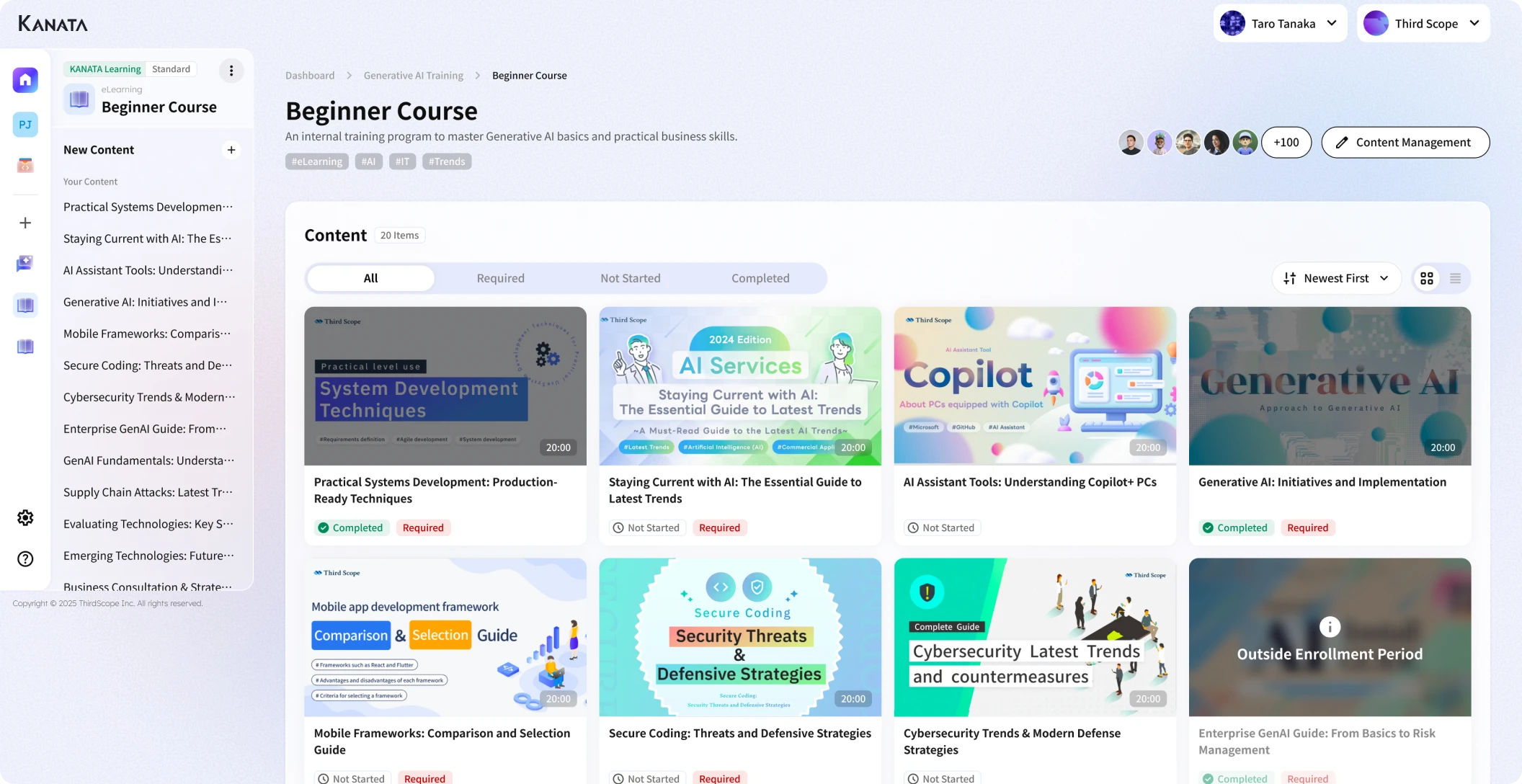
The team has now moved to an approach in which, for each task, they set the objective, decide how much authority to delegate, define how to monitor the work and clarify when to intervene, checking the division of responsibility between the AI and people before each meeting. For example, using an environment such as Kanata, provided by our company, where AI chat, AI summarisation, e-learning and a library of training data can be managed by project, allows teams to reuse prompts and reference materials, helping to standardise the way an AI agent is used.
This article sets out the AI supervision role required of AI agent managers, looking at operational oversight, feedback and decisions on when to intervene. The aim is a state in which AI is neither left unsupervised nor over-managed by people, so that the team can direct effective collaboration between humans and AI. However, training and new tools alone will not change everything. Only operating rules, a clear division of responsibility and ongoing review turn this into a practical capability for management in the age of AI.
How is the manager’s role changing in the age of AI agents?

An AI agent is an AI system that does more than answer a single question: it plans a sequence of steps towards a given objective and carries out multiple tasks. Companies are considering using AI agents for tasks such as producing first drafts of documents, summarising meeting minutes, handling initial responses to internal enquiries, preparing for sales activities and drafting reports.
Once AI agents take on some of this work, it is often assumed that managers will have less to do. It is true that certain tasks, such as drafting text, organising information and producing standard comparison tables, can more easily be delegated to AI. However, this does not mean that the manager’s role becomes unnecessary. If anything, what needs to be managed expands from “work done by people” to “a business process that combines people and AI”.
Under traditional management, the main role was to check on staff progress, provide support where there were delays and review the quality of deliverables. Once AI agents are introduced, a further set of questions is added to this.
- What should the AI agent be asked to achieve?
- How much decision-making should it be allowed?
- What information should it be allowed to reference?
- Who should check its output?
- If an error is found, how far back should the work be revisited and corrected?
These are issues with too great an impact to leave to frontline staff alone. Managers in the age of AI are responsible not only for checking that work is progressing, but also for designing how roles are divided between AI and people, and for overseeing the business process as a whole.
What is required of AI agent managers is not simply to become someone who can use AI. It is to ensure that work involving AI can be run safely and reproducibly as an organisation.
Where management goes round in circles by leaving everything to AI agents

Workplaces where AI agent adoption is not going well tend to run into similar problems. Three patterns stand out in particular.
Humans do not trust the AI output and redo the work from the beginning
For example, an AI agent may produce an outline for a proposal, only for the manager to feel that it is somehow not right and recreate it from a blank page. In such a case, the time spent using AI is followed by additional time spent revising or redoing the work manually. As a result, the overall working time is not reduced, and staff are left with the impression that there is little point in using AI.
The cause of this problem is not necessarily the performance of the AI alone. Operational issues may also be responsible, such as an unclear explanation of the objective, insufficient reference information or a lack of shared review criteria.
AI is used without clearly defining the scope of delegated authority
Consider an email to a customer. There are several possible levels of responsibility that could be assigned to an AI agent. It might only organise the main points, prepare a draft, check the email before sending or even schedule it for delivery. When these boundaries are not defined before use begins, individual staff members make different judgements.
One employee may use the AI output without changes, while another may seek approval from a manager every time. In this situation, there is no consistent standard for operational oversight.
Managers can only intervene after a problem has occurred
When an AI agent produces an incorrect output, a manager who only reviews the final deliverable cannot identify where the process went wrong. The original instruction may have been unclear, the reference data may have been out of date, or the AI’s decision criteria may not have aligned with the organisation’s operating rules. Unless the cause is identified, the same failure is likely to occur again.
AI supervision does not mean continually distrusting AI outputs. It means creating the conditions in which AI can operate appropriately and ensuring that humans can intervene when necessary.
The basics of AI supervision: setting objectives, delegating authority, monitoring and deciding when to intervene

The role of a manager supervising AI agents can be divided into four main areas: setting objectives, delegating authority, monitoring and deciding when to intervene.
| Responsibility | Main activities | Questions to consider |
|---|---|---|
| Setting objectives | Clarify what the AI is expected to achieve | What is the deliverable for, and who will use it? |
| Delegating authority | Define what the AI can handle and what must be reviewed by a person | How far can the AI proceed, and at what point must a human make the decision? |
| Monitoring | Review not only the deliverable but also the reference information and decision-making process | What information was used, and how was the output produced? |
| Deciding when to intervene | Switch between stopping, returning and delegating work according to the situation | Where has the process deviated enough to require human intervention? |
Setting objectives: deciding what the AI should achieve
Before delegating work to an AI agent, the first thing to define is the objective.
If the instruction is simply ‘Create meeting minutes’, the AI will produce a plausible summary. However, what the manager may actually need is a set of minutes that allows participants to identify agreed actions and unresolved matters immediately at the next meeting. In that case, the objective should be made explicit, for example: ‘Organise the decisions, responsible individuals, deadlines and unresolved matters into separate sections.’
Similarly, rather than saying, ‘Please create a proposal’, the instruction could be defined as: ‘Create an outline that demonstrates our understanding of the customer’s challenges after the initial meeting and presents the direction of the next proposal.’ This brings the AI output closer to the actual business objective.
Managers must decide more than what the AI should produce. They should also clarify why it is being produced, who will use it and what decision it will support.
Delegating authority: deciding how much responsibility to give the AI
The next requirement is to design the scope of delegated authority.
The level of responsibility assigned to an AI agent should vary according to the risk of the task. For internal note-taking, it may be acceptable to use the AI output as an initial draft for team discussion. By contrast, formal responses to customers, contractual terms and documents relating to recruitment or employee assessment should normally require human review.
When considering delegated authority, it is helpful to divide the process into stages.
- The AI organises information
- The AI proposes options
- The AI prepares a draft
- The AI prepares the work up to the point immediately before execution
- The AI carries out the action
Most organisations do not need to allow AI to carry out actions from the outset. A more realistic approach is to begin with information organisation and drafting, then expand the scope of delegated authority once an appropriate review system is in place.
Monitoring: reviewing the process, not only the deliverable
When supervising AI agents, it is important to review the process rather than looking only at the final deliverable.
Which data did the AI reference? Which instructions formed the basis of its decisions? Which parts were filled in through inference? What did it leave marked as requiring confirmation? Making this information available makes it easier to improve the quality of future outputs.
For example, where prompts and reference materials can be stored in a shared AI environment, teams can retain the instructions that produced strong outputs, the conditions that led to failures and the feedback used to correct them. This converts individual experimentation into a shared team asset. Tools such as Kanata, provided by our company, which allow AI chat, summarisation and learning data to be managed by project, are well suited to this type of reuse and standardisation. However, similar operating models can also be designed using other AI platforms or internal knowledge-management tools.
The important point is not the introduction of any particular tool. It is to create a situation in which prompts, reference materials, review criteria and correction policies can be shared by the team.
Intervention: switching between stopping, returning and delegating
The manager’s judgement is most clearly demonstrated in decisions about when and how to intervene in the use of an AI agent.
When an AI output appears inappropriate, there is no need for a person to take over the entire task immediately. If the AI has misunderstood the objective, the process should be returned to the original instruction. If the reference data is insufficient, additional information should be provided. If only the expression or wording is unsuitable, it may be enough to specify the audience and tone and regenerate the output. If the content contains factual errors, a person should verify the information and, where necessary, narrow the scope in which the AI is allowed to operate.
Intervention does not only mean stopping the AI. It also includes correcting its course and returning it to an appropriate direction.
The division of responsibility that makes human–AI collaboration work

In organisations that have introduced AI agents, confusion is often caused by an unclear division of responsibility.
Because the AI produced it
I assumed the person in charge had checked it
I assumed the manager would review it
Where this kind of mismatch in assumptions exists, using an AI agent becomes a source of risk rather than a benefit.
Making human-AI collaboration work requires at least the following three areas of responsibility to be considered separately.
- Responsibility for inputs
- This is the responsibility for deciding what information may be provided to the AI agent and what information must not be provided. When personal data, confidential information or unpublished information is involved, masking requirements and permitted uses should be confirmed in advance.
- Responsibility for decisions
- This is the responsibility for deciding whether to adopt an AI recommendation. AI can present options, but a person must decide whether a particular choice is consistent with organisational policy, customer relationships and legal or security requirements.
- Accountability
- This is the responsibility for ensuring that someone can explain documents or answers produced with the involvement of AI. Whether in an internal meeting or in communication with a customer, ‘because the AI said so’ is not an acceptable explanation. Ultimately, the member of staff or manager responsible must be able to explain the decision in their own words.
By documenting this division of responsibility, the use of AI agents moves away from reliance on individual judgement and becomes part of an organisational approach to operational oversight.
What AI agent training should cover

Training on how to use AI agents tends to focus on how to write prompts and how to operate the tools. These points are, of course, important. However, what managers need goes beyond simple operational skills.
Advanced reskilling for managers needs to cover the following areas.
Separating work that can be delegated to AI from work that should remain with people
Rather than delegating an entire business process to AI, the work should be divided into stages such as organising information, generating ideas, drafting, reviewing and execution. Managers can then decide which stages should involve AI.
Learning how to provide effective feedback
When an AI agent produces an output that differs from expectations, it is not enough to dismiss it as ‘wrong’ or ‘unusable’. Managers need to explain specifically what is missing. Is the objective incorrect? Is the intended audience different? Is information missing? Are the decision criteria unclear? Managers who can break feedback down in this way are better placed to improve the quality of AI use.
Sharing failures and using them to improve operations
An AI agent may produce an incorrect summary, refer to out-of-date information or generate wording that is inappropriate for a customer. Rather than concealing such cases, organisations should share them within the team and convert them into rules that help prevent recurrence.
Discussions concerning AI governance since 2025 have also emphasised that managing AI risk involves not only technical measures but also organisational oversight, operating processes and accountability. Useful references include the NIST AI Risk Management Framework, the OECD AI Action Summit 2025 and McKinsey’s The State of AI.
Training should not be treated as a one-off exercise. By turning practical decisions, failures and improvements into training materials and updating them continuously, organisations can embed AI supervision skills into everyday operations.
Operating rules that turn oversight into a system

When using AI agents, it is risky to rely solely on the efforts of individual managers. What is needed is to turn operational oversight into a system.
For example, teams can build the following checks into their regular meetings.
- Which tasks used an AI agent
- How much of the work was delegated to the AI
- What points a person checked
- If there was a problem with the output, what caused it
- How prompts or training data should be revised next time
Maintaining checks like these turns the use of AI into a team-wide improvement activity, rather than something that depends on individual effort.
It is also useful to keep a record of “AI-related decisions” in Slack or meeting minutes. Not everything needs to be recorded in detail, but for important tasks it helps to note down why an AI suggestion was adopted or rejected, and the points a person corrected, making it easier to review the decision later.
That said, adding too many rules will discourage staff from following them. Oversight rules for AI agents need to strike a balance between rigour and ease of use.
Pitfalls managers should avoid in the age of AI

There are three main pitfalls that managers supervising AI agents should avoid.
Treating AI too much like a subordinate
AI agents may appear to operate autonomously, but they do not understand context completely in the way that people do. They may not correctly interpret unspoken assumptions, internal organisational politics or the history of a customer relationship. Managing a human subordinate and supervising an AI agent have some similarities, but they are not the same.
Leaving AI unsupervised as though it were a fully automated tool
If managers assume that everything will be fine because the AI will handle the work and omit reviews of the output or process, incorrect information may be circulated without being detected. Human review should remain in place, particularly for customer communication, contracts, recruitment, assessment, finance and security.
Holding individual staff members solely responsible for AI failures
When an AI agent produces an incorrect output, blaming the individual employee by asking why they failed to check it may cause staff to conceal future failures involving AI. Managers should instead examine whether the original instruction was unclear, the reference data was out of date or the review criteria had not been shared properly.
Managers in the age of AI must avoid treating failures purely as individual responsibility and instead use them to improve the operating model.
Summary: supervising AI agents means designing how work is delegated

The role of a manager supervising AI agents is not to keep distrusting AI. It is to set the objective for what is delegated to AI, decide the scope of delegated authority, monitor the process and intervene at the right moments.
In the age of AI-enabled management, managers are changing from “people who manage other people’s work” into “people who design collaboration between humans and AI”.
AI agents are a powerful means of making work more efficient. However, they are not a cure-all. If the objective is unclear, the output will be unclear too. Without a clear division of responsibility, trouble leads to confusion. Without monitoring, the same mistakes are repeated.
This is precisely why managers need not only the skills to use AI, but also the skills to supervise it.
There is no need to try to change every task straight away. It is more realistic to start with lower-risk work, such as minutes from regular meetings, drafts of internal documents and the initial handling of enquiries. Building on this, putting objective-setting, delegated authority, monitoring and decisions on intervention into words as a team is the first step towards AI agent training and advanced reskilling.
Q&A: the role of a manager supervising AI agents
Will introducing AI agents reduce the amount of work managers have to do?
The burden of reviewing certain tasks or preparing initial drafts may be reduced. However, the manager’s role will not disappear. It becomes increasingly important to decide what should be delegated to AI, how much decision-making authority it should have and who should carry out the final review.
How should organisations distinguish between work that can and cannot be delegated to AI agents?
A practical approach is to begin with tasks that are easy to revise and have a limited impact, such as organising information, producing summaries, preparing drafts and creating comparison tables. By contrast, formal customer responses and decisions relating to contracts, recruitment, assessment, finance or security should continue to involve human review.
How should a manager respond when an AI output does not meet expectations?
Rather than immediately redoing the entire task manually, the manager should identify the cause of the difference. Was the objective unclear? Was the reference data insufficient? Was the output format inappropriate? The manager can then choose an intervention, such as revising the instruction, providing additional information or returning the decision to a human-controlled stage.
What should employees learn through AI agent training?
Training should cover more than prompt writing. It should include objective setting, delegated authority, monitoring, intervention and methods of providing feedback. Managers in particular must learn not only how to use AI themselves but also how to supervise its use across the team.
What is required to embed the use of AI agents across a team?
Teams should begin with small tasks and share the prompts, reference materials, revisions and examples of failure that emerge from their work. It is also helpful to establish basic rules, such as requiring human review for anything used externally, checking figures and proper nouns against original sources and ensuring that the person responsible can explain any AI-assisted content.