

It’s genuinely helpful that the AI tidies up my meeting notes, but in the end it’s still me typing everything into the CRM.
That was Saeki, who runs sales operations at a B2B firm, speaking at the Monday morning sales meeting. Nakamura from marketing, glancing at the lead scores in the MA platform, muttered that “the link between email engagement and deals actually progressing just isn’t visible,” while Yamashita from IT was up to his neck dealing with sync errors between the CRM and the SFA.
Previously, although the AI was trusted to draft meeting minutes and email copy, updating the CRM, SFA and MA still depended on people keying it in by hand. Data on leads, deals, email campaigns and scenarios sat in separate silos: sales watched “the deal as it stands now,” marketing watched “how leads were responding,” and IT watched “consistency between the systems.”
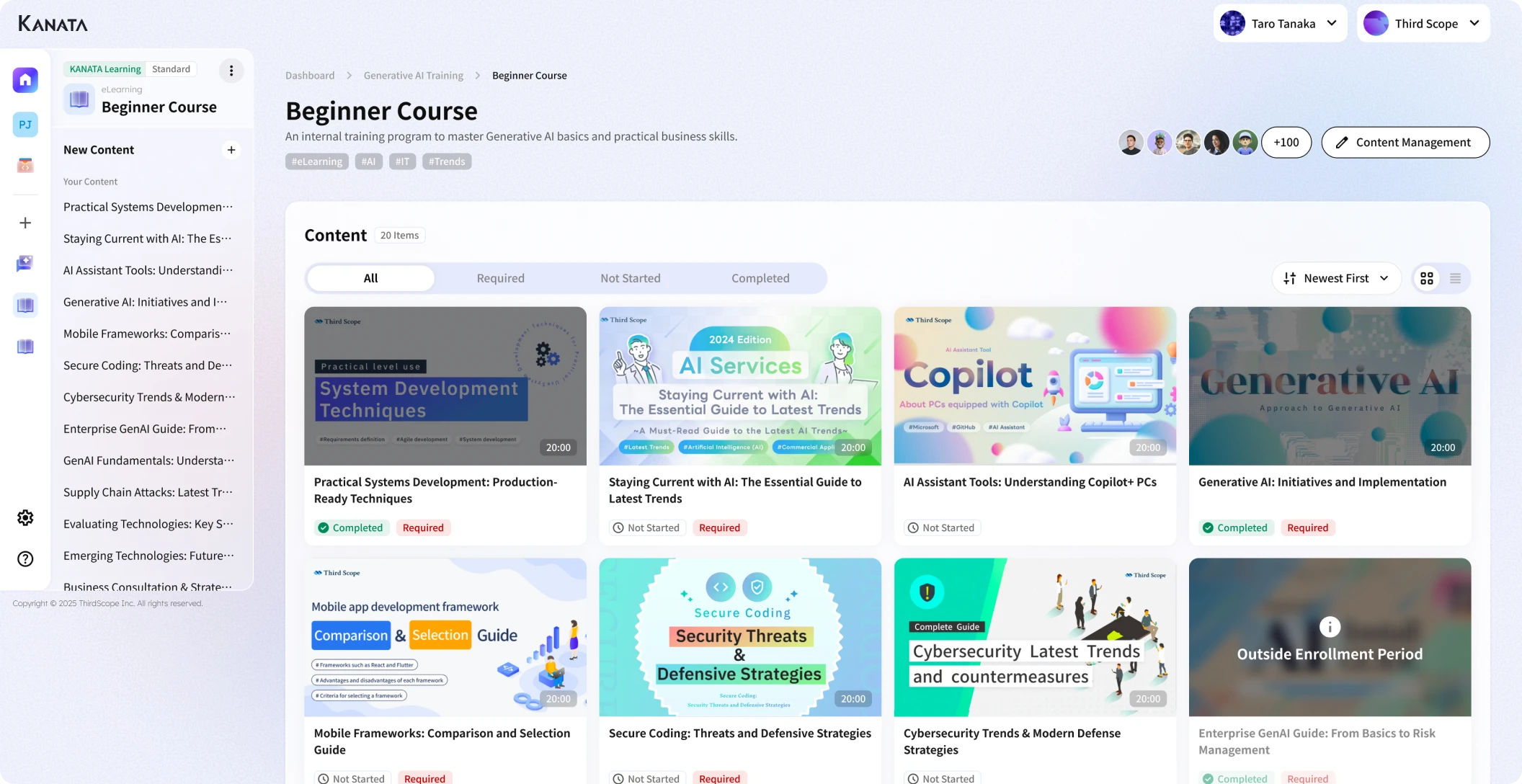
Today, a design in which an AI agent supports the whole sweep of work, from summarising meetings to proposing field updates, suggesting next actions and even recommending revisions to MA scenarios, is becoming a realistic option. Use a work-support platform such as Kanata, which lets you handle AI chat, AI summarisation and a learning-data library on a per-project basis, and the operational know-how and prompts used across sales and marketing become far easier to reuse.
This article is for companies weighing up AI agent CRM integration, SFA AI integration and MA AI integration, and it sets out which data to read, which operations to permit, and where a human ought to check. The aim is a state in which staff are not forever buried in data entry and transcription, and can instead spend their time on customers and decisions. That said, an AI agent is no panacea. Only once you have permission design, tidy data and operating rules for the exceptions will sales AI automation and marketing AI automation actually take root on the ground.
What it means to connect an AI agent to your CRM, SFA and MA

Connecting an AI agent to your CRM, SFA and MA is about rather more than having the AI write a sales email or summarise a set of meeting notes.
The CRM holds customer information. The SFA holds deals, opportunities and activity history. The MA holds lead behaviour, email campaigns, scores and scenarios. Creating a state in which an AI agent can reference all of this, propose updates where needed, and under the right conditions even help carry out the work, is what we mean here by integration.
For instance, once a salesperson finishes a meeting, the AI agent reads the recording or notes and pulls together a meeting summary, the customer’s issues, the next actions and any change in deal confidence. It then drafts how that ought to be reflected in the SFA’s activity log and deal fields, and the salesperson reviews it and signs it off.
At the same time, on the marketing side, you consider whether the interests surfaced in that meeting should feed into MA segments or scenarios. If a lead has viewed a particular document, clicked an email and turned into a deal, you can imagine the AI agent proposing something like, “shouldn’t this lead be switched from the existing scenario to priority sales follow-up?”
In short, AI agent CRM integration is not about treating CRM, SFA and MA as separate tools, but about designing them as a single operating environment that joins up your understanding of the customer.
Why CRM, SFA and MA integration becomes a sticking point

In the early days of adopting AI, most companies start with writing, summarising, meeting minutes and email drafts. That is a natural place to begin. The benefits are easy to feel on the ground, and the barrier to getting started is comparatively low.
In sales and marketing, though, you tend to hit a wall at the next stage.
- The AI produces a summary, yet the CRM still has to be filled in by hand.
- The AI drafts the email copy, but a person still sets the MA distribution conditions.
- The AI distils the temperature of a deal, yet the confidence and phase in the SFA go un-updated.
- The AI infers what a lead is interested in, but nothing progresses as far as notifying a salesperson or creating a task.
In this state, the AI may be “a tool that helps with the work,” but it struggles to become “a mechanism that moves the work forward.”
With conventional AI use, the AI’s output stopped inside a chat window or a document. What will be asked of us from here on is to connect that output to the operational data in the CRM, SFA and MA, and turn it into the next action.
First, work out which tasks you want it to carry out

The first thing to think about in AI agent integration is not which tools to connect. What you should consider first is which tasks you want the AI agent to support.
CRM, SFA and MA hold a great deal of data. But the moment you try to have the AI read all of it and update all of it, the design quickly becomes unwieldy.
At the start, carving things out task by task is the realistic approach.
Drafting the post-meeting SFA update
From meeting notes or minutes, it drafts proposed changes to the activity history, the issues, the next action and the deal phase. Rather than having the AI update things directly, the safe pattern is to first show the salesperson a review screen and apply the change only after sign-off.
Proposing lead priorities
Drawing on behavioural history in the MA, document views, email clicks and enquiry content, it surfaces the leads sales should attend to first. Here the AI’s role is to assist judgement. The final calls on whether to ring, convert to a deal or keep nurturing rest with sales and marketing.
Drafting improvements to email scenarios
Based on MA campaign results, it puts forward suggested improvements to subject lines, body copy, segments, send timing and the next scenario. Because the actual send configuration carries the risk of mis-sent campaigns, this is an area where human sign-off should be mandatory.
Surfacing candidates for tidying up CRM data
It detects company names, department names, job titles, statuses, duplicate records and blank fields, and proposes corrections. Tidying data is unglamorous work, but it is the foundation that determines how accurate AI agent integration will be.
In this way, the tasks you hand to an AI agent need to be broken down into “read,” “organise,” “propose,” “draft,” “update” and “notify.”
For CRM integration, the priority is aligning what the customer data actually means

The single most important thing in AI agent CRM integration is to align what the data sitting in the CRM actually means.
Take the very same status of “under consideration”: it can mean different things to different salespeople. To one, it might mean “I should be able to put a proposal together next month.” To another, it might mean “they made a single enquiry, nothing more.” A marketer might read it as “a lead with strong email engagement,” while the leadership might see it as “an opportunity close to becoming forecast revenue.”
When the meaning of a data field varies by department or by individual like this, the AI agent cannot make stable judgements either.
Before connecting an AI agent to the CRM, you need to define at least the following.
- What does a customer status actually signify?
- At what point does a lead become a deal?
- At what level of detail are lost-deal reasons recorded?
- What information should be handed over when an account owner changes?
- What information may the AI reference, and what should it not see?
- Where are the update and approval histories kept?
A CRM is not merely a contact list. It is the foundation on which sales, marketing, customer success and leadership all come to understand the same customer. If you are going to connect an AI agent, aligning “what the customer data means” is the indispensable precondition.
For SFA AI integration, design the proposed update before the update itself

A common misstep in SFA AI integration is to let the AI go straight in and update deal information.
It would be handy if an AI agent could read the meeting notes and automatically update the phase, confidence, next action, competitor details and customer issues. But SFA information also feeds sales forecasts and management decisions. A faulty update has consequences not only on the sales floor but in management and board meetings too.
For that reason, the initial design should begin not with “automatic updates” but with “proposed updates.”
For instance, the AI agent might put forward proposals such as these.
- The deal phase is a candidate to move from “initial meeting” to “proposal preparation,” because the customer has asked to be shown proposal materials next time.
- The next action is to “send a rough quote and an implementation schedule within five business days.”
- As lost-deal risks, “the decision-maker was not present” and “the budget timing is unconfirmed” both remain.
- Among the SFA’s required fields, “competitor” and “desired implementation date” are blank.
Set things up so that the AI offers its proposed update with the reasoning attached, and a human approves it, and confidence on the ground grows considerably.
With SFA AI integration, it is vital to design not only what you have the AI do, but at the same time where the human checks the work.
For MA AI integration, don’t leave the scenarios entirely to the AI

In MA AI integration, an AI agent can work with a great deal of behavioural data: lead scores, email opens, clicks, document downloads, webinar attendance, form submissions and the like.
On the strength of that data, the AI can propose “which leads to hand to sales,” “which email to send next” and “which segment to sort them into.”
The MA area, however, comes with a caveat. Email campaigns bear directly on the customer experience. Leave scenario changes too much to the AI and you risk over-sending, mis-sending and follow-ups that simply don’t fit the context.
For example: a customer already in active talks with sales is sent the step email meant for first-time enquiries. A company you have already lost is sent a campaign email aimed at prospects still deciding. An existing customer is sent a discount campaign meant for new business.
Situations like these affect not just marketing but sales and customer success as well.
For that reason, MA AI integration calls for a design along the following lines.
- Rather than changing the distribution scenario directly, the AI puts forward suggested improvements.
- Before sending, a person checks the target segment and the copy.
- Existing customers, active deals, lost deals, competitors and those who have opted out are clearly set as exclusion conditions.
- The AI analyses the response after sending and feeds it into the next round of suggested improvements.
- Any campaign that needs review on legal, brand or data-protection grounds is built into the approval flow.
What matters in marketing AI automation is not sending more. It is delivering communications that suit the customer’s situation, at the right moment.
To work across CRM, SFA and MA you need a common ID and sync rules

For an AI agent to handle the CRM, SFA and MA across the board, the systems need to be able to identify the same customer or lead.
This is where a common ID and sync rules come into play.
If the same company is registered as “ABC Corporation” in the CRM, “ABC Co.” in the SFA and “abc.co.jp” in the MA, a human can guess they are the same company. In a system integration, though, those variations in notation become a source of sync errors and duplicates. There are cases where an AI agent can fill the gap by inference, but when it comes to updating customer data or deciding who to send to, a design that leans too heavily on guesswork is best avoided.
In particular, the following data needs to be put in order.
- Company name
- Domain
- Contact email address
- Lead ID
- Account ID
- Deal ID
- Contact ID in the MA
- Sales owner ID
Sync timing matters too.
Do you sync in real time? Once an hour? Is a single daily batch enough? Who is notified when there is an error? Do you give priority to manual correction or to automatic correction?
A sync error is not merely a system glitch. It is what causes sales to ring a customer off the back of stale information, or marketing to send to the wrong segment.
When you think about AI agent integration, you must always check not only “is the AI clever” but “is the data the AI references in good order.”
Grant an AI agent’s permissions in stages

When connecting an AI agent to the CRM, SFA and MA, permissions are the thing to design with real care.
Our recommendation is to split permissions into the following four stages.
- Read permission
- The permission for the AI agent merely to read data. It can reference customer information, deal history, email responses, past activity logs and so on. For an initial rollout, starting from this read-only permission is the safe course.
- Proposal permission
- The permission for the AI agent to draft proposed updates and next actions. For instance, it can put forward candidate changes to the deal phase, suggested MA scenario improvements, draft email copy and lead priorities.
- Draft-creation permission
- The permission for the AI agent to create drafts, or data in a pending-approval state, within the CRM, SFA and MA. Nothing is yet committed to production. It is reflected only once a person has reviewed and approved it.
- Execution permission
- The permission for the AI agent to actually update data, send notifications or change email-campaign settings. This permission needs to be handled with care.
There is no need to grant every AI agent execution permission. For a good many tasks, “read,” “propose” and “draft-creation” are quite enough.
In particular, sales forecasts, contract values, distribution targets, personal data, deal phases and lost-deal reasons are best designed so that a human sign-off sits in the way, rather than letting the AI change them directly. This is not to slow efficiency down; it is to keep the boundaries of operational responsibility clear.
The operating environment AI agent integration requires

To build an AI agent into day-to-day work, a chat window alone is sometimes not enough.
AI chat is useful, of course. You can carry out a great many tasks conversationally: writing, research, sounding out ideas, summarising. With a tool such as Kanata that lets you handle AI chat and AI summarisation on a per-project basis, it lends itself well to the routine work of sales and marketing.
For CRM, SFA and MA integration, however, you need not only to “converse with the AI” but an operating environment in which you can see “what the AI is proposing and what it is about to carry out.”
Concretely, things run more smoothly with screens and mechanisms such as these.
- A list of the update proposals the AI has created
- A list of tasks awaiting approval
- A history of who approved what
- The sources of the data the AI referenced
- The difference between before and after an update
- Notifications of sync errors
- A record of the reasons for any rejection
- A searchable execution log
What matters above all is not turning the AI’s judgement into a black box.
Why did it judge this lead should be prioritised? Why did it make this a candidate to advance the deal phase? Why did it propose changing this email scenario?
If those reasons are not visible, the people on the ground cannot use it with confidence. An AI agent’s operating environment should be designed not as a place to receive the AI’s output, but as a place where people and AI move the work forward together.
How to think about it if you are using Kanata

As you progress with CRM, SFA and MA integration, one particular tool is not necessarily the only right answer. There are several options: your existing CRM, SFA, MA, BI, iPaaS, internal workflows, chat tools and more.
On that footing, if you do use a work-support platform such as Kanata, it lends itself well, as a stage that comes before CRM, SFA and MA integration, to organising the knowledge of your sales and marketing work.
In Kanata you can add apps such as AI chat, AI summarisation and e-learning on a per-project basis, and manage prompts and learning data as a library. In sales and marketing, it is well suited to designing use cases such as organising customer profiles, drafting proposals, extracting next actions from meeting notes, creating content and building customer playbooks.
For instance, you might set up a library like the following on a sales-department project.
- A meeting-summary prompt
- A summary prompt for transcribing into the SFA
- Rules for classifying lost-deal reasons
- A list of customer issues by industry
- Rules on the tone of email replies
- Checklist items for when MA scenarios are revised
- Definitions of sales terminology and statuses
Put these in order and it becomes easier to align the criteria for business judgement before the AI agent ever operates the CRM, SFA or MA.
The point of using Kanata is not merely to ask the AI questions. It is to accumulate the criteria by which sales and marketing decisions are made, and to create a state in which an AI agent can readily support the work.
Start small with the rollout and widen permissions over time

Try to roll out the integration of an AI agent with your CRM, SFA and MA all at once and you are liable to come unstuck.
Our recommendation is the following order.
-
Narrow to a single target task
At first, narrow to one task, such as “drafting the post-meeting SFA update” or “proposing lead priorities.” For both sales AI automation and marketing AI automation, the key is not to spread yourself too thin at the outset.
-
Limit the data you let the AI read
Have the AI reference only the data it needs, such as meeting notes, activity history, lead scores and email responses. Take care not to include unnecessary personal or confidential information.
-
Fix the output format
If the AI’s output differs every time, reflecting it into the CRM, SFA and MA becomes difficult. Fix the output format, with a meeting summary, next actions, candidate updates, points to check and so on.
-
Insert a human sign-off
In the early stage, build a flow in which a person reviews and approves rather than the AI updating directly. To earn the trust of those on the ground, this step is indispensable.
-
Watch the logs and improve
Check how often the AI’s proposals were adopted, where they were sent back, and which fields had the most errors. Use those logs to improve your prompts, data definitions and permission design.
-
Widen the target tasks
Once you can run it reliably, widen it to post-meeting follow-up, MA scenario improvement, tidying CRM data, drafting sales reports and the like.
AI agent integration is not about aiming for full automation from the off. It is something you build by accumulating trust on small tasks and gradually widening the range you delegate.
Common pitfalls and how to avoid them

- Putting off tidying the data
-
An AI agent makes its judgements on the basis of the data entered. Leave the entry rules in the CRM and SFA vague and the AI’s output will be unstable too.
The way round it is to align a minimum set of field definitions before integrating. Statuses, phases, lost-deal reasons, lead classifications, deal confidence and the like need to have their meaning agreed across sales, marketing and IT.
- Granting the AI too much execution permission
-
Hand the AI too much, such as CRM updates or changes to MA campaign settings, just because it is convenient, and the risk of mistaken updates and mis-sent campaigns climbs.
The way round it is to widen permissions in stages. Begin with read and propose, and move on to draft-creation and partial execution while keeping an eye on the logs and the accuracy.
- The checking burden on the ground grows
-
Too many proposals from the AI and the checking burden on salespeople and marketers grows. The upshot is that people decide “it’s quicker to do it myself.”
The way round it is to narrow the conditions under which the AI proposes. Rather than proposing on every deal, limit it to deals with blank fields, deals with a high likelihood of a phase change, leads above a certain score and so on.
- AI operation splinters by department
-
When sales look only at the SFA, marketing only at the MA and IT only at the sync errors, the value of AI agent integration is limited.
The way round it is to set up shared data definitions and an operating review. You need a structure in which sales, marketing and IT can improve while looking at the same metrics and the same customer states.
Pre-implementation checklist

Before integrating an AI agent with your CRM, SFA and MA, do check the following.
- Are the IDs that identify customers and leads aligned across the CRM, SFA and MA?
- Do the definitions of deal phases and lead statuses match across departments?
- Are the data the AI may reference and the data it should not separated?
- Have you decided which fields the AI may update and which need a human sign-off?
- Have you decided who is notified when a sync error occurs?
- Are the MA campaign exclusion conditions clear?
- Is there a screen or flow by which salespeople review the AI’s proposals?
- Have you decided who reviews the AI’s output logs?
- Is there a process for updating prompts and business rules?
- Do those on the ground understand “the work to delegate to the AI” and “the work a human decides”?
If a good many items on this checklist are still unsorted, it is safer to hold off going straight to execution permission. We would suggest starting with summarising, proposing and draft-creation first.
In summary

The point of connecting a work-executing AI agent to your CRM, SFA and MA is not simply to cut down on data entry.
It is to join up leads, deals, email campaigns, scenarios and activity history, and to create a state in which sales and marketing can act on the same understanding of the customer.
To get there, you need to design with care what you have the AI read, what you have it propose, what you have it update, and where a human checks.
An AI agent holds the potential to move work forward across the CRM, SFA and MA. But without tidy data, permission design, sync rules and approval flows, it can just as easily add to the confusion.
Begin with one task, one set of data and one approval flow. Widening sales AI automation and marketing AI automation a little at a time from there is the shortest route to an AI agent foundation that takes root on the ground.
Q&A
What is the first step in connecting an AI agent to my CRM, SFA and MA?
It is to narrow to a single target task. Start with something whose scope is clear and whose benefit and risk are easy to gauge, such as “drafting the post-meeting SFA update,” “proposing lead priorities” or “detecting blank fields in CRM data,” and operating it becomes more manageable.
Is it acceptable to let an AI agent update the CRM or SFA directly?
In the early stage, beginning with “proposed updates” rather than direct updates is the realistic course. Because deal phases, revenue forecasts, contract values, distribution targets and the like affect business judgement, a design with a human sign-off in the way is preferable.
What should I watch out for in particular with MA AI integration?
Mis-sending and over-sending. It is useful for the AI to put forward improvements to segments and scenarios, but before the actual send a person needs to check the recipients, the exclusion conditions, the copy and the send timing.
What does it take to raise the accuracy of AI agent integration?
Tidy data, first and foremost. If the definitions of customer status, deal phase, lost-deal reasons, lead classifications and so on are not aligned across departments, the AI’s proposals will be unstable too. Before improving prompts, it is important to check the field definitions in the CRM, SFA and MA.
In what situations is Kanata easy to use?
Because Kanata lets you handle AI chat, AI summarisation and a learning-data library on a per-project basis, it is easy to use when you want to accumulate sales and marketing prompts and decision criteria. Rather than replacing the CRM, SFA or MA themselves, it suits the job of organising and reusing business knowledge at the stage before AI agent integration.