

We want to hand things over to the AI, yet in the end someone has to step in every single time and explain how we actually do it here.
Those are the words of Mr Saeki, who had been trialling a task-executing AI agent within the DX promotion division of a manufacturing firm. Six months earlier, the company’s sales, IT, legal and frontline teams each kept their information in separate folders and Slack channels. The AI could manage general answers well enough, but it could not take account of internal rules, client-specific exceptions or the history of past decisions. Whenever they tried to delegate quotation drafting or enquiry handling, the work came straight back: “That judgement is different for Company A,” or “It hasn’t looked at the latest version of the policy.”
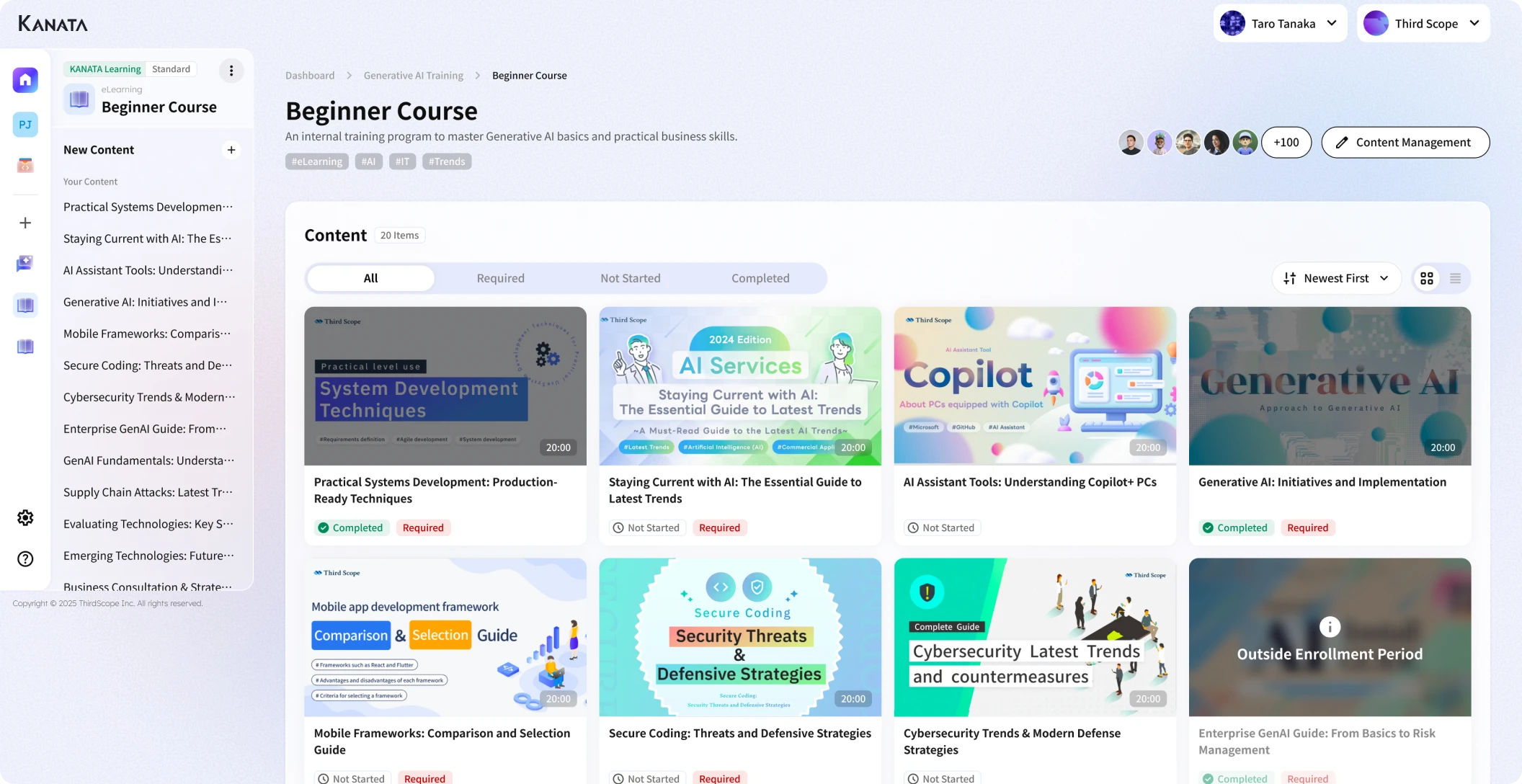
Today the picture is rather different. Over the past three months they have organised roughly 1,200 business documents, tagging each with metadata such as document type, update date, managing department and access rights, and they are close to a state where the AI agent can retrieve the internal knowledge it needs from a RAG environment. With a platform like Kanata, which lets you handle AI chat and learning-data libraries on a per-project basis, you can keep references separate by department or use case and try things out in stages.
This article is for organisations that want to build a task-executing AI agent RAG setup. As a shared, foundational piece, it walks through how to build a knowledge base for AI, how to design vector search, how to manage freshness, and which evaluation metrics to watch. The aim is a state in which the AI assists with work while checking your organisation’s own assumptions, rather than trotting out generalities. That said, RAG design alone will not automate every decision. Read on with your own operation in mind, taking in document preparation, permission design and human review along the way.
Why a task-executing AI agent needs a RAG environment

A task-executing AI agent plays a rather different role from an AI chat tool that simply answers questions.
Responding to enquiries, organising quotation terms, checking the content of internal applications, suggesting the next action in a customer interaction. When you ask an AI to assist with work of this kind, it needs not only general knowledge but also the company’s rules, its past decisions, its workflows and its exception conditions.
Suppose, for instance, you were faced with the following questions.
- Which clauses of the standard contract should apply to this client?
- Can this enquiry be handled with a first-line response, or does it need a legal check?
- Does this application pass muster under internal policy, so that it can be approved?
These are questions that general-purpose generative AI alone struggles to answer accurately. The answers lie not in the general commentary found on the internet but in your own contract templates, internal policies, history of past decisions and department-by-department operating rules.
That is where a task-executing AI agent RAG setup comes in.
RAG stands for Retrieval-Augmented Generation, known in Japanese as “search-augmented generation.” Before the AI generates an answer, it retrieves relevant information from an external knowledge base and refers to that content in its response. For a general explanation of RAG, seeGoogle Cloud’s overview of RAG, among others.
By combining internal knowledge search, vector search and metadata search, you make it easier for the AI to produce answers that reflect not merely “what is generally the case” but something closer to “how this company tends to decide.”
A RAG environment is not a way of making the AI memorise all your internal common sense

Building a RAG environment does not mean the AI will automatically understand everything about your organisation.
RAG is not a mechanism for having the AI swallow knowledge wholesale. Rather, it is a way of getting it to retrieve the internal knowledge it needs, at the moment it needs it, and use that as the basis for its answer. The quality of a RAG environment therefore turns largely on four things.
- The quality of the registered documents. If the system is stuffed with outdated files, duplicates, PDFs with no headings and notes of unknown authorship, the AI too will struggle to find the grounds it needs.
- Search design. Plain keyword search alone copes poorly with questions phrased a little differently. Lean solely on vector search, on the other hand, and you weaken the exact matching of document names, policy numbers and contract clauses.
- Access rights. If the AI ends up referring to material it was never meant to see, you have an information-governance problem before you have any efficiency gain at all. The risks of inadequate authorisation and data leakage in LLM applications are set out as a key concern in theOWASP Top 10 for LLM Applications 2025.
- Operation. A knowledge base for AI is never finished once built. You have to add new material, swap out the old, and review search results that went unused and answers that went wrong.
In short, RAG design is not simply the task of feeding knowledge to an AI. It is the business design of getting your internal knowledge into a state the AI can handle safely.
Organising the information that belongs in your knowledge base

The first thing to do is not to gather all your internal information. It is to decide which tasks you want your task-executing AI agent to help with, and organise only the knowledge that task needs.
If you are targeting internal enquiry handling, the candidates are your work rules, expense policy, travel policy, FAQs and the history of past enquiries.
For sales support, the candidates are proposals, deal notes, client-specific contract terms, case studies, competitor comparison tables and the sales playbook.
For marketing support, the candidates include past articles, white papers, ad copy, persona documents, brand tone guidance and lists of prohibited expressions.
The important thing here is not to view knowledge solely by document type. What a task-executing AI agent needs is not the document itself but the information within it that can inform a decision.
Sales material, for example, may contain information you can put straight to a client alongside interim notes meant only for internal eyes. An expense policy likewise mixes wording you can relay to staff as-is with wording that HR or finance must interpret.
When building a knowledge base for AI, it helps to classify material along the following lines.
| Classification | Examples | Role expected of the AI |
|---|---|---|
| Official rules | Policies, contract templates, approval flows | Cite as authoritative grounds |
| Business procedures | Manuals, checklists, operating procedures | Guide users through procedures |
| Past cases | Enquiry history, deal notes, reasons for lost deals | Find similar cases |
| Decision criteria | Exception-handling rules, approval criteria, risk classifications | Support decision-making |
| Expression assets | FAQs, email examples, proposals, article drafts | Reflect them in the tone of the output |
Document preparation is the precondition for RAG design

Mention a RAG environment and attention tends to drift towards the technology, vector search, embedding models and the like. In practice, though, what decides success or failure is document preparation.
A common mistake is to point the AI straight at your existing file server or internal wiki and have it read whatever is there.
In states like the following, the AI struggles to find the right information.
- Files sitting side by side called “latest version,” “final version” and “final version_v2”
- PDFs full of text rendered as images, which cannot be read as body content
- A single set of minutes with several topics jumbled together
- Internal abbreviations used with no explanation
- No discernible update date or author
- Rules that have already been retired left lying about
A person might draw on context and experience to judge “this one is probably the newer.” But when you have an AI agent assisting with work, that ambiguity becomes a source of misjudgement.
At a minimum, you will want the following in order.
| Item | Detail |
|---|---|
| Title | Give it a name that conveys the document’s content at a glance |
| Headings | Add meaningful headings for each chapter and section |
| Update date | State clearly as of when the information holds |
| Document owner | Decide who is responsible for managing the material |
| Scope of application | State whether it applies company-wide, by department or by client |
| Status | Distinguish active, retired, reference-only, under review and similar states |
| Confidentiality class | Separate company-wide internal, department-restricted, client-confidential and similar material |
Where you use a mechanism, as Kanata does, that lets you keep apps and learning-data libraries separate by project, this organising work matters too. Kanata’s approach is to organise members, data and apps on a per-project basis and to place AI settings, prompts and learning data in a project library.
Metadata underpins the AI’s retrieval accuracy

In a knowledge base for AI, what matters is not only the body text but the metadata.
Metadata is the supplementary information attached to a document itself, things like department, business category, target client, document type, creation date, update date and permission class.
When a person hunts for material, they think “the proposal in the sales folder, for Company A, updated last year.” The AI needs the same sort of retrieval cues.
In a RAG environment, metadata makes the following kinds of control much easier.
- Refer only to policies updated on or after April 2025
- Search only the manufacturing-sector proposals among the sales team’s material
- Refer only to documents in projects this user can access
- Base answers on official rules only, not on reference material
For a task-executing AI agent in particular, what matters is not just the relevance of the search results but whether the material may be referred to at all. However relevant a document, the AI must not use material the user has no rights to.
For that reason, metadata design should consider at least the following items.
| Metadata | Purpose |
|---|---|
| Department | Used for departmental knowledge search |
| Business category | Narrow by expenses, contracts, sales, customer support and so on |
| Document type | Separate policies, FAQs, minutes, proposals and so on |
| Client / matter | Used for client-specific or matter-specific reference |
| Update date | Prevent mistaken reference to outdated material |
| Expiry date | Exclude material past its validity |
| Confidentiality class | Control the range of permitted reference |
| Document owner | Make clear who is responsible for revision and review |
Make the metadata too fine-grained and the operation will not be sustained. Too coarse, and both retrieval accuracy and permission control weaken. In the early stages, starting with these five — department, business category, document type, update date and confidentiality class — tends to be the most workable on the ground.
Knowing when to use vector search and when to use keyword search

In internal knowledge search, vector search comes up a great deal.
Vector search converts text into a vector, a sequence of numbers, and finds related documents on the basis of semantic proximity. For the thinking behind vector search and databases built for RAG, seeIBM’s explanation of vector databases for RAG. So when someone asks “I’d like to know the deadline for settling travel expenses,” even if the phrase “travel expenses” does not appear in the document, the system can more readily find related expressions such as “travel-allowance claim,” “reimbursed expenses” and “settlement due date.”
This is a genuinely useful technique in a RAG environment, since the wording of a user’s question and that of an internal document often fail to match.
That said, there are situations where vector search alone will not do.
Policy numbers, contract clauses, product codes, client names and matter numbers turn on an exact match rather than semantic proximity. You must not conflate “Article 12” and “Article 21” merely because they are semantically close.
In practice, then, you need to use the methods in concert as follows.
| Search method | Best suited to |
|---|---|
| Vector search | Questions with phrasing variation, similar-case search, FAQ search |
| Keyword search | Document names, policy numbers, client names, product names, clause numbers |
| Metadata search | Narrowing by department, permissions, update date, document type |
| Hybrid search | When you want to combine semantic and exact search |
For a task-executing AI agent RAG setup, it is realistic to assume hybrid search from the outset.
If an employee asks “what is the maximum I can claim for a hotel on an overseas trip,” you might picture this flow: vector search to find the relevant travel policy, metadata to narrow it to the latest, company-wide version, and keyword search to confirm “accommodation cost,” “overseas trip” and “upper limit.”
Chunk design changes the quality of the answer

In a RAG environment, rather than searching whole documents wholesale, you split them into set units. This unit of division is called a chunk.
Make the chunks too large and extraneous information creeps into the results. The AI has a harder time finding the relevant passage, and the answer turns vague.
Make them too small, by contrast, and the surrounding context is lost. A policy’s conditional clauses and exceptions get severed from one another, which can lead to misreadings.
Suppose, for instance, you had the following document.
The accommodation limit for domestic travel is set at 12,000 yen per night. However, where there are unavoidable business reasons, such as accompanying an executive, disaster response, or staying at a client-specified facility, an exception may be granted with the approval of a line manager.
Cut this out as just “the accommodation limit for domestic travel is set at 12,000 yen per night” and the exception conditions vanish. Conversely, make the entire travel policy a single chunk and you may surround the needed information with far too much else.
For chunk design, the following ideas help.
- Put one point in one chunk
- Do not sever conditions from their exceptions
- Include heading information in the chunk
- Handle tables and bullet lists in units that keep their meaning intact
- For policies and contracts, work to the clause as your basic unit
- For FAQs, keep question and answer together as a set
- Split minutes by theme
Chunk design is an area that tends to come unstuck if decided by the technical team alone. The business side needs to be involved, confirming “how far does one unit of judgement extend.”
Access rights are at the heart of a RAG environment

When you have a task-executing AI agent refer to internal knowledge, access rights are unavoidable.
The more useful the AI becomes, the wider the range of information it can reach. But it does not follow that everyone may be shown company-wide information.
Client-specific proposals from the sales team, appraisal material from HR, contract-negotiation notes from legal, minutes of management-committee meetings, each of these has a limited set of people who may see it. When an AI agent searches across these, the scope of its search must be controlled according to the individual user’s own permissions.
A common failure is for the knowledge base to hold permissions while the RAG search itself takes no account of them.
If material a person cannot see on the file server ends up mixed into the AI’s answer, that amounts to a genuine information leak.
For that reason, RAG design should rest on the following principles.
- If a user cannot see a document, neither can the AI
- Separate knowledge bases by project or department
- Hold permissions at the document level, and where possible at the chunk level
- Manage confidentiality classes as metadata
- Show the source in the answer so it can be verified
- Reflect permission changes for leavers and people who move roles
Kanata’s best practice frames projects around the question “is it acceptable for the people involved to see the same information?” That same lens, deciding whether the sales team’s and the engineering team’s information may sit together or ought to be kept apart, applies neatly to a RAG environment.
A RAG setup with no freshness management reproduces stale decisions

In a RAG environment, there is a risk of referring to outdated information.
For a task-executing AI agent this is a serious matter. The more natural the AI’s answer sounds, the more readily users take it to be correct.
If, for instance, an old policy lingers after the work rules have been revised, the AI may relay outdated application conditions. If old-price proposals remain after the price list is updated, a sales AI agent may draft a proposal at the wrong figure.
For that reason, the knowledge base needs a mechanism for managing freshness.
In concrete terms, you decide on operations such as the following.
| Management item | Detail |
|---|---|
| Update date | Record when the document was last updated |
| Expiry date | Set how long it may be referred to |
| Owner | Make clear who is responsible for updates |
| Retirement flag | Take old material out of the search scope |
| Version control | State clearly the relationship between old and new versions |
| Stocktake frequency | Review monthly, quarterly, half-yearly and so on |
What deserves particular care is that the longer-lived a piece of material, the more prone it is to going stale.
Internal FAQs, sales material, case studies and policy collections may be correct when written, yet six months on the conditions have changed. In a RAG environment, “removing” old material is itself part of improving quality.
Build an AI that can say “I don’t know”

For a task-executing AI agent, what matters is not solely producing correct answers. Being able to say “I don’t know” when it does not know is every bit as important.
If the knowledge base offers no grounds and the AI papers over the gap with generalities, you have an accident waiting to happen in the course of business.
Suppose, for example, an employee asks “can this be claimed as an expense,” and the AI replies “generally speaking, it would likely be allowed” even though the policy says nothing explicit about the case. That is dangerous.
The desirable answer in this case is something like the following.
I could find no explicit mention of this case in the registered expense policy. Please check with the finance team. The most likely related policy is the travel-expense settlement in Chapter 3.
Getting the AI to answer this way requires both prompt design and evaluation design.
Kanata’s best practice likewise holds that, for policy and FAQ help-desk uses, prompts that make the AI “say when it doesn’t know” are important, and that forcing it to answer regardless leads to mistaken interpretations of policy.
In a RAG environment, you build rules like the following into the prompt.
- Where no supporting material is found, do not answer by guesswork
- In the answer, cite the source document name, chapter, page and clause
- Where old and new material conflict, present both and prompt the person to check
- Where information needed for a judgement is lacking, ask a follow-up question
- Where a final business judgement is needed, direct the user to check with the relevant department
An AI that “answers within the bounds of its grounds and stops outside them” is better suited to executing work than one that simply “can answer.”
Without evaluation metrics, you cannot improve

A RAG environment is not a build-it-once-and-be-done affair. You need to improve it while watching the search results, the answer content, the user’s edits and the business outcomes.
For that, you need evaluation metrics decided in advance.
Representative evaluation metrics include the following.
| Metric | What it looks at |
|---|---|
| Retrieval hit rate | Whether relevant documents were retrieved for the question |
| Citation accuracy | Whether the grounds used in the answer were correct |
| Answer adoption rate | Whether the user could use the answer as-is |
| Edit rate | How much the human revised |
| Escalation rate | The proportion that needed a human check |
| Wrong-answer rate | How many answers had no grounds, miscited, or referred to stale information |
| Time saved on the task | How much the processing time for the target task changed |
What matters here is not to evaluate the AI’s answer in isolation.
The purpose of a task-executing AI agent is not to turn out elegant prose but to carry work forward safely and reproducibly. Evaluation metrics therefore need to include business-side measures as well.
For enquiry handling, you look at first-response time, first-contact resolution rate, return rate and escalation rate to the relevant department.
For sales support, you look at proposal-drafting time, deal-preparation time, gaps in CRM entry and the knowledge-reuse rate.
For internal applications, you look at the application-defect rate, time to approval and the number of clarification requests.
Rather than chasing the AI’s accuracy alone, what matters is to see where in the work things have improved.
Steps for starting a RAG environment small

Start a RAG environment company-wide all at once and it becomes unwieldy. It is realistic to begin narrowly, one task, one department, one body of knowledge.
Here I will set out an approach assuming roughly a 30-day trial. The actual period will vary with the complexity of the target task, the volume of documents and the difficulty of permission design.
Decide the target task
First, narrow to a single task you want the task-executing AI agent to assist with.
For example, internal enquiry handling, drafting sales proposals, answering FAQs, or organising the points before a contract review.
At this stage, choose not by what is technically feasible but by where the business pain is greatest and a reasonable amount of knowledge survives.
Gather and prepare the knowledge
Gather the material the target task requires.
But do not merely gather it: organise the title, update date, owner, confidentiality class and document type. Old and duplicate material should be weeded out at this stage.
You need not aim for perfection from the start. Trying it first with around 50 to 100 documents makes it easier to check the search results and work on improvements. The right number will vary with the nature of the work and the structure of the documents.
Test the search and the answers
Use real questions to check the search results and answers.
At this point, it is important to have people from the business team look it over. A search result that looks relevant on technical grounds may, from the frontline’s point of view, be “this document is old” or “it cannot be used under these conditions.”
In testing, check the following points.
- Whether the necessary documents are retrieved
- Whether too many unnecessary documents get mixed in
- Whether grounds are shown in the answer
- Whether it is referring to stale information
- Whether material the user has no rights to is surfacing
- Whether it can stop when it does not know
Decide on evaluation and operating rules
Finally, decide the evaluation metrics and the operating rules.
Who adds knowledge. Who approves updates. Where a wrong answer is reported. Which metrics you review monthly.
Only once this much is settled is a RAG environment in a state to be built into the business.
Common pitfalls

In building a RAG environment, there are several recurring failure patterns.
Dumping in a mass of material and calling it done
The most common is to upload a heap of internal material and conclude the knowledge base is complete.
But more material does not make the AI cleverer. If anything, mixing in old documents, duplicates and unsorted minutes can drag retrieval accuracy down.
What matters is not volume but that the material the work needs is organised into a form the AI can handle.
Leaving permission design until later
At the PoC stage, with a small group testing, permission problems are easy to overlook. Yet the closer you get to live operation, the more you need control by department, by role and by matter.
Try to bolt permissions on afterwards and you may find yourself rebuilding the very structure of the knowledge. Be conscious of the permission relationship between documents and users from the outset.
Keeping no evaluation data
When the AI’s answer turns out wrong, it is tempting to fix it on the spot and move on.
But unless you keep a record of which question, which documents were retrieved and which answer was unsuitable, you cannot improve.
Wrong answers are important evaluation data for nurturing a RAG environment.
Not bringing the business team in
A RAG environment is a technical foundation and, at the same time, a business foundation.
Build it with IT or the data-platform team alone and you may get something that works as a search system but cannot be used for frontline judgement. Run it with the business team alone, conversely, and permission design and data structure tend to come out weak.
From the start, it matters that IT, the business team, DX promotion and the information-governance team divide the roles between them.
An example of knowledge-base operation, thought through with Kanata

You can build a RAG environment as a standalone search system, or you can run it in combination with an existing business-support platform or AI foundation.
For instance, if you useKanata, one design might be to create a project for the sales team and, within it, place a sales-support AI chat, an AI summariser for condensing proposals, and e-learning for sales training. Register proposal templates, competitor comparisons, past deal notes and sample sales talk in the project library, and you make it easier to keep references organised by use case.
Kanata lets you add apps such as AI chat, AI summarisation and e-learning within a project, and describes a structure in which AI settings, prompts and learning data are managed from the project library.
With this structure, it becomes easier to keep the knowledge referred to separate by task.
For an HR and general-affairs project, build an enquiry bot that refers to work rules, the expense policy and FAQs. For a sales project, build a deal-preparation AI that refers to proposals and customer case studies. For a marketing project, build a content-creation AI that refers to past articles, the brand tone and the list of prohibited expressions.
Splitting knowledge and apps by project in this way makes it easier to organise access rights, purpose of use and evaluation metrics. That said, this is by no means peculiar to Kanata; the same design can be realised with other AI foundations, internal search platforms or document-management systems. What matters is not the name of the tool but aligning knowledge, permissions and evaluation metrics around the unit of work.
Design a RAG environment from three perspectives

As a shared, foundational point to hold onto, a RAG environment has three perspectives.
The management perspective
A RAG environment is not merely an AI initiative. It is an effort to turn internal knowledge into a reusable asset, reduce reliance on individuals and standardise the quality of work. Which task to begin with, and which metrics to judge return on investment by, are matters for management judgement.
The IT leader’s perspective
A RAG environment is a technical foundation encompassing search, data integration, permission management, log management, security and model selection. How you guarantee access rights and freshness management in particular becomes a key issue when rolling out across the company.
The business owner’s perspective
Sales, marketing, HR, legal, customer support, each department has its own distinct knowledge. To use a RAG environment in the work, you need to organise each department’s material, decision criteria and exception rules, and decide the range the AI may refer to.
For the same RAG environment, the points that matter shift depending on whose vantage point you take. That is precisely why it is important first to align on a common design philosophy, and then to design for your own organisational structure and the particulars of the work.
In summary

Getting a task-executing AI agent to assist with your own work takes more than the answers of a general-purpose AI.
What you need is a RAG environment that can search internal knowledge, respect permissions, refer to the latest version, and answer while showing its grounds.
That said, a RAG environment is not completed by technology alone. Only when document preparation, metadata design, access rights, freshness management, evaluation metrics and human review all come together do you have a foundation usable in the business.
There is no need to aim for a company-wide rollout from the outset. It is realistic to begin with one task, one department and one body of knowledge, and to nurture the internal knowledge the AI agent can refer to while verifying the search results and answers.
Turning tacit knowledge and scattered material into a knowledge base the AI can handle. It is the accumulation of that work that moves a task-executing AI agent from a teller of generalities towards a practical partner that can act on your organisation’s own assumptions.
Q&A
Once I build a RAG environment, will the AI agent be able to judge internal work automatically?
No. A RAG environment is a mechanism that makes it easier for the AI to refer to internal knowledge. It will not necessarily automate final judgements or exception handling in full. For higher-risk work in particular, such as contracts, legal, HR, finance and customer interactions, you should design on the assumption that a human will check.
Is it best to put all of our internal material into the knowledge base?
There is no need to put everything in from the start. Indeed, loading in masses of old or duplicate material can drag retrieval accuracy down. The realistic approach is to narrow to a single target task first, and prepare the official rules, procedures, FAQs and past cases that the task needs.
Is vector search alone enough?
Not necessarily. Vector search is good at finding documents close in meaning, but for policy numbers, contract clauses, client names and product codes an exact match is what counts. In practice, hybrid search, combining vector search, keyword search and metadata search, is effective.
What security issue deserves particular care in a RAG environment?
The most important is access rights. If the AI ends up referring to a document the user was never meant to see, an information leak can occur through the answer. You need to manage permissions at the document level, and at the chunk level where possible, and control the search scope according to the user’s permissions.
How should I measure the results of a RAG environment?
It is important to look not only at the AI’s answer accuracy but at business metrics alongside it. For enquiry handling, first-response time and first-contact resolution rate; for sales support, proposal-drafting time and deal-preparation time; for internal applications, the application-defect rate and time to approval. Looking at retrieval hit rate, citation accuracy, answer adoption rate and wrong-answer rate together makes the areas for improvement easier to grasp.