


“I spent so long revising outreach messages that, once again, it was late in the evening before I could start writing performance review comments.”
HR teams routinely handle work that involves writing and organising information, such as preparing job adverts and outreach messages, designing interview questions, structuring performance review comments and creating training materials. When this work becomes concentrated among a small number of people, it can leave too little time to develop new recruitment initiatives, support employees’ career development or provide coaching through meaningful dialogue.
One B2B company with around 600 employees ran department-specific training using Kanata, a generative AI platform for business, focusing on standard documents used in recruitment, performance management and learning and development. According to internal figures, across 120 documents produced over three months, the average time required to create a first draft fell from approximately 45 minutes to around 18 minutes per document. However, if these results are published as evidence of the impact of implementation, they should be accompanied by details such as the number of participants, the types of documents involved, the measurement method and whether review and revision time was included.
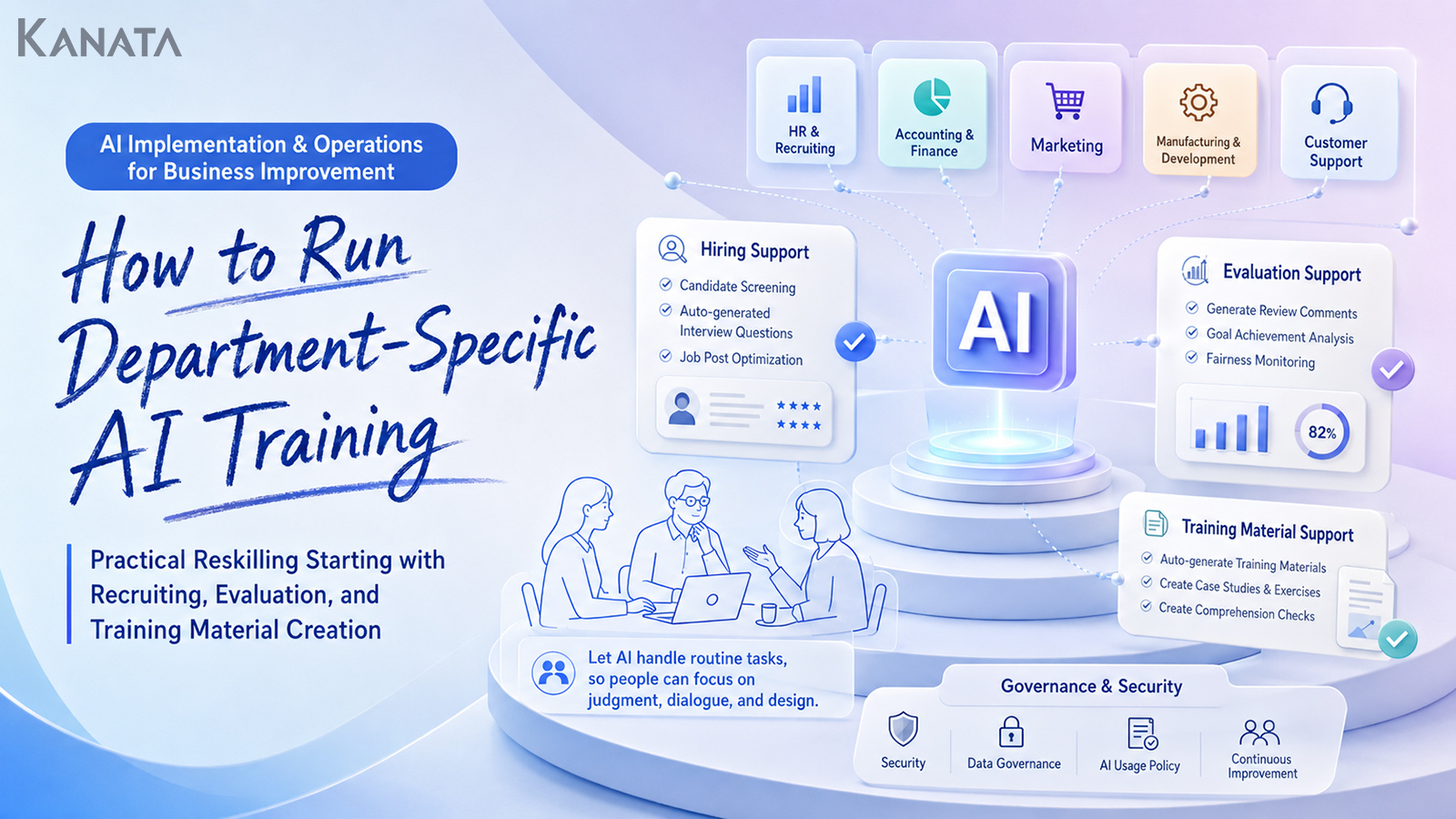
The aim of using generative AI is not to delegate recruitment or performance-related decisions to AI. It is to use AI to support tasks such as drafting, summarising, classifying and comparing information, thereby freeing up more time for people to make judgements, hold conversations, support development and design initiatives.
This article explains how to design training that enables organisations to integrate generative AI safely and sustainably into day-to-day departmental work, with a particular focus on HR.
Why generative AI training rarely sticks if it only explains how to use the tools

Generative AI training often focuses on how to write prompts and operate chat-based tools. Learning the basics of text generation, summarisation and information organisation is important, but this alone may not be enough to support sustained use within an organisation.
In practice, teams may encounter issues such as the following:
- The tools seem useful, but employees do not know where they fit into their own work.
- Employees try them immediately after training, but later return to their previous ways of working.
- Only a small number of knowledgeable employees use them, and working methods are not shared across the team.
- Employees do not know what information they may enter or how much responsibility they may delegate to AI.
- It is unclear who should review AI-generated outputs and take responsibility for them.
The AI Guidelines for Business, Version 1.2, published by Japan’s Ministry of Economy, Trade and Industry and Ministry of Internal Affairs and Communications in March 2026, states that information should be provided on AI capabilities and limitations, as well as on appropriate and inappropriate uses, and that measures should be taken to ensure relevant stakeholders develop sufficient AI literacy.
For this reason, corporate generative AI training should go beyond simply explaining what generative AI is and define the following in practical terms:
- Which tasks are in scope
- Which stages of the process AI should support
- Which stages require human review and judgement
- What information may and may not be entered
- How working methods will be shared and updated
- Who should be notified if a problem occurs
Training content should be tailored to each department

Generative AI can be used for a wide range of purposes, including writing, summarising, classifying, comparing, generating ideas and organising information in tables. However, practical requirements and acceptable levels of risk vary from one department to another.
- Human resources
- Key considerations include fairness to candidates, alignment with assessment criteria, fairness in employment practices and the protection of personal data.
- Marketing and sales
- Teams need to consider customer challenges, the buying process, the stage of each sales opportunity and consistency with existing materials, as well as verifying advertising claims and factual accuracy.
- Information systems
- Teams must consider matters such as the contractual terms of the services used, the handling of internal data, access permissions, log management and integration with existing systems.
- Senior management
- Leaders need an organisation-wide design covering which activities should use AI, which performance indicators should be set and who should manage the associated risks, rather than focusing only on reducing the time spent on individual tasks.
Organisation-wide AI literacy training and practical training focused on department-specific work, data and decision criteria should be designed separately.
Start with support tasks, not decision-making

In the early stages of introducing generative AI, organisations should not rely on AI alone to make decisions that could have a significant impact on individuals or the business, such as recruitment decisions, performance review scores, promotions, job assignments or contractual risk assessments.
Generative AI outputs may contain factual inaccuracies, unsupported statements or biased assessments. The AI Guidelines for Business, Version 1.2, published by Japan’s Ministry of Economy, Trade and Industry and Ministry of Internal Affairs and Communications, also calls for consideration of principles including human-centricity, safety, fairness, privacy, security, transparency and accountability when using AI.
In addition, the EU AI Act treats certain AI systems used in recruitment, worker selection, promotion, dismissal and staff allocation as high-risk uses. The Act does not apply directly to every use of AI in Japan, but it provides a useful reference point for why AI use in HR should be designed with particular care.
Support tasks such as the following are often easier to address in the early stages of adoption:
- Creating first drafts of written content
- Summarising lengthy notes or meeting minutes
- Organising multiple options into a comparison table
- Producing initial drafts of interview questions or training materials
- Separating source material for performance review comments into facts, interpretations and expectations
- Drafting FAQs from approved internal documents
- Improving the structure and tone of written content
| Responsible party | Primary role | Examples |
|---|---|---|
| Generative AI | Supports the organisation of information needed for decisions and the creation of first drafts | Summarising, classifying, comparing, rephrasing and creating outlines |
| People | Verify facts and take responsibility for decisions and explanations | Final decisions, legal review, meetings with the individual concerned and approval |
Even for these uses, AI outputs should not be used without review. The person responsible must check them against the source material and confirm that the wording is appropriate. The key is to define, at each stage of the process rather than for the task as a whole, what AI may support and what remains a human responsibility.
HR teams can often start with recruitment, performance management and learning and development

HR teams carry out a large volume of work involving writing and information organisation. This makes HR a department where generative AI support can be relatively straightforward to explore, provided that input data and review procedures are managed appropriately.
However, HR work involves candidate data, employee data, performance information, health information and other sensitive material. Before using a service, organisations must check its contractual terms, where data is stored, whether submitted content may be used to train models and which administrative controls are available.
Recruitment: creating first drafts of outreach messages and interview questions
Recruitment involves a substantial amount of writing, including outreach messages, job adverts, job descriptions and interview questions.
One possible training exercise is to enter role requirements and target candidate profiles that have been prepared in a form that does not identify individuals, then generate several first drafts of an outreach message.
For example, the target audience and key messages can be specified as follows:
- For experienced candidates, describe the responsibilities and expected contribution in concrete terms.
- For early-career candidates, explain the development environment and possible career paths.
- For prospective managers, outline the scope of decision-making authority and the business challenges they would be expected to address.
Interview questions can also be drafted on the basis of role requirements, expected responsibilities and assessment criteria, with a focus on eliciting evidence of past behaviour.
Performance management: structuring source material for review comments
Performance reviews require managers to organise objectives, results, behaviours, challenges and future expectations, then express them in language that the employee can understand.
One approach is to enter anonymised or pseudonymised information where appropriate and ask generative AI to organise it under the following headings:
- Verified results and behaviours
- The reviewer’s interpretation
- Strengths
- Areas for improvement
- Expected actions in the next review period
Conditions such as “describe observable behaviour rather than personality”, “separate facts from assessment” and “avoid unsupported conclusions” can make it easier to structure a draft performance review comment.
However, when the information provided is incomplete, generative AI may infer the context and add unsupported explanations. Reviewers must compare the output with the underlying facts and take responsibility for the final wording and assessment.
Learning and development: creating first drafts of materials and knowledge checks
Training materials are another area where generative AI support may be worth considering.
Approved training documents, manuals and video transcripts can be used as the basis for initial drafts of materials such as:
- Summaries of training content
- Slide outlines
- Glossaries
- Knowledge checks
- Case studies
- Post-training surveys
For materials that are delivered and revised regularly, such as induction training and management training, generative AI may help reduce the effort required to prepare outlines and draft questions.
Where training materials cover laws, internal rules or product specifications, however, the source material must be checked to ensure that it is up to date. The correct answers and explanations for AI-generated questions must also be reviewed by the person responsible or by someone with relevant subject-matter expertise.
How to design department-specific AI training

Take stock of the work in scope
The first question should not be “What can AI do?” but “What is taking up the team’s time?”
For each activity, record at least the following information:
- Name and purpose of the activity
- How often it is carried out
- Approximate time required per item
- The person responsible and the approver
- Source materials used as inputs
- The output produced
- The impact of any errors
- Whether personal or confidential information is involved
For an HR team, possible candidates include recruitment documents, interview design, performance review comments, training materials and responses to enquiries.
When measuring time, recording each stage separately — such as first drafting, review, revision and approval — makes it easier to identify which parts of the process have been affected by generative AI.
Separate the stages supported by AI from those owned by people
Break down each activity identified in the review into stages, then decide which stages AI may support and which must be handled by people.
AI is well suited to supporting stages such as first drafting, summarising, classifying, comparing, rephrasing and creating outlines.
People should remain responsible for final decisions, fact-checking, building agreement with stakeholders, meetings with the individuals concerned, and ethical, legal and employment-related judgements.
Documenting the following for each activity can help reduce inconsistencies in how different employees make decisions:
- Information that may be entered
- Information that must not be entered
- Tasks that may be assigned to AI
- Items that must always be reviewed by a person
- The approver for the final output
- Who should be notified if a problem occurs
Use exercises that reflect real work
Training should include not only general examples, but also exercises that closely reflect day-to-day work.
For an HR team, possible themes include:
- Create three outreach messages from anonymised role requirements.
- Standardise the wording and structure of job descriptions.
- Create interview questions that elicit behavioural evidence for each assessment criterion.
- Separate source material for performance review comments into facts, interpretations and expectations.
- Create draft knowledge checks from approved training materials.
If real candidate or employee data is used in training materials, it is not enough simply to remove names and departments. Organisations must also consider whether individuals could be identified from combinations of career history and events.
Treat prompts and review procedures as shared assets
If working methods remain confined to individual notes or chat histories, the same trial and error will be repeated every time responsibility changes hands.
Instructions that have proved effective should be managed together with the following information:
- The activity and intended purpose
- The information to be entered
- The information that must not be entered
- The expected output format
- Review criteria
- The author and approver
- The AI service or model used
- The date of the latest update
However, even when the same prompt is used, outputs will vary depending on the information entered and the model selected. Sharing prompts does not automatically guarantee quality; it is better understood as a way to standardise working procedures and review criteria.
Review impact and risk regularly
AI training is not a one-off exercise.
Work processes, recruitment requirements, assessment criteria, internal rules and service specifications all change over time. If prompts and reference materials are not updated, outputs may increasingly fall out of step with current practice.
Review the following indicators monthly or quarterly:
| Category | Indicators to review |
|---|---|
| Usage | Number of users, number of uses and frequency of use by activity |
| Working time | Time required for first drafts and total working time including review and revision |
| Quality | Number of revisions, number of items returned for rework, and instances of serious errors or inappropriate outputs |
| Operations | Templates that are no longer used, the update status of reference materials and improvement requests from users |
It is important to assess not only the time saved, but also the accuracy and consistency of outputs and the burden placed on users and reviewers.
Build compliance and information governance into the training

HR teams handle information that requires particular care, including candidate data, employee data, performance information, health information and reports of harassment.
A blanket rule stating that “personal data must never be entered” is not, by itself, an adequate policy for the use of generative AI. Organisations need to review the purpose of use, internal rules, the contractual terms of the service, how data is stored and processed, and whether data may be used for model training, then define what may be entered for each activity.
At a minimum, training should make the following rules clear:
- Do not enter personal or confidential information into services that have not been approved by the organisation.
- Even where use is necessary for business purposes, anonymise or pseudonymise information wherever possible.
- Do not rely on AI alone for final performance or hiring decisions.
- Have a person review AI outputs before communicating them to employees or candidates.
- Refer legal, employment and compliance judgements to the relevant specialists.
- Distinguish between materials that may be used as references and those that must not be uploaded.
- Establish a reporting process for suspected data entry errors or information leaks.
- Keep records, to the extent necessary, of work carried out using AI and the results of human review.
How to sustain adoption after training

To embed what employees learn in generative AI training into day-to-day work, organisations need systems that do not depend solely on individual initiative.
For example, they can create an environment that:
- Separates workspaces by department or use case
- Shares approved prompts
- Organises internal materials that may be used as references
- Stores examples of good outputs and examples of revisions
- Records the author and latest update date of each template
- Allows users to report areas for improvement
- Allows administrators to review usage and the update status of training materials
This kind of environment can be built in several ways, including through an intranet, a knowledge management tool, a learning management system or a business-focused generative AI service. The right choice depends on the required functions, security requirements, integration with existing systems and the operational burden on the team responsible.
Kanata is one possible option. According to Kanata’s official website, the platform offers features such as separate AI environments for different use cases, shared standard prompts, configurable response policies aligned with internal rules, content creation and conversational learning.
For an HR department, for example, the environment might be organised as follows:
- Recruitment team
- First drafts of job adverts, outreach messages and interview questions
- Reviewers
- Organising source material for performance review comments
- Learning and development team
- First drafts of course structures, knowledge checks and surveys
- Administrators
- Managing approved prompts and reference materials
However, introducing a tool does not in itself ensure sustained adoption. Operations become easier to improve only when tool use is accompanied by appropriate task selection, high-quality input data, clear review procedures, designated administrators and ongoing support for users.
When comparing services such as Kanata, it is worth checking not only the number of features, but also the following:
- Whether the required AI models are available
- Where input data is stored and processed
- Whether input content may be used to train models
- Whether permissions can be configured by user or department
- Whether activity logs and usage data can be reviewed
- Whether prompts and reference materials can be managed
- Whether training and operational use can be managed in the same environment
- Whether implementation support and an enquiry service are available
Summary: let AI handle supporting work so people can focus on judgement and dialogue

The most important aim of department-specific AI training is not to showcase the full range of generative AI capabilities. It is to break day-to-day work into stages and define clearly which parts AI may support and which parts remain a human responsibility.
Generative AI can assist with drafting, summarising, classifying, comparing and preparing outlines for training materials. It cannot, however, be entrusted with hiring decisions, performance assessments, compliance judgements or conversations with employees.
AI should organise the information needed for decisions and produce first drafts. People should verify the facts, take individual circumstances into account and explain the reasons for their decisions.
When this division of responsibilities is clear, recruiters may be able to spend more time speaking with candidates, reviewers more time supporting employees’ development and learning professionals more time designing effective learning experiences.
To achieve this, training should not be designed by starting with the tool’s features. It should be designed backwards from the work employees actually do, the information they handle, the judgements required and the risks that may arise.
Questions and answers about department-specific AI training
Should generative AI training begin by teaching employees how to write prompts?Basic operating skills are necessary, but prompt writing does not need to be the main focus of the training. It is usually easier to connect training to practical work if the organisation first reviews the activities in scope, decides which stages AI may support and which stages require human review, and then teaches the prompts needed for those activities.
Is it appropriate to use generative AI to write performance review comments?Generative AI may be used to support drafting and information organisation, but it is not appropriate to use its output unchanged as a performance review comment. The reviewer must verify the accuracy of the input information, the fairness of the wording and alignment with the assessment criteria, and must take responsibility for the final assessment and explanation.
Can candidate or employee personal data be entered into generative AI tools?There is no single answer that applies in every case. Organisations need to review the purpose of use, applicable data protection law, internal rules, the contractual terms of the service, data storage and processing methods, and whether submitted data may be used to train models. As a general rule, personal data should not be entered into services that have not been approved by the organisation, and anonymisation or pseudonymisation should be considered where use is necessary.
How should the impact of generative AI training be measured?Organisations should review not only first-draft time, but also total working time including review and revision, the number of revisions, the number of items returned for rework, output accuracy, the number of inappropriate outputs and the number of users. When comparing results before and after implementation, the activities, document difficulty and measurement period should be kept as consistent as possible.
What are the benefits of using a business-focused service such as Kanata?Business-focused services may offer features that support organisation-wide operation, such as separate environments for different use cases, shared prompts and reference materials, permission management and usage monitoring. Kanata may be one option for organisations that want to manage AI adoption and workforce development in a single environment. However, it is important to assess the functions your organisation requires, its data management conditions, compatibility with existing systems and the operating model, and to compare the service with other available options before making a decision.