

We asked the AI agent to “put together the monthly report” — and each time it handed back something different
This was the situation faced by Saeki (a pseudonym), who leads DX initiatives in the corporate planning department of a manufacturing firm, alongside the on-site team leaders, the IT department and the division head. Six months earlier, the company had been handing entire tasks over to an AI agent wholesale, without properly separating the objective, the input data, the success criteria and the interim checks. The upshot was that the very same “report creation” brief would lean towards sales analysis one day and towards minute-taking summaries the next; the granularity of the output simply would not settle.
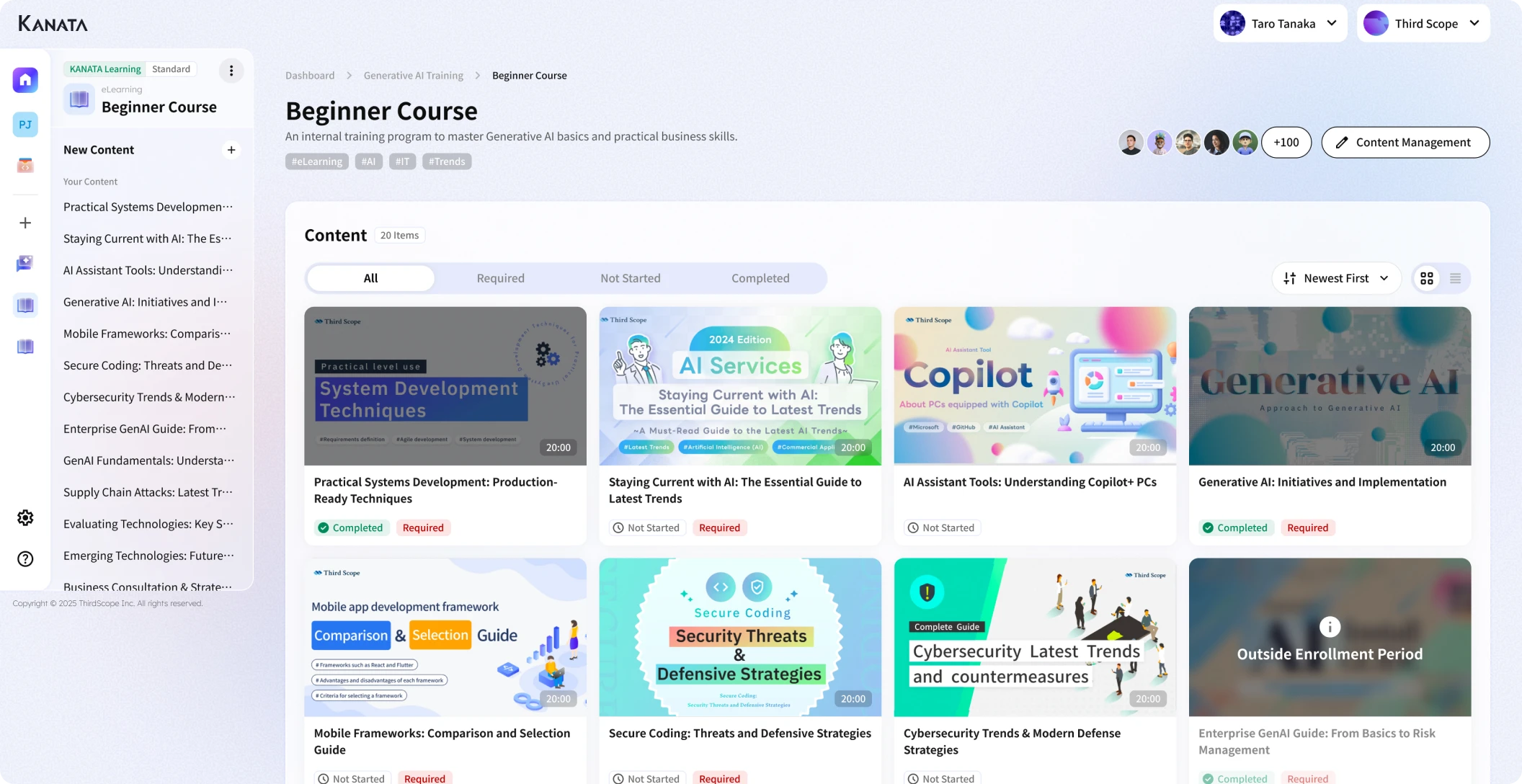
Today, they break work down into subtasks, dependencies and decision points, and maintain it as a reusable brief. For instance, Kanata, a tool provided by our company that lets you handle AI chat, a prompt library and training-data management within the same working environment, makes it considerably easier to preserve an individual’s request as a team template. Over a three-month trial from January to March 2026, comparing twelve target tasks, the number of rework cycles fell from an average of 3.1 to 1.4 per task. That said, this figure reflects one company’s limited deployment, and results will vary with the nature of the work and the quality of the data.
This article sets out the work-decomposition design needed to make business requests to AI agents more dependable — written for the on-site leaders and process designers who want to get to grips with task-decomposition AI. The aim is a state in which, whoever does the asking, a brief that brings together subtasks, dependencies and success criteria moves you closer to reproducible results. Mind you, simply drafting a template will not make everything run flawlessly; you need to weigh it alongside domain knowledge, human checking and continual review.
Why AI agents stumble: it is not just a matter of “performance”

In the period immediately after an AI agent is introduced, expectations on the ground tend to run ahead of reality.
- Now we can hand over report writing
- We can automate the preparation for sales meetings
- We can delegate the first-pass triage of enquiries
- It can even tidy up the post-meeting task list for us
Such expectations are perfectly natural. AI agents have drawn attention not as mere text generators but as a mechanism for carrying work across multiple steps. For background, the World Economic Forum’s report on the evaluation and governance of AI agents also lays out the technical foundations, taxonomy, evaluation and governance of AI agents.
In practice, however, once you actually start using them, problems of the following sort crop up.
- The deliverable comes back slightly different from what was asked for
- It does well up to a point, but the way it pulls everything together at the end is weak
- The same request as last time, yet the granularity of the output has shifted
- The human checking does not fall away nearly as much as expected
When this happens, pinning the cause solely on the AI’s performance tends to stall any improvement. AI agents do, of course, have their limits. They may produce output containing incorrect information, and they cannot be expected to grasp a company’s particular circumstances in full.
Even so, part of the reason the output fails to settle lies on the human side — in how the work is handed over. The single biggest culprit is making a request without first breaking the work down.
- Please create the monthly report
- Please put together the sales materials
- Please sort out our customer response
- Could you carry out a competitor analysis
Between people, a request like that might just about get through. If the other person knows the past context, the unwritten conventions of the organisation, the boss’s preferences and the nature of the customer relationship, they can fill in the missing pieces as they go.
For an AI agent, though, the scope of work is far too broad. While it remains vague what to use as input, in what order to process it, where to check, and which state counts as finished, the agent may well act on a different interpretation each time.
To put an AI agent to good use in your work, an ability to “write a polished request” is not enough on its own. What you need is the ability to decompose the work itself.
Task decomposition is not about making the work granular — it is about making the order of judgement explicit

Hear the phrase “task decomposition” and you tend to picture “splitting a large piece of work into smaller pieces”.
That, naturally, matters too. The task of “preparing materials for the sales meeting”, for example, can be split as follows.
- Review the minutes of the previous meeting
- Pull together this month’s sales figures
- Identify the reasons for missed targets
- Summarise the status of key accounts
- Propose next month’s measures
- Work it up into a slide structure
That said, when it comes to entrusting work to an AI agent, simply listing the tasks in fine detail is not sufficient.
What matters is how each subtask connects to the others. Before tidying up the sales figures, for instance, you need to decide which period they cover. Before identifying the reasons for missed targets, you need to check the gap between target and actual figures. And before proposing next month’s measures, you need to separate whether the shortfall stems from external factors or from internal ones.
Task decomposition, in other words, is not about drawing up a list of tasks; it is about laying bare the dependencies within the work.
An AI agent proceeds on the basis of the information it is given. If you do not specify which information to check first and which judgements to leave until later, it may process things in a plausible-looking order. And when that order is out of step with the human sense of how the work runs, the quality of the output drifts out of step too.
Three perspectives worth keeping in mind with task-decomposition AI
- Separate the deliverable
- Be clear about whether you want a report, a summary, a comparison table or a decision-making memo.
- Separate the judgements
- Distinguish which information is to be treated as fact and from what point onwards it is treated as conjecture.
- Separate the checkpoints
- Decide whether the AI agent may carry on to the end, or whether a human needs to check partway through.
By sorting out these three, a business request to an AI agent changes from a “big ask” into a “workflow with a clear way of proceeding”.
A poor request conveys only the “finished article”; a good one conveys the “way of proceeding” as well

A common failing when making requests to an AI agent is to convey only the finished article.
Take the following request, for example.
Please prepare the materials for next week's sales meeting.At first glance, the objective appears to have been conveyed. Yet a great deal of information is missing from this request.
- Who will be attending the sales meeting
- Is the purpose of the meeting to report, or to decide
- Roughly how many slides are wanted
- What period does it cover
- Of sales, number of deals, win rate and reasons for lost deals, which should take priority
- What, ultimately, do you want the attendees to decide
While these remain vague, the AI agent may well be able to produce “something that looks like a sales deck”, but producing “a sales deck you can actually use in that meeting” becomes far harder.
An example request, with the task decomposed
Recast in decomposed form, the same request reads as follows.
Please draft a structure for the materials to be used at next week's sales meeting.

# Objective
To carry out the sales department's monthly review and decide next month's priority actions.

# Period covered
1 April 2026 to 30 April 2026.

# Attendees
The head of sales, each team leader, the marketing lead and the corporate planning lead.

# Input information
- Monthly sales results
- Number of deals
- Win rate
- Reasons for lost deals
- List of key accounts
- Decisions from the previous meeting

# How to proceed
1. First, set out the gap between the sales target and the actual figures.
2. Next, form hypotheses about the causes of that gap, separating them into number of deals, win rate and average unit price.
3. After that, draw three improvement themes for next month from the reasons for lost deals.
4. Finally, put forward five points worth debating at the sales meeting.

# Output format
- A draft slide structure
- A title for each slide
- The key points to convey on each slide
- Questions worth confirming during the meeting

# Points to note
Do not fill in any unknown figures; mark them "to be confirmed".
Written this way, the AI agent does not merely produce materials; it finds it far easier to judge in what order it ought to think.
The important thing here is not to make the request longer. It is to convey the premises, inputs, processing order, outputs and checking conditions of the work as separate elements.
The quality of a business request to an AI agent turns not only on the eloquence of the request, but on the clarity of the work-decomposition design.
In work-decomposition design, think of “subtasks” and “dependencies” as a pair

When breaking work down, you start by drawing out the subtasks.
For “monthly report creation”, say, the subtasks might look like this.
- Confirming the period covered
- Gathering the necessary data
- Setting out the difference from the previous month
- Checking the movement in key indicators
- Organising hypotheses about the drivers of change
- Drawing out the points to confirm with the relevant departments
- Drafting the report structure
- Writing the closing commentary
Yet merely lining the subtasks up still leaves things awkward to use in practice, because you cannot see which task depends on which.
For instance, you cannot begin “organising hypotheses about the drivers of change” until “checking the movement in key indicators” is done. “Drawing out the points to confirm with the relevant departments” shifts depending on the outcome of the hypothesis-organising. And “writing the closing commentary” ought to come only after the outstanding items have been sorted out.
Work, in short, has an order to it. Hand things to an AI agent while ignoring the dependencies, and it may end up writing conclusions on the basis of information that has not yet been confirmed. A case in point: declaring flatly that “the cause is a drop in the effectiveness of the advertising campaign” when the reason for the fall in sales is not yet known.
An example of making dependencies explicit with a brief for the AI
# Dependencies
- Confirm the sales gap before drafting any hypotheses about the causes.
- Draft the cause hypotheses before drawing out the points to confirm with the relevant departments.
- Where points remain to be confirmed, do not state the final conclusion in absolute terms.
- Where there are unresolved questions, set them aside under "items awaiting confirmation" rather than in the body of the report.
With this specified, the AI agent’s output becomes easier to review. Even when the output drifts, you can correct it in concrete terms — “the dependencies have not been observed”, or “items still to be confirmed have been mixed into the main text”.
Dependencies grow especially tangled in cross-departmental work. Where marketing’s data, sales’ deal status, customer success’s feedback and corporate planning’s figures all come into play, it readily becomes vague which information ought to be looked at first.
Before handing things to an AI agent, a human sorts out the flow of the work. That is the starting point of workflow decomposition.
Without success criteria, an AI agent finds it hard to judge how to finish

One thing that is easily left out when requesting work from an AI agent is the success criteria.
In work between people, judgements such as “that’s enough for now”, “share it once you’ve got this far” or “at this level of detail it’s fit for the meeting” are often filled in by experience. An AI agent, however, has no sense of what “enough” means in that particular workplace.
So if you do not make the success criteria explicit, the output ends up either overdone or, conversely, too shallow.
An example of success criteria for report creation
# Success criteria
- The structure can be explained in under five minutes at a management meeting.
- The important numerical changes are pared down to three or fewer.
- For each change, fact and hypothesis are written separately.
- The unconfirmed items needed for a decision are made explicit.
- The next actions to take are organised by responsible department.
An example of success criteria for sales materials
# Success criteria
- The customer's problem is clear within the first two slides.
- The proposal corresponds to the customer's problem.
- The post-adoption change is shown both quantitatively and qualitatively.
- The questions to confirm at the next meeting are clearly stated.
An example of success criteria for enquiry handling
# Success criteria
- The rules or documents underpinning the answer are cited.
- Unclear points are not filled in by guesswork.
- Items to confirm with the responsible department are written separately.
- It is clear what the employee should do next.
Success criteria, as you can see, differ from one task to the next. That is precisely why a brief meant for reuse across the team needs to include them.
Once the success criteria are clear, review on the human side becomes easier too. Rather than looking at the AI agent’s output and feeling that it is “somehow off”, you can point out, concretely, that “the third success criterion has not been met”.
Building in interim checks makes it easier to cut down on rework by the AI agent

When entrusting work to an AI agent, plenty of people would like it to “see the whole thing through in one go”.
Having everything completed automatically would, admittedly, be convenient. In practice, though, a good many tasks call for a check partway through.
Interim checks matter especially in work of the following kind.
- Preparing materials that bear on management decisions
- Organising the substance of proposals to customers
- Drafting documents touching on contracts, legal matters or HR
- Proposing measures grounded in numerical analysis
- Work that settles the division of roles between departments
In work of this kind, if the AI agent gets the initial premise wrong, the whole of the subsequent output drifts off course. Even in the wider debate on managing the risks of AI systems, the design of human oversight and checking is held to be an important element. The NIST AI Risk Management Framework, for example, sets out a framework for managing AI risk on an organisational basis. The EU AI Act, Article 14, meanwhile, lays down requirements for human oversight of high-risk AI systems.
An example of building an interim check into a competitor analysis
If you are commissioning a competitor analysis, say, rather than having it produce the final report straight off, you split it into stages as follows.
First, just give me the angles for the investigation.
Once I have checked them, we will move on to the next step.
If the angles are right, you then make the next request.
Based on the investigation angles we have confirmed, draw up the columns for the comparison table.
Do not write the body text yet.
If you want to take it further, you request as follows.
The columns of the comparison table are fine as they stand.
Next, organise the candidate primary sources to investigate for each column.
By staging the AI agent’s work this way and inserting points at which a human checks, you make it easier to cut down on rework.
An interim check is not something you build in because you do not trust the AI. It is a safeguard for embedding the AI agent into your business process.
The closer you move towards autonomous operation, the more the design of the checkpoints matters. Rather than leaving it entirely to its own devices, you decide how far to entrust to the AI and from where a human takes the decision. It is precisely this line in the sand that makes an AI agent easier to embed in the work.
Turning task decomposition into a template raises the team’s reproducibility

Leave task decomposition as an individual knack and it will not spread.
One person makes requests to the AI agent skilfully; another comes unstuck every time. When that happens, AI use becomes dependent on the individual.
This is where templating comes in.
The template meant here is not merely a stock phrase of a prompt. It is a reusable brief that takes in the way of proceeding, the checkpoints and the success criteria.
An example of a template for monthly report creation
# Role
You are an AI agent supporting the corporate planning department with report creation.

# Objective
To set out the month's performance changes and put the meeting's attendees in a position to decide the next actions.

# Input information
- Period covered
- Sales results
- Target figures
- Previous month's results
- Department-level data
- Supplementary notes

# Subtasks
1. Confirm the period covered and any gaps in the input information.
2. Set out the gap between target and actual.
3. Set out the difference from the previous month.
4. Draw out the indicators showing the largest movement.
5. Form hypotheses about the drivers of change.
6. Separate out the points needing confirmation.
7. Pull it together into key points for the meeting.

# Dependencies
- Do not draft cause hypotheses until the gap analysis is done.
- Where data is missing, do not state conclusions in absolute terms.
- Set confirmation items aside in a separate section, not in the body.

# Output format
- Summary
- Principal changes
- Cause hypotheses
- Items to confirm
- Next actions

# Success criteria
- It can be explained in under five minutes.
- Fact and hypothesis are kept apart.
- Unconfirmed items are clearly stated.
Register a template of this kind somewhere the team can share it, and new members need not dream up their instructions from scratch. Using a mechanism that lets you manage frequently used instructions and work templates on a per-project basis — as with Kanata’s prompt library — also makes it easier to drive standardisation across departments.
A template, however, is not something you draft once and have done with. You refine it as you use it, improving the spots that drew the most rework.
If, for example, you keep getting work sent back with “the cause hypotheses are shallow”, you add analytical angles such as “by customer”, “by product” and “by channel” to the input information. If the common complaint is that it is “hard to use in the meeting”, you add “points worth debating” to the output format.
In AI-agent training in using AI agents and advanced reskilling need to cover this idea of refining templates too. It is not simply a matter of memorising how to operate the tool; what is needed is the capacity to keep revisiting the granularity at which work is broken down.
Set out in advance which work to entrust to AI and which work a human decides

As you press on with task decomposition, it becomes clear which work is easy to entrust to an AI agent and which work you should not hand over entirely.
| Category | Example work | The thinking behind it |
|---|---|---|
| Work easy to entrust to an AI agent |
|
The input and output formats are easy to pin down here, and the success criteria are comparatively clear, so this is an area well suited to task decomposition. |
| Work a human should decide |
|
Even where an AI agent can lend support, the ultimate responsibility has to rest with a human. |
You can, for instance, have the AI help with a draft of an appraisal comment. But how it is ultimately worded to the individual, and what the rating should be, are matters a manager should decide and own.
A first-pass review of a contract is the same. The AI can help flag risky clauses, but the legal judgement has to be made by a specialist.
The more you put AI agents to use, the more it matters to decide not only “what to entrust” but “what not to entrust”.
This does not mean being unduly cautious about using AI. By being clear about the scope you delegate, you widen the territory you can hand over with confidence.
The knack of task decomposition is a work-design skill for the age of AI

In business improvement to date, the emphasis has been on documenting procedures, standardising and reducing things to checklists.
In the age of the AI agent, the importance of all that is unchanged. What shifts, slightly, is the level of granularity required.
In a manual written for people, a style of “the person in charge will understand once they read it” is sometimes enough, because the background and the exceptions can be filled in by experience on the ground.
A brief meant to be entrusted to an AI agent, by contrast, needs to make the unwritten knowledge explicit as far as it can.
- What to confirm first
- Which missing information should bring things to a halt
- From what point onwards something is treated as conjecture
- Which state counts as finished
- At what moment a human’s confirmation is to be sought
The ability to put these into words is the knack of task decomposition.
This is not an ability needed by DX leads alone. It bears on everyone who uses AI agents within an organisation — executives, IT leaders, marketing and sales leaders, on-site leaders, process designers and the rest.
Entrusting work to an AI agent does not mean lobbing human work over the fence as it stands. It means redesigning the understanding of the work that people hold into a form the AI can handle.
In that sense, the knack of task decomposition is not a mere prompting technique; it is a work-design skill for the age of AI.
In summary: AI-agent use is settled less by the knack of asking than by the knack of breaking work down

When a business request to an AI agent fails to settle, the first thing to revisit is not merely the phrasing of the request.
You need to examine the work itself from the following angles.
- Is the work broken down into subtasks
- Are the dependencies between subtasks sorted out
- Are the success criteria defined
- Is the position of the interim check settled
- Are fact and conjecture kept apart
- Has a scope for human judgement been left in
By getting these in order, the AI agent’s output becomes easier to stabilise.
Task decomposition will not, of course, let you automate every piece of work. AI agents are not all-powerful, and they can draw mistaken inferences. Nor can you entrust to them, in full, a company’s particular circumstances, the nature of customer relationships, or legal and ethical judgements.
Even so, break work down into subtasks and dependencies and bring it to a state where it can be reused as a brief, and the AI agent becomes not merely a handy tool but something that underpins the team’s business processes.
What matters is not to let a successful request end as a one-off, but to keep it as a template and go on refining it.
The knack of entrusting work to an AI agent is not a skill for the AI-savvy alone. It is the ability of those who know the work to break that work down and design it into a form the AI can take in.
If you feel, right now, that handing a large task to an AI agent wholesale is not working as you hoped, then with your next request try writing the “way of proceeding” rather than the “finished article” first. From there, the reproducibility of your AI-agent use will climb, little by little.
Q&A: task decomposition for entrusting work to an AI agent
What is task-decomposition AI?
Task-decomposition AI is the approach of not handing a large piece of work to an AI agent as it stands, but requesting it as separate parts — the objective, the input information, the subtasks, the dependencies, the success criteria and the interim checks. Rather than simply making the work granular, what matters is being clear about the order in which the AI processes things and where a human checks.
What tends to cause business requests to AI agents to fail?
A common cause is conveying only the finished article while leaving out the way of proceeding. With requests such as “please put together the sales materials” or “please create the monthly report”, the period covered, the input data, the criteria for judgement and the success criteria readily become vague, and the granularity of the output may waver.
In work-decomposition design, where should you start?
Start by being clear about the final deliverable of the work. On that basis, draw out the subtasks leading up to the deliverable and sort out which task depends on which. Finally, decide at which stage a human checks and what has to be satisfied to count as complete.
What is the difference between work you may entrust to an AI agent and work you must not entrust entirely?
Work whose input and output formats are easy to settle — summarising, classifying, producing comparison tables, drafting, organising the points at issue — is an area easy to entrust. Final decisions, legal judgements, performance appraisals, negotiating terms with customers and the final check on externally published documents, on the other hand, need a human to take responsibility for the judgement.
How should you operate a task-decomposition template?
A template is not finished once drafted; you refine it as you use it. Record the spots that drew the most rework, where misunderstandings arose and where the output was shallow, and update the input information, the dependencies and the success criteria. Keep it somewhere the team can share it and standardise the most frequently used work first, and it becomes easier to reuse.