

Streamlining Candidate Management with Task-Executing AI Agents: How Recruiters Can Focus on Judgement and Conversation
A practical guide for recruiters on using candidate-management AI and task-executing AI agents to streamline scout replies, scheduling, ATS integration, and funnel analysis.
“Once again, I never got round to checking how the candidate was feeling before the interview.”
When Saeki, the hiring lead, let that slip in the recruitment review meeting, I fell quiet for a moment. It is a remark one hears rather often at companies where hiring isn’t going well. Handling applicants, replying to scouts, arranging schedules, keying things into the ATS, briefing interviewers — every one of these matters. Yet the more a recruiter is run ragged by them, the further they drift from the questions they ought to be sitting with: “Why is this candidate thinking about a move now?” and “In what environment would they truly come into their own?”
This is the story of Saeki, a hiring lead at a B2B company, together with the frontline interviewers, the HR and labour team, and the leadership, all wrestling with candidate management. Until six months ago, communication with candidates was scattered across several channels — email, the ATS, internal chat. Interviewers grumbled that “we can’t see each candidate’s background,” while leadership complained that “we can’t tell where the hiring funnel is getting clogged up.”
Today they have shifted to a way of working in which AI assists with drafting candidate communications, composing scheduling requests, updating the talent pool, and producing first drafts of funnel analysis. In one internal rollout covering 120 mid-career candidates over the most recent three months, for instance, the average time to a first reply to a candidate came in under 24 hours, and recruiters were able to claw back time for interview preparation and decision-making discussions.
In this article I will walk through, in plain terms, how to design, operate, and improve a task-executing AI agent for recruitment, using recruitment AI automation and candidate-management AI. The goal is a state in which people concentrate on conversation and judgement with candidates while AI continually keeps routine tasks in order. That said, AI agents are not omnipotent. Only once people take charge of the evaluation criteria, the handling of personal information, and responsibility for the final decision does this lead to reproducible HR-tech automation.
Why candidate management is so well suited to AI automation

Recruitment is a mixture of work that demands deep human engagement and work that can comfortably be handed to a system.
Talking with candidates, gauging their potential to thrive after joining, taking their anxieties seriously, and arriving at a final hiring decision — that is the territory people must own. On the other hand, receiving applications, replying to scouts, arranging interview times, updating the status of each stage, briefing interviewers in advance, and tidying candidate lists are tasks that recur to a fairly fixed pattern.
When I sit down to untangle the workflow at a hiring team, the first thing that comes into view is precisely this split. Recruiters do not lack time with candidates because there is none to be had; rather, their concentration is whittled away by fiddly administration before they ever get in front of anyone.
They check scout replies in the morning, share candidate details with interviewers at midday, sort out scheduling with candidates in the afternoon, and key the latest status into the ATS by evening. In between, leadership asks “how’s this month’s hiring progress looking?” Meanwhile a message lands in the internal chat from an interviewer: “What did this candidate talk about last time?”
In that state, the time to read a candidate’s career history properly and to think through what to probe in the interview gets eaten away.
Candidate-management AI and task-executing AI agents earn their keep precisely because they can support this band of work — “not judgement, but the sort of thing that quietly erodes hiring quality if left to fester.” When AI organises candidate information, drafts communications, and sets out the points worth checking before an interview, recruiters find it far easier to spend their time on the conversations and decisions that genuinely matter.
The crucial thing here is not to treat recruitment AI automation as “a mechanism for cutting recruiter headcount.” Rather, you should think of it as a way to give recruiters back the time to engage with candidates’ careers and their potential to flourish once on board.
What a task-executing AI agent can take on in recruitment

Hearing the phrase “recruitment AI automation,” some people picture handing the hire/no-hire decision itself over to AI. In practice, though, the first place you tend to see real returns is not the decision but the work surrounding candidate management.
What I most often tell teams on the ground is this: rather than letting AI decide who you hire, use it to create the breathing room in which recruiters can make good decisions.
Drafting scout replies and candidate correspondence
With scout AI, you can draft replies and follow-up messages to candidates tailored to the role, the candidate’s background, prior touchpoints, and the selection stage.
Take situations such as these.
- You want to follow up — without being pushy — with a candidate you once approached for a casual chat
- After a first interview, you want to write an email that conveys genuine anticipation about the next round
- You want to compose a message that gently asks a candidate’s reasons for withdrawing
Writing such messages from scratch takes surprisingly long. What’s more, the busier you are, the more slapdash the wording becomes, and the consideration owed to the candidate quietly falls away.
AI produces the draft; the recruiter then tunes it to suit the relationship with that particular candidate. Simply by dividing the labour this way, the quality of candidate communication tends to hold steady.
That said, you ought not send AI-generated text as it stands. Whether the candidate reads it and feels “this was written for me” is something a person must check at the very end.
Streamlining scheduling and reminders
Among recruitment tasks, scheduling is a heavy one. You have to line up the diaries of the candidate, the interviewers, and the recruiter, and a slow reply can sour the whole selection experience.
Scheduling looks like a “small job” but in reality it tends to become a sizeable burden. You send the candidate several possible dates, check the interviewers’ availability, issue a meeting link, and send a reminder the day before. Each step takes only a few minutes, yet as candidate numbers grow it steadily robs the recruiter of focus.
A task-executing AI agent can help with proposing dates to candidates, requesting confirmation from interviewers, sending day-before reminders, and drafting the day-of guidance notes.
In particular, preparing templates for each interview stage keeps scheduling quality consistent. A first interview, a final interview, a casual chat, and an offer meeting each call for different things to be conveyed. Before you hand anything to AI, it pays to sort out the wording rules for each stage.
Summarising candidate communications
In recruitment, the more touchpoints you have with a candidate, the more the information scatters.
Scout platforms, email, the ATS, interview notes, internal chat discussions — information about a candidate tends to end up split across several places. As a result, the next interviewer can’t see the earlier exchanges and ends up asking the candidate the same questions all over again.
To a candidate, that registers as a small jarring note.
- I already said all this last time
- Perhaps things aren’t being shared internally
- How much does this company actually care about me?
The candidate experience in recruitment shifts on the accumulation of just these small jarring notes.
With candidate-management AI, you can summarise the exchanges so far and lay out the points worth checking before a meeting.
- The conditions the candidate values in a move
- The frustrations they feel in their current role
- Why they took an interest in your company
- The reservations they hold
- The points to confirm at the next meeting
This lets the interviewer grasp the candidate’s background quickly and step more readily into a deeper conversation.
Updating the talent pool
Recruitment doesn’t begin and end with the candidates who apply right now.
People you’ve been in touch with before, those who withdrew but you’d happily re-engage in future, individuals who are attractive even if their appetite to move is currently low — how you manage the talent pool matters a great deal.
In reality, though, updating the talent pool tends to slip to the bottom of the pile. Time and again on the ground I have seen the state of “we have a candidate list, but we’ve no idea who to contact, or when.”
A task-executing AI agent can, drawing on candidate information and past communications, help classify who is worth re-approaching, organise the timing of contact, and jot down each candidate’s areas of interest.
People maintain the relationship with the candidate; AI shores up the information-keeping. Once you split it this way, recruitment turns from a one-off response to applications into the building of relationships over the medium and long term.
Producing a first draft of funnel analysis
For a hiring lead, making the recruitment funnel visible is important. The recruitment funnel is a way of laying out the selection process — application, document screening, first interview, final interview, offer, acceptance — stage by stage, so you can see where candidates are dropping off.
Look at application numbers, document pass rates, first-interview pass rates, offer rates, acceptance rates, and withdrawal rates, and you can see where things are getting clogged up.
But staring at the numbers isn’t enough on its own.
- Why are withdrawals rising?
- For which roles is the interview booking rate slipping?
- Candidates from which channel are most likely to accept an offer?
- Is there variation in how individual interviewers score?
For questions like these, an AI agent can put together a first draft of the funnel analysis.
Drawing on data exported from the ATS, for example, it can organise the bottlenecks by selection stage and put forward hypotheses for improvement. The final call rests with people, but having AI support the entry point to the analysis makes it easier for the hiring lead to spend time weighing up what to do next.
Drawing the line between what AI handles and what people own

The single most important thing when advancing recruitment AI automation is deciding “how far to hand things to AI.”
Work that lends itself readily to AI includes the following.
- Organising candidate information
- Producing pre-meeting summaries
- Drafting scout messages and replies
- Composing scheduling wording
- Tidying up ATS entries
- The first pass of funnel analysis
- Drafting a way to categorise the talent pool
Equally, there is work that people plainly must own.
- The hire/no-hire decision on a candidate
- Reading a candidate’s values and inclinations
- Probing deeper in the interview
- Negotiating terms and winning candidates over at the offer stage
- Designing the evaluation criteria
- Judgement calls on handling personal and sensitive information
- The care taken in rejections and in responding to withdrawals
On an AI project, I make a point of deciding first which work “people must not let go of.” Before settling how much to hand to AI, you decide the territory for which people hold responsibility.
In recruitment, that means the decisions bearing on a candidate’s career. What experience a candidate brings, the environment in which they perform at their best, the expectations under which they would join — this is not a domain AI should process on efficiency alone.
AI is not there to replace recruiters. It is the guideline that lets recruiters get back to the work they ought to be doing.
Designing recruitment as “AI prepares, people decide” — not “AI decides” — is the precondition for using candidate-management AI safely.
How to think about designing a task-executing AI agent for recruitment

When putting an AI agent to work in recruitment, the first thing to do is not to dump candidate information into the AI. It is to organise the information involved in hiring by its intended use.
You might, for instance, organise job descriptions, evaluation criteria, candidate-response templates, briefing materials for interviewers, frequently asked candidate questions, and recruitment-marketing materials. On that footing, you then decide who uses which information, and to what end.
In my experience, the companies where AI adoption goes well are the ones that design the “places where the work lives” with care, rather than fussing over the tool itself. Bring AI in while the organisation of information remains woolly, and you simply end up with one more handy chat tool and nothing more.
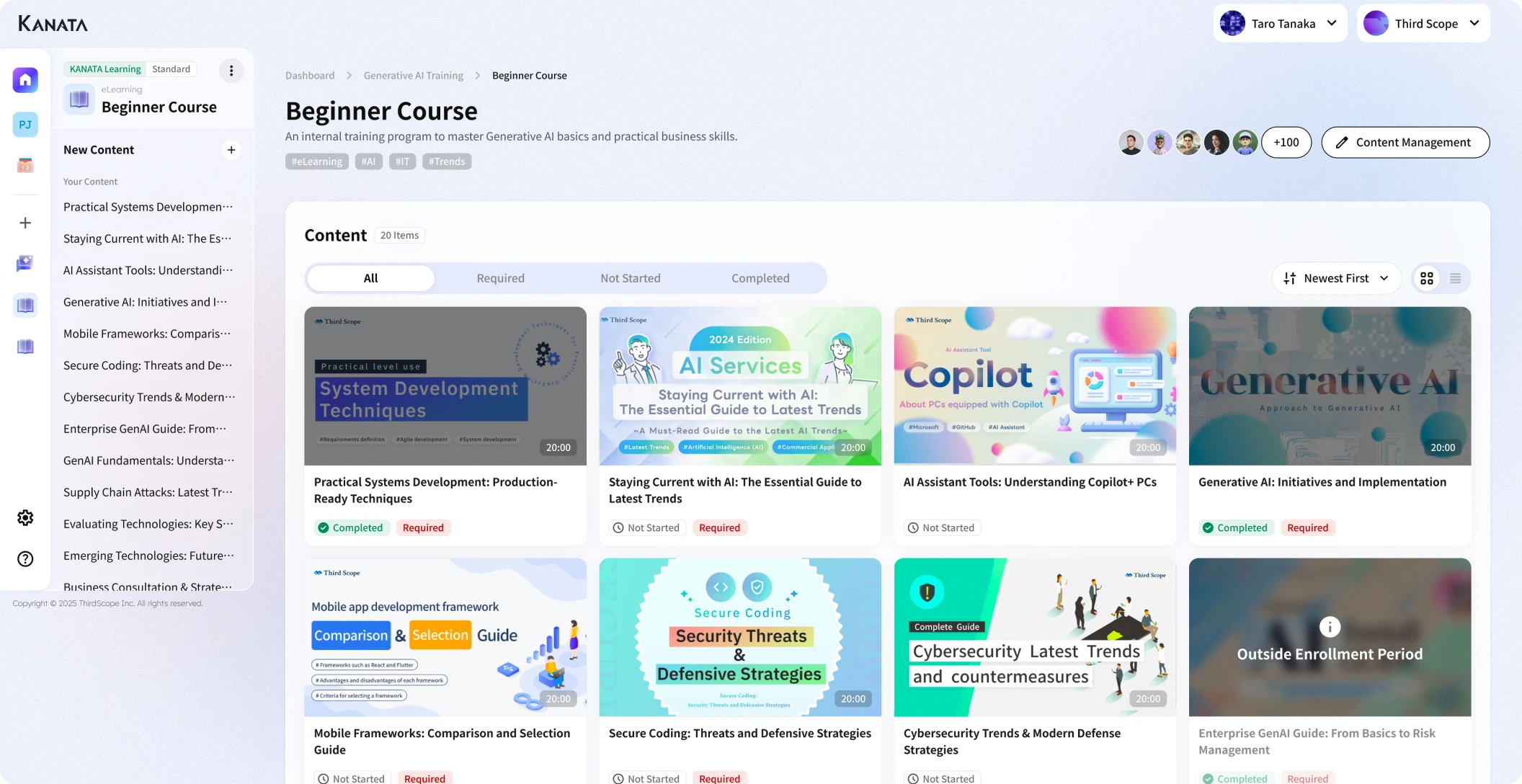
A service like Kanata, which lets you organise AI chat, summaries, and learning data on a per-project basis, is one option when you want to build a work-support environment dedicated to a recruitment team. It comes into its own particularly when recruiters, interviewers, and the hiring lead all refer to the same baseline information yet each use AI for different ends — being able to organise information and permissions by project pays off.
AI chat for recruiters
AI chat aimed at recruiters supports candidate responses, scout messages, scheduling, and the drafting of pre-meeting summaries.
As learning data, you register information such as the following.
- Job descriptions for each open role
- Evaluation criteria
- The points to confirm in interviews
- Candidate-response templates
- Your own recruitment-marketing materials
- Past scout messages
- Frequently asked candidate questions and example answers
This spares recruiters from building wording and checklists from scratch every single time.
The crucial point here is not to let AI “think freely” but to have it “think in line with your own hiring approach.” When the job descriptions, evaluation criteria, and tone of candidate communication are in good order, the AI’s output too edges closer to how the hiring team thinks.
AI chat for interviewers
For frontline interviewers, an AI chat that organises candidate summaries and interview angles is effective.
Drawing on the candidate’s career history, the exchanges to date, and the requirements of the role applied for, the interviewer can grasp the points worth confirming in the interview.
For example, you give the AI an instruction like the following.
Compare this candidate’s career history against the requirements of the role applied for, and set out five points worth confirming in the first interview. Separate fact from inference, and present them as suggested questions rather than as evaluations.
The point, as this shows, is not to have AI do the evaluating, but to have it surface the raw material that helps interviewers ask better questions.
I place particular weight, in AI use for interviewers, on raising the quality of the questions. Rather than scoring candidates, increasing the number of questions that help you understand a candidate’s experience accurately has more real-world impact in recruitment.
Funnel analysis for the hiring lead
For the hiring lead, one use of AI is to organise the recruitment funnel on the basis of data and selection status exported from the ATS.
Each month, for example, you organise the following angles.
- Applications by role
- Document pass rate
- Interview booking rate
- Interview pass rate
- Offer rate
- Offer acceptance rate
- Trends in reasons for withdrawal
- Results by channel
From the numbers, AI can organise “where the blockage might be” and “which metric to look at next.”
The interpretation of the numbers, however, must be done by people. Don’t take the hypotheses AI puts forward as conclusions; weigh them against the situation on the ground and the candidates’ own voices.
There is always a context behind recruitment numbers. Whether a rise in the withdrawal rate is down to a competitor’s terms, the interview experience, the speed of selection, or a mismatch in the role requirements — AI can lay out the issues, but reading the story behind them is a job for people.
The improvement cycle that moves a recruitment AI agent closer to autonomous operation

A task-executing AI agent is not a “build it once and you’re done” affair. It needs continual improvement in step with the state of your recruitment.
This is the point I weigh most heavily in AI-adoption support. AI is not finished the instant you switch it on. Rather, by being used on the ground, throwing up the odd jarring note, getting corrected, and being used again, it gradually settles into the work.
In recruitment, four cycles matter especially.
Reviewing the output
Recruiters check the scout messages, replies, pre-meeting summaries, and funnel analysis the AI has produced.
When doing so, don’t leave it at a flat “usable / not usable”; record what was good and where something felt off.
- Does the wording show respect for the candidate?
- Has it tipped into pushing the company’s own agenda?
- Does it reflect the candidate’s career accurately?
- Has it strayed too far into evaluation?
- Is it mishandling personal or sensitive information?
- Is it clear what the interviewer should confirm next?
This review feeds the next round of prompt improvement.
When AI output feels off, it can be premature to pin the blame on the tool. Is the input information lacking, is the prompt woolly, is the learning data stale, or was it work that ought never to have been handed to AI in the first place? Drawing those distinctions is the starting point for improving operation.
Updating the prompts
The quality of AI output hinges heavily on the prompt.
“Write it politely” simply won’t do. In recruitment you need to make clear the role, the selection stage, the relationship with the candidate, the purpose of the message, and the expressions to avoid.
In a prompt for a scout reply, for instance, you build in conditions such as these.
- Refer to the candidate’s career concretely in a single sentence
- Don’t whip up excessive expectations
- Frame the meeting as mutual understanding, not selection
- Include a line that lowers the burden of replying
- Keep it within 300 characters
- Avoid categorical, evaluative phrasing
- Don’t make assumptions about the candidate’s current role or appetite to move
Save these conditions as prompts and make them reusable across the whole hiring team, and you’ll find it easier to rein in the variation in wording from one person to the next.
Taking stock of the learning data
In recruitment, role requirements and evaluation criteria change.
Leave a job description from six months ago, an old scout message, or a pre-update set of evaluation criteria lying around, and the AI’s output too will be dragged towards stale information.
So once a month, take stock of the learning data.
- Are you holding on to job descriptions for closed roles?
- Are the evaluation criteria current?
- Have old recruitment messages crept in?
- Do the candidate-response templates match the current tone?
- Are files containing personal information needlessly left lying around?
- Has the recruitment-marketing material drifted from how things actually are?
- Do the example questions for interviewers match the latest role requirements?
AI’s accuracy hinges on the freshness of the information fed in. Moving a recruitment AI agent closer to autonomous operation is impossible without managing the learning data.
In operations meetings on AI use, I rather avoid the phrase “make the AI cleverer.” In truth, the work of cleaning up what you feed the AI matters more. Hand the AI material that even a person would find stale, woolly, or self-contradictory, and the output will, naturally enough, wobble.
Watching how the recruitment funnel changes
Once you’ve brought AI in, check not only whether the work has got easier but what has changed across recruitment as a whole.
The metrics worth watching include the following.
- Average time to a first reply to a candidate
- Average days to confirm an interview date
- Scout reply rate
- Interview booking rate
- Number of missed advance briefings to interviewers
- Candidate withdrawal rate
- Offer acceptance rate
- Time recruiters were able to put into interview preparation
The important thing is not to let the aim of bringing in AI become “mere time-saving.”
Replies getting faster means nothing if the candidate experience deteriorates. Scheduling getting easier won’t lift hiring quality if interviewers aren’t deepening their understanding of candidates.
Recruitment AI automation should be designed to raise the quality of both the candidate experience and the hiring decision.
Risks to watch for when adopting it

When using AI in recruitment, pressing ahead on convenience alone carries risks.
The three to watch especially are personal information, evaluation bias, and the candidate experience.
When asked to advise on adoption, before “which work do you want to automate?” I often ask “which information must absolutely never be handled carelessly?” In recruitment, that question matters enormously.
Be clear about the premises for handling personal information
Candidate information may include names, contact details, career history, salary, reasons for moving, and information that can touch on family or health.
You need to decide in advance what information may be put into AI, what must not, and what should be masked. When inputting data containing personal information into an AI service, you need to confirm the purpose of use, third-party provision, outsourcing, the retention period, and whether it will be used for re-training. For an authoritative English-language treatment of these points, see the UK ICO’s guidance on AI and data protection below.
At the very least, information such as the following should be handled with care.
- Names and contact details
- Current or desired salary
- Health status
- Family composition
- Information bearing on beliefs or convictions
- The details of reasons for rejection
- Interviewers’ subjective evaluation comments
In recruitment, rather than “input it because it’s handy,” you should first ask “is there any need to input this?”
If you are only drafting a scout message, for instance, the candidate’s name and email address are in most cases unnecessary. The key points of their career and what you want to convey about your company’s appeal are enough. Don’t put in what isn’t needed. That is the bedrock of using AI in recruitment.
Don’t hand the hire/no-hire decision wholesale to AI
Candidate-management AI is useful for organising information and surfacing the issues.
The hire/no-hire decision, however, must not be handed wholesale to AI.
AI produces plausible-sounding answers on the basis of past data and the context fed in, but the responsibility for the final judgement of a candidate’s potential and their fit with the organisation rests with people. When using AI in recruitment and HR, questions of discrimination, adverse treatment, explainability, and auditability arise, so managing the decision process is important.
If you do ask AI for help, you should keep it to forms such as these.
- For this candidate, organise the points worth confirming further in the interview
- Against the evaluation criteria, separate the confirmed facts from the unconfirmed issues
- Rather than a hire/no-hire decision, surface the angles worth discussing before deciding
The point is to use AI not as an evaluator but as an aide that organises the recruiter’s thinking.
The more I use AI in recruitment, the more I believe one should separate “judgement” from “the material for judgement.” What you hand to AI goes only as far as organising the material. The responsibility for the judgement should be held by people and the organisation.
Don’t let automated replies spoil the candidate experience
Use scout AI and automated replies, and contact with candidates gets faster.
But when the wording is too uniform, candidates feel “this wasn’t written for me.”
Recruitment is the work of building trust with candidates. Take efficiency too far, losing the human touch and courtesy along the way, and it ends up harming the candidate experience instead.
Wording for scouting, withdrawal notices, rejection notices, and anything offer-related should be handled with particular care. AI-drafted wording should always be checked by a person before it goes out.
What I often tell people on the ground is a simple check: before sending anything to a candidate, read it imagining how you would feel receiving that email yourself. However polished and AI-like the writing is, wording that hasn’t imagined the other person’s situation isn’t suited to recruitment.
In summary

The aim of streamlining candidate management with AI is not merely to lighten the recruiter’s workload.
The real aim is to increase the time recruiters spend engaging with candidates.
- What is the candidate troubled by?
- Why are they thinking about a move?
- What potential might they have to flourish at your company?
- What support will they need once on board?
- How do you build the reason to choose your company over others?
Sitting with questions like these takes time and breathing room.
When AI shores up applicant handling, scout replies, scheduling, ATS entry, and the first draft of funnel analysis, recruiters find it easier to concentrate on the work only people can do.
That said, simply adopting an AI agent does not, in itself, transform recruitment.
- Getting the evaluation criteria in order
- Being clear about how candidate information is handled
- Reviewing AI output
- Strengthening the link between interviewers and recruiters
- Continually revisiting the recruitment funnel
Only when these come together does a task-executing AI agent genuinely help with continual improvement on the recruitment front line.
On the ground of AI adoption, I always feel that in the end it comes back to the work of people. AI can process quickly. It can organise vast amounts of information. It can compose messages. But taking a candidate’s anxieties seriously, and conveying the warmth of “we genuinely want you here, as a company,” is something only people can do.
Recruitment AI automation is not a means of taking the people out of recruitment. It is a mechanism for letting people engage with candidates more deeply.
Q&A
With recruitment AI automation, which work is easiest to hand over first?
To begin with, things such as drafting scout messages and candidate replies, composing scheduling wording, pre-meeting summaries, tidying up ATS entries, and putting together a first draft of the recruitment funnel analysis are safest to start with. Rather than the hire/no-hire decision, it is safer to begin with organising information and drafting wording.
May I leave the hire/no-hire decision to candidate-management AI?
I wouldn’t recommend it. AI is useful for organising the material for a decision, but the responsibility for the hire/no-hire decision should be held by people and the organisation. Have AI organise “the points worth confirming,” “the unconfirmed information,” and “the comparison against the evaluation criteria,” and leave the final decision to people.
When using AI in recruitment, how should personal information be handled?
Not inputting more personal information than necessary is the basic rule. Names, contact details, health information, family composition, beliefs, the details of reasons for rejection, and the like should be handled with particular care. Before inputting into an AI service, you need to confirm the purpose of use, the retention period, whether it will be used for re-training, permission management, and consistency with internal regulations.
How can Kanata, which our company provides, be used in recruitment?
A service like Kanata, which lets you organise AI chat and learning data on a per-project basis, lets recruiters, interviewers, and the hiring lead use AI for their respective ends while referring to the same baseline information. The idea is to organise job descriptions, evaluation criteria, and candidate-response templates, and use it to support drafting scout messages, pre-meeting summaries, and funnel analysis.
What should I look at to keep improving a recruitment AI agent?
Check the average time to a first reply to a candidate, the average days to confirm an interview date, the scout reply rate, the interview booking rate, the candidate withdrawal rate, and the offer acceptance rate. Alongside this, have people review the quality of the wording and summaries the AI produces, and update the prompts and learning data on a regular basis.